


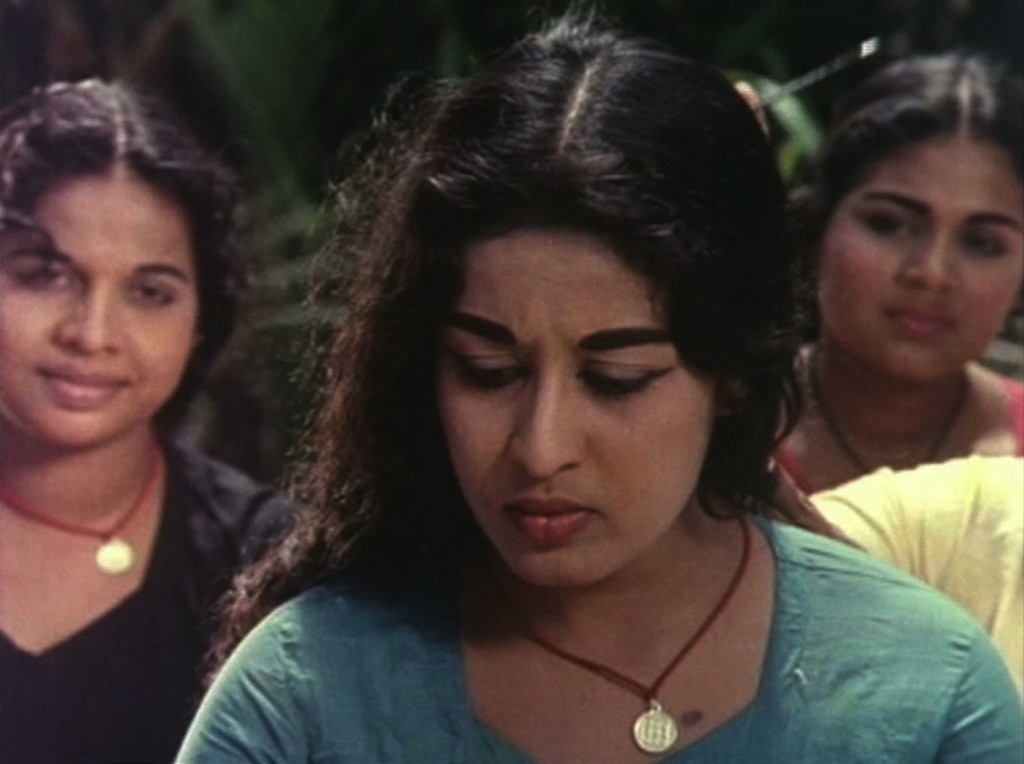
Chembankunju’s (Kottarakkara Sridharan Nair) only aim in life is to own a boat and a net. He finally succeeds in buying both with the help of Pareekutty (Madhu), a young Muslim trader, on condition that the fish hauled by the boat will be sold to him. Chembankunju’s pretty daughter Karuthamma (Sheela) and Pareekutty love each other. Karuthamma’s mother, Chakki, knows about it and reminds her daughter about the life they lead within the boundaries of strict social tradition. Karuthamma sacrifices her love for Pareekutty and marries Palani (Sathyan), an orphan discovered by Chembankunju in the course of one of his fishing expeditions. Following the marriage, Karuthamma accompanies her husband to his village, despite her mother’s sudden illness and her father’s requests to stay. In his fury, Chembankunju disowns her. On acquiring a boat and a net and subsequently adding one more, Chembankunju becomes more greedy and heartless. With his dishonesty, he drives Pareekutty to bankruptcy. After the death of his wife, Chembankunju marries Pappikunju, the widow of the man from whom he had bought his first boat. Panchami, Chembankunju’s younger daughter, leaves home to join Karuthama, on arrival of her step mother. Meanwhile, Karuthamma has endeavoured to be a good wife and mother. But scandal about her old love for Pareekutty spreads in the village. Palani’s friends ostracize him and refuse to take him fishing with them. By a stroke of fate, Karuthamma and Pareekutty meet one night and their old love is awakened… Palani, at sea alone and baiting a shark, is caught in a huge whirlpool and is swallowed by the sea. Next morning, Karuthamma and Parekutty, are also found dead hand in hand, washed ashore. At a distance a little away from them, lies a baited dead shark…
Chemmeen is based on a highly acclaimed novel by Gyanpith Award Winner Thakazhi Sivasankara Pillai. Since its initial publication in Malayalam in 1956, the novel has run into several editions in quick succession, setting an all India record for all time and is perhaps the most well known literary work in Kerala. It has also been translated in various Indian Languages and also in English, Russian, German, Italian, French, Czech, Spanish and Polish among others. Hence, when the film was being made, expectations were sky high. The film, needless to say, firmly delivers and has subsequently acquired cult status in the history of Malayalam Cinema besides being the film that put Malayalam Cinema on the National Map as it was the first South Indian film to win the coveted President’s Gold Medal for Best film. Malayalam Cinema has never looked back since.
Chemmeen’s tale is rich and multilayered. On one level while it is a tragic love story of forbidden love. On the other hand it proves that true love recognizes no religious, cultural or geographical boundaries. If the film reaffirms the required commitment to relationships, it also shows how deep, passionate love can both save and destroy man. It tells you how people can change with greed and jealousy and it illustrates the deeply rooted nature of superstition in the Hindu psyche while looking at the life of a typical Kerala fishing community of Allapuzha. While its grandeur flows from the wild and powerful ocean that rules the fishing community, its poetic beauty lies in its depiction of those small moments that can make or mar our lives.
At the core of the film are the three central performances of Sheela, Sathyan and Madhu. The film offers all three of them their career-defining roles with Sheela being known as ‘Chemmeen Sheela’ even today! Needless to say, the trio responds with their career-best performances. Incidentally, Madhu introduced to films through Ramu Kariat’s Moodupadam (1963), was one of the ensemble cast in KA Abbas’s Saat Hindustani (1969), Amitabh Bachchan’s debut film. The three are strongly supported by Kottarakkara Sridharan Nair, who all but steals the film by vividly bringing alive the wily and greedy Chembankunju. But it has to be said here that the actors owe a lot to their characters being well-fleshed out with different shades to them as we all have. If Chembankunju exploits Pareekutty’s love for Karuthamma, his love for his wife, Chakki, is touching and he is a genuinely shattered man after her death. Chakki too knows her husband is wrong in his treatment of Pareekutty but only opposes him to a point, enjoying his wealth that comes at Pareekutty’s cost. Much as Karuthamma tries to be an ideal wife, she can never forget Pareekutty and continues to be conflicted with her love for him. And Palani might defend his wife in public regarding the rumours of her liaison with Pareekutty but he has his internal doubts and confronts her with his suspicions as any man would. If one character suffers from uni-dimensional writing, it is Pareekutty, who comes across as little more than a forlorn Majnu prototype. It is to Madhu’s credit that he still breathes some live into his potentially lifeless character. And certain changeovers in characters are admittedly rather sudden like Chembankunju’s descent into madness.
Another major strength of the film is its superb musical score by Salil Chowdhury. It is said that Chowdhury composed the tunes first and then the lyrics were added in. The most well-known number of the film is the haunting – Manasa Maine Varu rendered brilliantly with great pathos by the great Manna Dey. His Hindi and Bengali songs notwithstanding, this is one of Mannada’s best ever songs. Other songs, all extremely popular, include Pennale Pennale sung by KJ Yesudas and P Leela,Puthan Valakkare by KJ Yesudas, P Leela, KP Udaybhanu and Shantha P Nair (‘inspired’ by Choudhury’s own Baag Mein Kali Khili from Chand aur Suraj (1965)) and Kadalinakkara by KJ Yesudas. In fact, the songs were dubbed into Hindi as well under the collective title Chemmeen Lehren. Chemeen was Salilda’s first film in Malayalam and would lead him to composing music in several more Malayalam films especially in tandem with lyricist Vyalar Rama varma.
Besides ‘importing’ Chowdhury and Dey, the film also has the expertise of Hrishikesh Mukherjee in the Editing Department. Hrishida did speak about how he had to salvage what was shot by working with fellow editor KD George and altering the structure of the film compared to what director Ramu Kariat had in mind but since it helped the film overall, no one complained ! In fact, Hrishida used various shots of the sea in different moods not just as transitions but in accordance with the story, thereby making the sea an integral character of the film. Mention must be made of cinematographer Marcus Bartley and U Rajagopal’s evocative cinematography of the sea front with good use of the technicolour format. Some of the sequences of the fishermen at sea and the seashore captured in evening light are truly spectacular and poetic.
Perhaps the high regard for the film particularly in Kerala is best summed up by Malayalee superstar of today, Mohanlal. To quote him… “It is an exceptional film. I don’t think there will be another like it in Malayalam. All those who worked in Chemmeen were so great. I don’t think such a combination has happened again or will happen again.”
Beside the National Award, Chemmeen also won a Certificate of Merit at the Chicago Film Festival and the film was also screened at the 2005 Brisbane International Film Festival as part of a retrospective on 50 years of Malayalam Cinema.
Malayalam, Drama, Color