


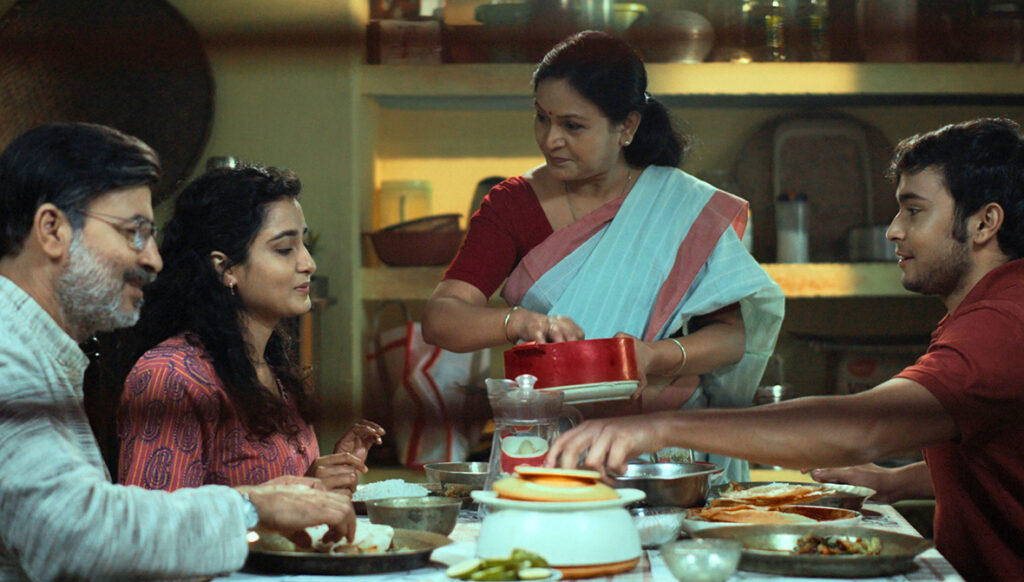
Adapted from a story by the legendary Assamese filmmaker and writer Dr Bhabendra Nath Saikia, Himjyoti Talukdar’s Moromor Deuta is a sombre domestic drama that peers beneath the fragile architecture of familial devotion to reveal its fractures, silences and buried violences.
Pradip Barua (Mintu Baruah), a school headmaster posted in a remote hill town of Arunachal Pradesh, lives away from his family – his wife (Aparna Dutta Choudhury), daughter Ponkhi (Aparajita Mahanta), and troubled son Partha (Bodhisattva Sharma), who remain behind in a small Assamese town. Hot-tempered and increasingly drawn towards alcohol and cannabis, Partha’s reckless behaviour becomes a constant source of distress for the family, particularly in his father’s prolonged absence. But when, on a fateful night, Partha is brutally assaulted while out with his friends, the family is thrown into deep anxiety. Soon, a police investigation begins to unravel troubling circumstances surrounding the attack, forcing the family to confront painful truths far more unsettling than they had imagined…
As with Talukdar’s earlier Calendar (2018) and Taarikh (2024), this film returns to his recurring preoccupation with parenthood, particularly the burdens, anxieties and moral compromises bound up with fatherhood. Here, Talukdar, along with his co-writers Abhishek Dutta and Santanu Rowmuria, extends that thematic continuum into murkier ethical territory. Thus, Pradip is rarely a figure of certainty; instead, he is repeatedly pushed towards uncomfortable reckonings where love must contend with failure, guilt and compromise.
One of the film’s more revealing ironies lies in Pradip himself. As an educated headmaster, he is shaped by reason and discipline, but finds himself so cornered by paternal helplessness that he turns to an astrological stone hoping to control his son’s rage. Yet the film does not reduce Partha to mere pathology. It subtly suggests his violence may also be the consequence of parental indulgence and emotional mismanagement, implicating the family structure itself. Talukdar sharpens this contradiction in a particularly striking scene. As Pradip confides in a doctor about his son’s alarming decline, a hospital staff member distributes sweets celebrating his own son’s academic success. The juxtaposition is understated yet piercing, and in this single scene, Moromor Deuta captures the uneasy chasm between aspiration and disappointment, reminding us that parental love can nurture, enable or unravel with equal force.
The film also gestures towards wider social tensions beyond the domestic sphere. In one understated interrogation scene, a Muslim character explains how rumours are being deliberately spread to dispossess him of his land. Though fleeting, the moment carries considerable weight, quietly invoking the corrosive mechanics of prejudice and opportunism that shape vulnerable lives. Talukdar does not overstate this thread, but its inclusion broadens the film’s moral landscape, suggesting violence and mistrust are woven into the social fabric surrounding the family.
For much of its runtime, Moromor Deuta grounds itself in emotional weariness and simmering tensions. It is precisely this tonal foundation that makes the film’s later pivot into investigative territory feel somewhat jarring. Once the police inquiry takes centre stage, the staging adopts the grammar of a procedural thriller that seems partially at odds with the intimate emotional texture the film had cultivated till then. Thankfully, Talukdar regains his footing through a dramatically charged final movement that restores the story’s moral complexity, pushing the viewer towards uncomfortable questions about justice, sacrifice and the ethical cost of familial love.
Mintu Barua gives a sincere performance as a father caught between love for his troubled son and responsibility towards his family. Bodhisattva Sharma effectively captures the anger and recklessness of a young man heading down a destructive path, while Aparna Dutta Choudhury is fine enough as the mother trying to hold together a fractured household. Arun Nath, in a brief appearance, performs his part well. The supporting cast helps sustain the film’s emotional core.
Chandra Kumar Das’ cinematography captures the film’s domestic and social landscape with clarity, giving its emotional tensions a believable visual setting. Uddipta Kumar Bhattacharyya’s editing maintains a steady pace and rhythm, ensuring the narrative moves with coherence. Debajit Gayan’s sound design adds texture to the drama, helping build atmosphere in key moments, while Arnab Bashistha’s music remains effective without overwhelming the story.
Moromor Deuta remains a sincere family drama that engages with difficult social realities without becoming didactic. What’s more, it compels us to reconsider whether protection can itself become a form of destruction, and whether care, when pushed to its limits, can ever remain morally unblemished.
Assamese, Drama, Color