


David Dhawan’s latest outing, Hai Jawani Toh Ishq Hona Hai, revolves around an old-fashioned farcical predicament, staged in the broad style long associated with his brand of filmmaking. Beneath its chaotic energy, however, lies a film whose humor soon turns into an endurance test.
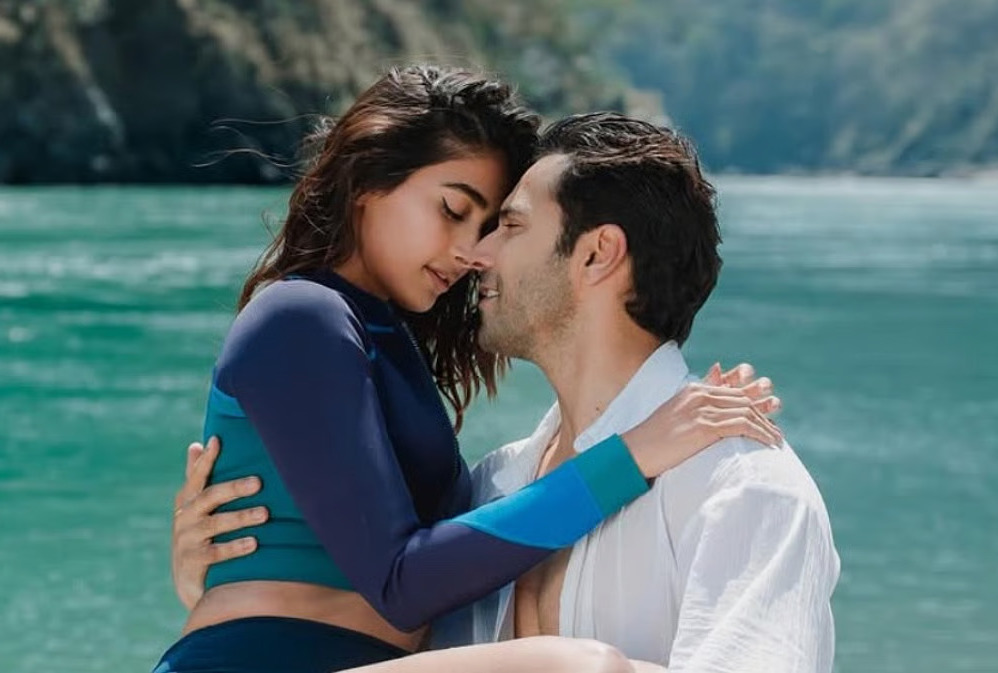
Jaswinder Ahuja, aka Jass (Varun Dhawan), is a wedding photographer whose marriage to Bani (Mrunal Thakur) is collapsing under conflicting priorities. He wants children, while she remains focused on her career. Though the court gives the estranged couple a final chance at reconciliation, Bani tells him to move on. Jass relocates to London and unexpectedly reconnects with Preet (Pooja Hegde), a woman whose life he had once saved during a boating accident in Rishikesh. Romance soon follows, and while Preet’s protective elder brother, Jogi Randhawa (Jimmy Shergill), reluctantly comes to approve of the relationship, he warns Jass against ever betraying his sister. One fine day, Bani arrives in London to reveal that she is pregnant with his child. To make matters worse, Preet informs Jass that she too is expecting…
Hai Jawani Toh Ishq Hona Hai leaves one with a peculiar sensory numbness. Not because it is provocative or psychologically unsettling, but because it quickly establishes a universe where anything can happen at any moment and almost nothing carries consequence. The film’s major plot turns emerge from conflicts so flimsy that they dissolve almost immediately. These are not isolated lapses but symptoms of a screenplay that mistakes randomness for comic momentum. Scenes continue to arrive with the apparent purpose of sustaining narrative movement and amplifying the comic chaos, yet each new addition only adds further unbearable excess to a film already overwhelmed by its own absurdist impulses.
The film’s title itself is borrowed from a line in the song Ishq Sona Hai from the filmmaker’s Biwi No. 1 (1999), another comedy built around infidelity and escalating deception. In many ways, Hai Jawani Toh Ishq Hona Hai feels like an extension of concerns that have long occupied David Dhawan’s cinema. He explored similar territory in Saajan Chale Sasural (1996) and Gharwali Baharwali (1998), and in recent years has increasingly returned to the worlds and rhythms of his earlier successes. Those films were hardly models of sophistication, but beneath their broadness, there was at least an evident desire to engineer laughter through rhythm, timing, and escalating preposterousness. Here, Yunus Sajawal’s screenplay, coupled with dialogues by Farhad Samji, rarely seems interested in constructing comic situations so much as merely assembling them. Entire stretches feel second-hand because they recall earlier farces that executed similar ideas with greater control. It is a world where comedy is not built through progression but through accumulation.
The film’s problems are not limited to structure or lack of comic timing. They extend to what it chooses to normalize. As multiple male characters are revealed to have engaged in extramarital affairs or deception, the film attempts to soften Jass’s actions through a justification that he acted out of circumstance rather than intent. The defence is revealing because it encapsulates the film’s larger approach to consequence, where actions matter less than momentum, accountability less than convenience.
In a film where almost everything feels so mechanically put together, it is difficult for the performances to rise above the limitations of the writing. Varun Dhawan, who occupies most of the screen time, commits fully to the film’s exaggerated register and expends considerable energy trying to keep the chaos afloat. Mrunal Thakur and Pooja Hegde are saddled with roles that provide little room beyond romantic complications and song sequences. Jimmy Shergill’s Jogi operates largely as a functional presence within the narrative, while the supporting ensemble—including Mouni Roy, Rajesh Kumar, Rakesh Bedi, Chunky Panday and Maniesh Paul—are reduced to comic accessories.
Ayananka Bose’s cinematography embraces a glossy visual palette though the imagery seldom develops a visual personality of its own. Editor Ritesh Soni keeps the narrative moving at a relentless pace, but the speed often feels more like compensation for a screenplay unwilling to pause and give audiences time to think. Raju Singh’s background score remains serviceable. Songs, traditionally one of David Dhawan’s strengths, prove unexpectedly forgettable here, despite contributions from a large pool of composers—including White Noise Collective, Tanishk Bagchi, Javed-Mohsin, Ronnie-Anjali, and Gill Machrai.
Hai Jawani Toh Ishq Hona Hai feels like the work of a filmmaker trapped within the grammar of his own past successes. What emerges is a film that looks backward so insistently that it rarely discovers a reason to exist in the present.
Hindi, Comedy, Drama, Color