


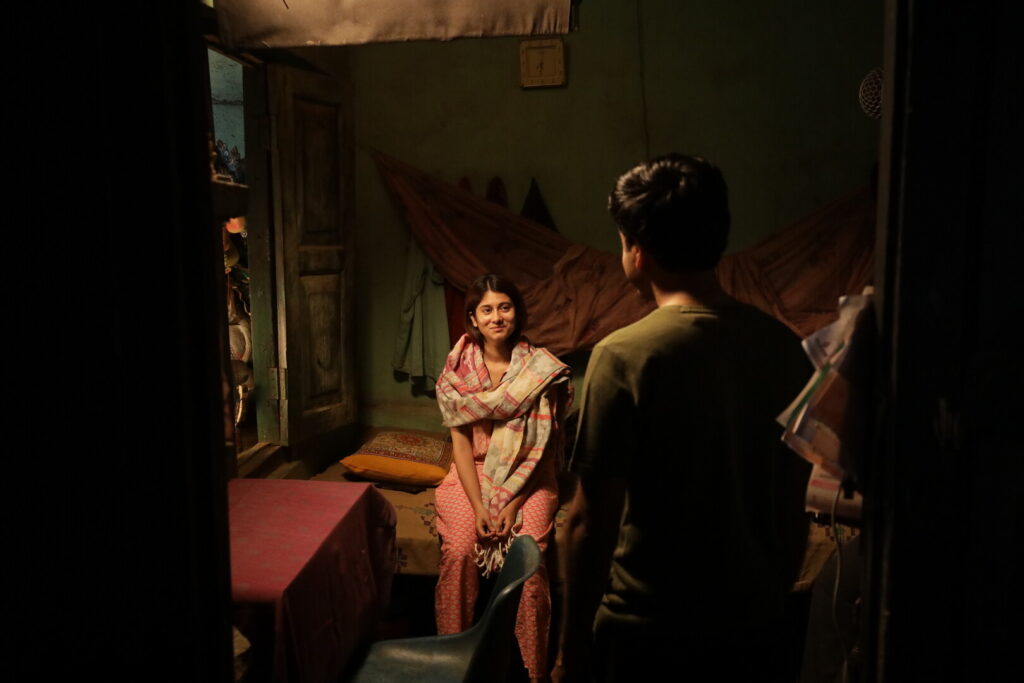
Monjul Baruah’s recent Assamese feature film, Romantic Affairs, approaches adolescence not as a period of innocent transition but as a turbulent terrain of desire, confusion, and social scrutiny. Following a young girl navigating the uneasy threshold between childhood and adulthood, the film examines how her search for freedom and identity reshapes not only her own life but also those around her.
Bobita (Kasvi Sonkorison), two months pregnant, is taken to a hospital by her husband, Satyajit (Boloram Das), for an abortion, with help from his friend, Rafique (Ronald Hussain), a cleaner at the hospital. After an initial examination, the doctor asks Bobita to undergo blood tests and return later for the procedure. On their way back, it gradually emerges that Bobita is just a ninth-grade schoolgirl, and Satyajit is not her husband but a mechanic employed at her father’s garage. When they return to the hospital, an unforeseen turn of events puts not only their lives but also their families’ reputations at risk…
One of the film’s most revealing scenes unfolds when Bobita visits Satyajit late at night and asks him uncomfortable questions about love and physical desire. The scene is less about romantic curiosity than about a young girl trying to make sense of experiences and impulses she has neither the language nor the support system to understand. Bobita is attempting to negotiate the demands of her changing body, the confusion between intimacy and attachment, and the unspoken rules governing female behaviour. Her desire for autonomy emerges not from abstract rebellion but from lived experience.
Having grown up watching her father physically abuse her mother – a woman more educated than him yet unable to exercise agency within her own household – Bobita’s understanding of relationships is already shaped by unequal power structures. Freedom, in this context, appears both necessary and elusive. Baruah remains attentive to the friction between individual desire and collective morality. In a milieu where reputation often outweighs personal truth, Bobita’s choices create consequences that extend beyond herself, unsettling parents, friendships, and the social networks that simultaneously police and protect young women. The film understands her situation not as a private crisis but as a condition shaped by family histories, social surveillance, and the anxieties of those who claim authority over it.
Baruah’s screenplay derives much of its emotional weight from small, carefully observed moments that expand the film’s social world beyond its central conflict. The narrative constructs a world where social tensions lie just beneath the surface, allowing even the smallest incident to trigger disproportionate consequences. Set within a fragile and tightly wound social ecosystem, the film gradually reveals the circumstances surrounding Bobita’s pregnancy, with each disclosure deepening tensions and widening the circle of those drawn into its fallout. Narratively, Baruah builds the film through a series of escalating situations, where every complication intensifies the last and private dilemmas steadily transform into collective crises.
The film also introduces a character who casually invokes mythological anecdotes, offering reflections on transformation, morality, and fate. His references to Ratnakar’s transformation into Valmiki and the ways divine intervention can alter moral certainties are not merely ornamental. Such references quietly mirror the predicament faced by Satyajit and those around him, and how individuals are pushed into circumstances where conventional notions of right and wrong begin to blur under social pressure. The film’s final shot, in which a van full of carefree youngsters passes by a family caught in helplessness, quietly suggests the indifference of the world to individual suffering. Life moves on, indifferent to individual tragedies, turning deeply personal crises into moments that quickly fade within the larger flow of everyday life.
Kasvi Sonkorison delivers a confident performance as a teenager caught in circumstances far beyond her emotional preparedness. Much of her performance rests on silences and restrained expressions, and she conveys confusion, fear, and defiance with notable ease. Boloram Das brings an understated vulnerability, portraying a man whose attempts to do the right thing gradually entangle him in situations beyond his control. Alok Jyoti Saikia as Sonkorison’s hot-tempered father, brings volatility and emotional weight to the role. In a special appearance, Arun Nath lends the film a philosophical texture, with his presence functioning almost as a reflective counterpoint to the chaos unfolding around the characters. The supporting cast, too, contributes meaningfully to grounding the film’s social world.
Sumon Dowerah’s cinematography captures the textures of small-town life with sensitivity, balancing intimacy with the social unease that surrounds the characters. Twenchang’s editing lends the film a steady rhythm, allowing its escalating tensions to unfold without losing emotional coherence. Debajit Gayan’s sound design effectively grounds the narrative in its lived-in spaces, while Hopun Saikia’s background score heightens the emotional undercurrents of the narrative and reinforces the film’s atmosphere of quiet unease.
Romantic Affairs stands as Monjul Baruah’s most assured film to date and is less a film about romance than about the fragile and often painful process of growing up—one shaped as much by social scrutiny as by personal longing. With its nuanced understanding of human behaviour and the social structures surrounding it, the film undoubtedly ranks among the strongest Assamese films of the year.
At the 22nd Third Eye Film Festival, the film won the award for Best Actress (Female), Special Jury Actor & Best Director. The film also had its international premiere at the just concluded New York Indian Film Festival.
Assamese, Drama, Color