


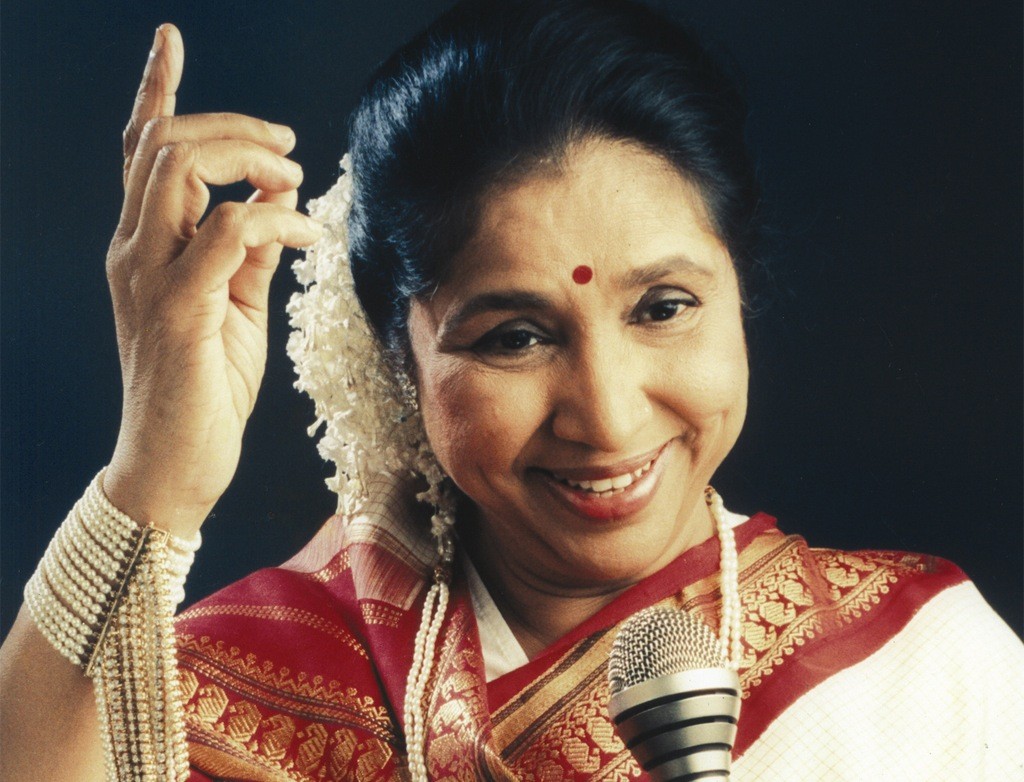
Versatility could well be Asha Bhosle’s second name. No type of song has been beyond her vocal or emotional range be it a club dance, sad song, bhajan, ghazal, pop, classical, semi-classical etc.
Born on September 8, 1933, like her older sister Lata Mangeshkar, Asha also initially did a small stint as a child artist to support the family after the untimely death of her father, Dinanath Mangeshkar. Being trained in classical music, it was but natural that she too ultimately turn to playback singing like Lata did.
Asha would sing her first song, Chala Chala Nava Bala for the Marathi film, Majha Bal (1943). She made her playback debut in Hindi cinema in 1948 with the film Chunariya under Music Director Hansraj Behl. But it took a long, long time for Asha to make it to the top. It’s not as if singing opportunities didn’t come her way. In fact, in the 1950s Asha probably sang more songs than any other playback singer but the bulk of these were in small films with no distinction. And if she did get a chance to sing in an A-film, it was probably just the song of the vamp or the heroine’s friend or a female duet with bigger singers like Lata, Shamshad Begum or Geeta Dutt. But Asha had no choice. Having made an ill-advised early marriage, eloping with her secretary, Ganpatrao Bhosle, when just 16, which also alienated her from her family, she had to take up all the assignments she got to fend for her children. Especially, as she was ill-treated by her husband as well her in-laws. The two finally separated in 1960.
1957 was her big breakthrough year when OP Nayyar used her to sing the heroine’s songs in Tumsa Nahin Dekha and Naya Daur. The same year SD Burman had his rift with elder sister Lata and decided not to utilize her services as a singer. And though Burman dada said that at the time, Geeta Dutt could have been his next natural choice after Lata since she was already a mature singer and familiar to Burman Dada, who moulded her in the early part of her career, Geeta’s troubled marriage to filmmaker-actor Guru Dutt did not make her easily available for rehearsals. Consequently SD Burman, a hard taskmaster, chose to groom the relatively raw Asha along with OP Nayyar rather than wait for Geeta. The same year also saw her songs in films like Nau Do Gyarah and Paying Guest composed by Dada Burman become extremely popular. The following year, Asha made it right to the top with hit songs in films like Howrah Bridge (1958), Chalti Ka Naam Ghadi (1958) and Lajwanti (1958). She also got involved with OP Nayyar and thereafter, she remained his premier singer till their break-up in the 1970s. Initially, Asha’s voice did sound influenced by Geeta Dutt’s style of singing but post 1957, she came into her own and how! By the end of the decade she was second only to Lata and the two sisters ruled the playback scene well into the 90s.
The 1960s saw Asha go from strength to strength as she belted out some of her best songs particularly under composers Ravi and OP Nayyar – Aage Bhi Jaane Na Tu from Waqt (1965), Tora Man Darpan Kehlaye from Kaajal (1965) or Jab Chali Thandi Hawa from Do Badan (1966) scored by the former, and Aankhon Se Jo Utri Hai Dil Mein from Phir Wohi Dil Laya Hoon (1963), Jayiye Aap Kahan Jayenge from Mere Sanam (1965) and Woh Haseen Dard De Do from Humsaya (1968) to name but a few composed by the latter. However, in spite of her incredible emotive ability, she was getting typecast in songs that were more on the sensual side. A pity really, because she was equally effective in all types of songs. Especially, as one listens one of her most haunting songs, Ab Ke Baras, under SD Burman’s baton from Bimal Roy’s masterpiece, Bandini (1963). Asha is simply matchless as she beautifully brings out all the emotions within this song.
OP Nayyar and Asha finally split in the 1970s but not before he composed the prophetic gem Chain Se Humko Kabhi from the film Pran Jaaye Par Vachan Na Jaaye (1974) which won her the Filmfare Award but which did not fine place in the final film. It has to be said Asha poured all her emotions into the song, making it one of her best ever songs. even if not seen on the screen.
The 1970s also brought her close with RD Burman, who she later married and who gave her a new hip and happening sound altogether. Songs like Piya Tu Ab To Aaja (Caravan (1971)), Dum Maro Dum (Hare Rama Hare Krishna (1971)) and Mera Naam Shabnam (Kati Patang (1970)) offered fresh and stimulating challenges to her voice. Jaan-e-Jaan from Jawani Diwani (1972) had her switching from the higher scales to the absolute lower ones within the song with ease!
But as she had been typecast in mainly sensual songs earlier, so also with RD Burman and other composers, she now got typecast in mainly Western type of songs. In fact, Asha has always maintained that in spite of her proximity to RD Burman, he still reserved his best songs for elder sister, Lata. It was finally Umrao Jaan (1981), which showed further new possibilities in Asha’s voice. Khayyam got her to sing the ghazals in the film two notes lower and the result was magical! Dil Cheez Kya Hai, In Aankhon Ki Masti, Yeh Kaisi Jagah Hai Doston, Justaju Jiski Ki represent some of the finest singing Asha has ever done. She even deservedly won the National Award for Dil Cheez Kya Hai.
Ijaazat (1987) saw her winning another National Award for Mera Kuch Samaan, a most difficult song to sing as the lyrics were more in prose form rather than standard rhythmic verse. Her other songs in the film Katra Katra Milti Hain, Chhoti Si Kahani Hai and Khali Haath Shaam Aayi Hai from the film, all represent some of the finest singing that Asha Bhosle has ever done.
In the 1990s, Asha further widened her horizon by succesfully coming out with albums in Indipop and beating the Indian pop artists on their own turf. Though she has cut down on her singing now, she still made an Urmila Matonder or Aishwarya Rai sizzle in Rangeela (1994) or Taal (1999). The 2000s has seen very little film singing from her. But she did make an extremely impressive feature film acting debut playing the titular role of an elderly woman battling Alzheimer’s with the film, Mai (2013).
Besides Hindi, Asha Bhosle has also sung several popular film and non-film songs in Bengali, Assamese, Marathi and even Tamil amongst others. One of her most well-known Marathi film songs is the sensual Reshmachya Rhegani from Maratha Tikuka Melvava (1964), composed by elder sister Lata Mangeshkar using the nom de plume, Anandghan.
The winner of several awards, including seven Filmfare Awards and two National Awards, the biggest feather in Asha’s already crowded cap has been the Dada Saheb Phalke Award for her contribution to Indian Cinema.
On 11 April, 2026, Asha Bhonsle was hospitalized in Mumbai due to exhaustion and pulmonary chest infection. She passed away, the following day at the age of 92, leaving behind a legacy as one of those rare artists, who comes but once in a lifetime and about who one can genuinely say that an era has ended with her death.