


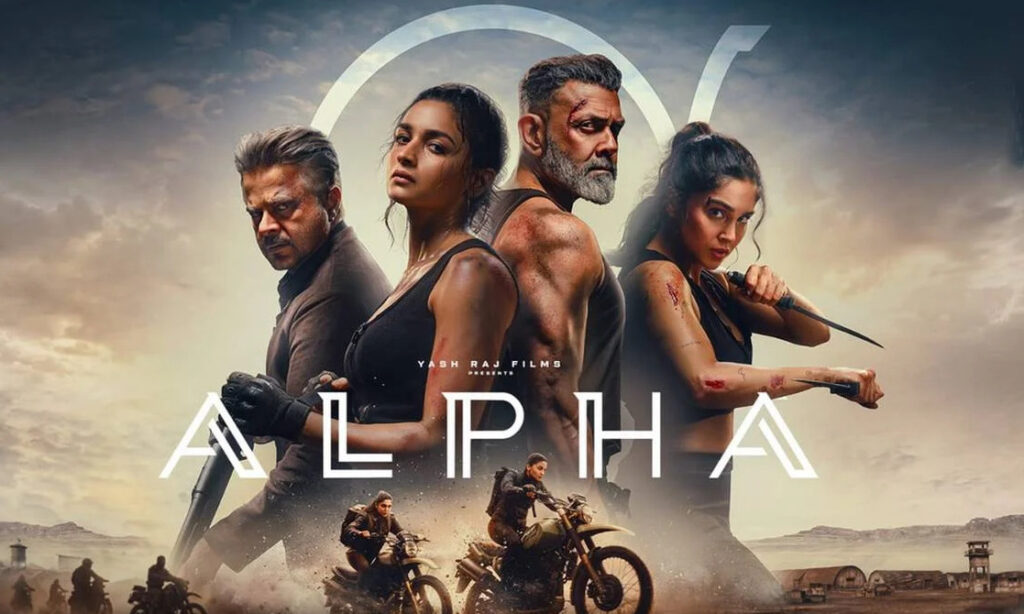
Shiv Rawail’s Alpha follows an assassin bent on avenging the wrongs that have defined her life. But what begins as a quest for revenge gradually turns into a search for identity as she uncovers the family ties that were taken from her at birth. Bolstered by exhilarating action set pieces and some gleefully over-the-top plot twists, this seventh instalment in the YRF Spy Universe does enough to have its moments as one of the series’ more distinctive entries.
Set in the aftermath of the Kargil War of 1999, Alpha begins with Colonel Fateh Singh (Bobby Deol) and Colonel Vikrant Kaul (Anil Kapoor) launching a covert military programme to create super-soldiers using an experimental serum known as Alpha under the supervision of Dr Varghese (Dibyendu Bhattacharya). The mission takes a devastating turn when Vikrant secretly injects the serum into his pregnant wife, Janki (Dia Mirza), in a desperate attempt to save her from a life-threatening condition. Within months, every soldier who has received the serum dies, and Janki, too, succumbs soon after giving birth to a baby girl. Convinced that Vikrant’s actions have led to the tragedy, Fateh takes the child into his care and raises her in secrecy, moulding her into a deadly assassin, Sita (Alia Bhatt)…
The most refreshing thing about Alpha is its decision to centre the story on a female assassin. Sita may initially seem like an Indianized Lara Croft, but she gradually emerges as a character with an identity of her own. Denied a childhood and raised as a weapon, she carries emotional scars that give her actions some heft. Torn between duty and personal identity, she becomes far more than just another action hero. Durga is equally compelling. Her confrontations with Sita are driven as much by conflicting identities as by slick action sequences. Rawail, along with writers Soumil Shukla and Shridhar Raghavan, also breaks from one of the franchise’s familiar conventions by keeping the conflict largely within India. From the mountains of Kashmir and Ladakh to the rain-soaked landscapes of Cherrapunji, the locations do more than provide visual variety. They give the film a stronger sense of rootedness and a distinct identity within the Spy Universe.
But old habits die hard. For all its efforts to take the franchise in a fresh direction, Alpha never quite escapes the excesses that have long defined its predecessors. Its characters continue to perform feats that border on the superhuman, stretching credibility to the point where the action begins to resemble fantasy rather than espionage. The problem becomes most apparent when Kabir (Hrithik Roshan) turns up in a cameo designed to reaffirm the film’s place within the shared universe. His gravity-defying stunt feels less like an extension of the story than a reminder of how some Indian filmmakers continue to borrow heavily from Hollywood spectacle. The introduction of Durga in a glossy song sequence feels closer to an inner wear commercial rather than the arrival of a dangerous operative. Without that foundation, some of her most elaborate action sequences land more as spectacle instead of a natural extension of her character. The same tendency towards convenience surfaces in the film’s use of technology. The antagonist has access to surveillance gadgets that are so implausibly advanced they seem to have been invented purely as easy narrative shortcuts to create tension.
Can a film in the YRF Spy Universe exist without patriotic fervour? Alpha suggests the answer is no. Even as it tries to tell a more personal story, it repeatedly falls back on familiar displays of nationalism. The shift becomes most apparent when one of the key characters is revealed to be a Pakistani agent. From that moment, what had largely been a story of individual loss and revenge is conveniently reframed as a battle for the nation. Flashbacks are then deployed to justify the twist, but instead of deepening the drama, they expose how neatly the film has reverse-engineered its patriotism into a story that was far more compelling when its conflicts were intimate. The film further reinforces this shift by invoking mythological references – its two central characters are named after Indian goddesses (Sharvari is called Durga), underscoring the film’s symbolic moral framework.
Alia Bhatt is easily and predictably the film’s biggest asset. She brings conviction to every aspect of the role, whether it is the emotional beats, the understated reactions or the physically demanding action sequences. Bobby Deol lends Fateh Singh more complexity than the writing initially suggests. Beneath his stern exterior lies a man consumed by his mission, and Deol imbues the character with a quiet yet compelling sense of villainy. Anil Kapoor, meanwhile, is in commanding form and remains believable as an agile combatant despite his age. Sharvari makes for a welcome addition to the ensemble although she is not always entirely convincing in the film’s more demanding action scenes. In smaller roles, Dibyendu Bhattacharya lends quiet gravitas to the story, while Dia Mirza brings warmth to her character in spite of limited screen time.
Rubais’ cinematography is one of the film’s strongest technical assets. His frames and lighting lend a gritty, stylish look to the narrative. The camera is just as attentive to the characters’ quieter, emotionally charged moments as it is to the film’s large-scale action set pieces, giving both equal dramatic weight. Aarif Sheikh’s editing keeps the film moving with confidence and maintains a brisk pace while ensuring the action never slips into visual chaos. Sanchit and Ankit Balhara’s background score plays a crucial role in sustaining the film’s energy, injecting the action with a palpable sense of momentum. The songs by Rohansh and Abeer Pandit, however, rarely linger in the memory.
Though Alpha deserves some praise for its female-led narrative, it doesn’t quite match the assurance of Shiv Rawail’s The Railway Men. Still, displays a confident hand with both drama and action, hinting at stronger work ahead.
Hindi, Action, Drama, Color