


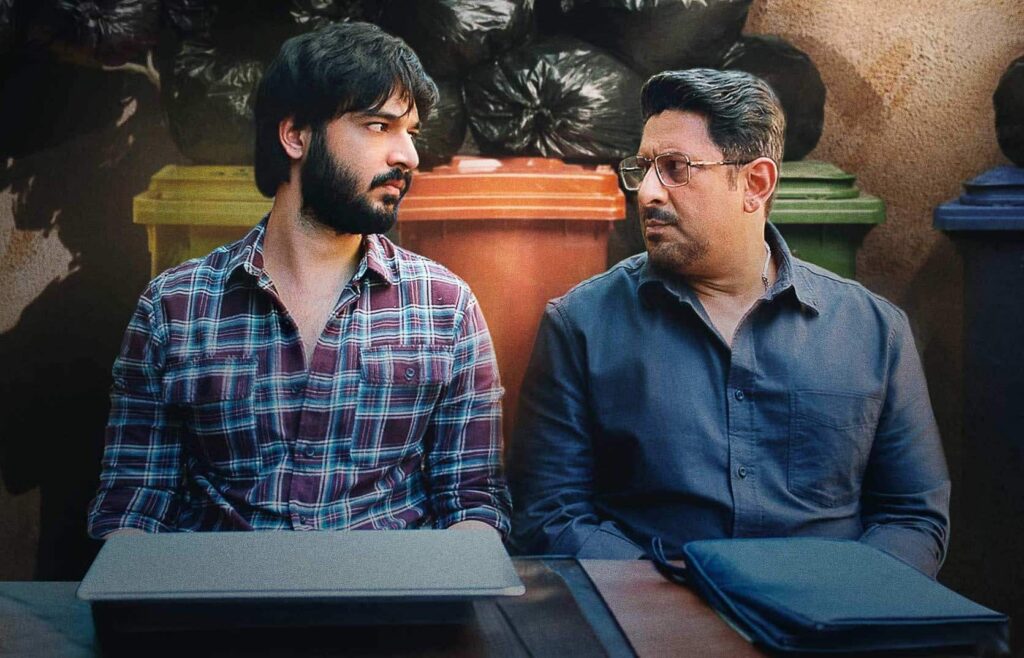
Pritam And Pedro, a six-part series directed by Avinash Arun and streaming on JioHotstar, marks Rajkumar Hirani’s debut as a producer in the OTT format. While engaging enough, the series is disappointing and surprisingly lightweight, considering the talent associated with it .
The series sees Pedro (Arshad Warsi), a middle-aged crime branch Police officer with old-school instincts who gets punished with a transfer to the cyber cell. his worst nightmare. Pritam (Vir Hirani) is a young genius hacker who sells vacuum cleaners and is searching for his grandfather’s (Vinod Nagpal) old tape recorder that has his grandmother’s voice, the only tangible thing left of her. He impresses Pedro by instantly solving an ATM heist, leading them to strike a deal amongst themselves. Pritam will help Pedro solve high-profile cases using his hacking skills to get back to the crime branch, and in return, Pedro will use police resources to help find the beloved recorder. Things get out of hand when the sports minister’s son gets kidnapped. The two start to investigate the case, but what seemed to be a straightforward abduction at first slowly reveals itself to be a part of something more complex…
Avinash Arun’s earlier projects like his films Killa (2014) and Three Of Us (2022) or season 2 of the series Paatal Lok (2025) show a distinctive visual and emotional style in his filmmaking. But here, he adopts a lighter, more mainstream approach that clearly echoes the style of producer Rajkumar Hirani. This choice would have been fine if it sharpened the storytelling, but here simplification becomes flattening and reduces complex conflicts, packing the series in an easily and convenient, neat manner.
The series is inspired by the books Hidden Files: True Cyber Crime Investigation Stories and Return Of The Trojan Horse: True Cyber Crime Investigation Stories – both by Amit Dubey. Co-written by Hirani, Abhijat Joshi, and Suyash Trivedi with dialogue by Pranjal Saxena and Shashank Kunwar, it seemed to have picked the a relevant topic as cyber crime is an urgent subject of today’s reality. What with scams, catfishing, digital arrest, deepfakes, and AI-generated misinformation, all becoming a part of our everyday reality. However, the series fails to delve deep into these issues, treating them more as a means of convenience and little else.
Thus, what could have been a complex narrative layered is let down with easy and lazy plot points, greatly reducing the emotional stakes of the show. Instead of actually taking the time and exploring the technical nuances of contemporary cyber crime, the show dumbs it down, and is stuck with old stereotypical hackers- with rapid typing montages and glowing screens. It becomes predictable and much too easy to decode, the stakes never feeling high enough or threatening.
There is a major turn in the fourth episode, when it is revealed that the minister’s son has been manipulated through an online game, Blue Whale, where each level pushes him towards increasingly dangerous tasks, which shifts the case from a simple kidnapping into something more unsettling, also because this was the same thing that happened to Leo, Pedro’s Son. But despite a momentarily thrill, it remains superficial as the show fails to explore the psychological impacts, moral complexities, and technical exploration of the game’s mechanics. As a result, the structure feels less like a steadily escalating thriller and more like a series of mini-cliffhangers that are quickly and easily resolved.
That said, the series does set up the dynamics between Pedro and Pritam nicely, which, in fact, is the show’s strongest element over the six episodes. What begins as comic friction between the analogue and the digital gradually softens into a genuine, family-like relation. Yet by prioritising the duo’s chemistry, the show sometimes short charges the serious nature of crime, turning tense moments into moments of character banter. Also, both leads remain largely unchanged by the narrative, lacking developing character arcs in spite of their considerable interactions with each other.
Pedro’s argument with his wife Lucy (Mona Singh) and her leaving home tells us of an emotional fallout between the two. Their reconciliation at the end is cute but feels forced rather than organically developed. His technological illiteracy is written to the point of a joke. He can use his smartphone, yet when faced with a computer, he can’t type on the same QWERTY keyboard. As a result, Pedro ends where he began. Pritam too remains mostly unchanged, the series failing to explore his issues in depth such as his problems with alcohol. And though the series is set in Goa, it could have been anywhere. Goa as a place is barely present and never a character through the show.
Arshad Warsi brings his customary charisma and comicalness to his character Pedro, making him standout even when the script fails him. Vir Hirani, in his debut, is likeable and understated, but the role offers very little for him to showcase his potential. Several capable actors, Mona Singh, Boman Irani, and Vikrant Massey, are there but are underused, and the celebrity cameos of Sanjay Dutt and Virender Sehwag seem more decorative than necessary.
The cinematography is largely functional. Rather than using framing, colour, or camera movement to sharpen the storytelling, most sequences are shot plainly. The editing could also have been tighter while the background music works best in the bantering sequences, where it has this peppy kind of energy. The theme for Vikrant Massey’s character has this recurring harmonic tune which works effectively with the creepiness of his character. The AI made visuals did not work in the film, it was too noticeable, looked tacky, and did not go with the rest of the production.
Pritam And Pedro is at best an amiable, easy-to-consume series with likeable leads, but misses the chance to be emotionally resonant and lacks the rigour to fully explore the current cybercrime angle.
Hindi, Thriller, Comedy, Drama, Color