


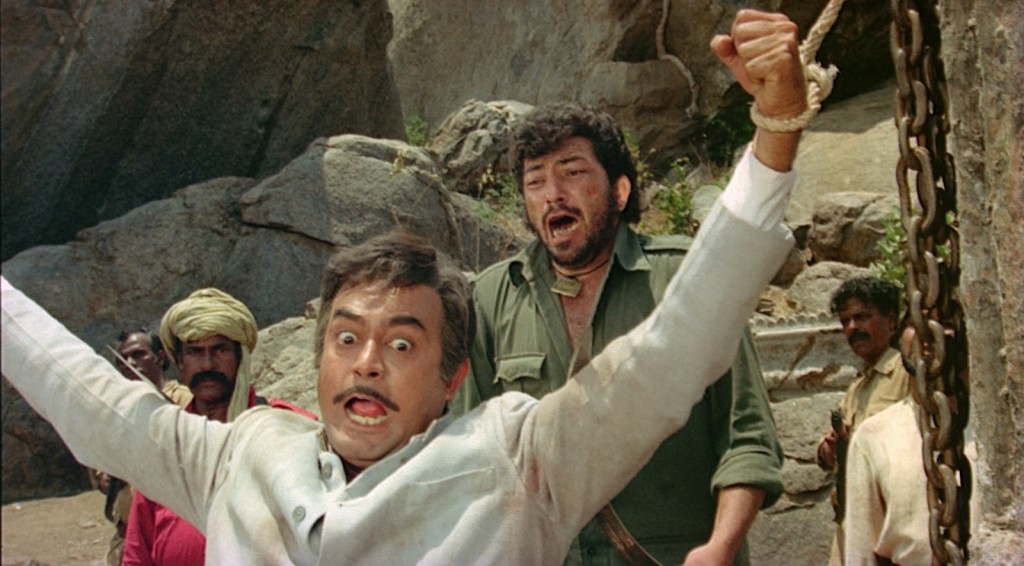
Thakur Baldev Singh (Sanjeev Kumar), once a senior police officer, hires two small-time crooks, Veeru (Dharmendra) and Jaidev (Amitabh Bachchan), to bring the dreaded dacoit, Gabbar Singh (Amjad Khan), to him alive. Gabbar had been caught by the Thakur and sent to jail. He escaped soon after and had gunned down the Thakur’s entire family, barring the youngest daughter-in-law, Radha (Jaya Bhaduri), who was away at the temple. In a violent rage, the Thakur rode unarmed to the ravines where Gabbar Singh reigned to confront him. Thinking humiliation a better revenge than death, the bandit hacked off the Thakur’s arms. In the village, Veeru falls in love with the garrulous but winsome Basanti (Hema Malini), while the more serious Jaidev feels drawn to Radha. When Veeru goes late to a tryst with Basanti, he discovers she has been kidnapped by Gabbar’s men. Walking into a trap, he is saved by Jaidev, who gives him cover to get Basanti away. Fatally wounded, Jaidev pretends he is mildly hurt, and sends Veeru away with Basanti. He manages to blow up a bridge and kill most of the bandits before he dies. Veeru comes back and corners Gabbar in the ravines, and is about to kill him when the Thakur arrives on the scene. He insists on fighting Gabbar alone, and hits out at Gabbar’s arms with his hobnailed shoes. Gabbar’s life is saved only when the police arrive and remind the Thakur that he cannot take the law in his own hands. Veeru decides to leave Ramgarh, but in the empty compartment of the train, he finds Basanti waiting for him…
Sholay became a legend, and by far the most successful film of its time, which ran for five consecutive years in a theatre (Minerva) in Bombay. Often described as India’s best known ‘Curry’ western, Sholay was ‘patterned’ on Spaghetti westerns and bears a heavy influence of Raj Khosla’s superb dacoit drama, Mera Gaon Mera Desh (1971), but the superb addition of the usual ‘masalas’ – romance, comedy, and songs gave it the ambiance that one expects of a typical commercial Hindi film. Ironically, the film opened to a lukewarm response and distributors asked the director to trim the film because of its length but soon the word of mouth spread and the rest, as the cliché goes, is history. While the dilution of the story with the tropes of mainstream Indian cinema did give the film a wider audience, it has to be said here that Khosla’s film, which was also super successful, is the better and tighter film. That said the film, even if overrated in my eyes, has enough going for it to connect to its audiences the way it did and thereby get included in Upperstall as a classic film.
Sholay had all the elements of a Western – rugged countryside (the film was shot in the rocky landscape of Ramnagaram, a small village about 30 miles from Bangalore), bandits on horseback, fierce gun fights etc. But unlike the Hollywood westerns, which had moral issues as their core, Sholay, like Sergei Leonne’s ‘Spaghetti Westerns’, was strewn with corpses and brutality. In fact, Sholay took film violence to new heights. A key factor in this was the villain, the cold-blooded killer, Gabbar Singh. Unlike earlier villains who were content to bring about a misunderstanding between the lovers’ families, Gabbar seems to pursue evil as an end in itself. Played by newcomer Amjad Khan, Gabbar Singh was by far the most popular character of the film with his dialogues remembered till today! In fact, along with the music cassettes and records of the film, cassettes and records of the film’s dialogues too were released and were extremely popular. Sholay was merchandised on water bottles, belts, jackets etc.
In a brilliantly executed sequence, Gabbar in his hideout taunts three of his men on a failed mission. In a form of Russian Roulette, he randomly removes three of the six bullets from his gun and holds the barrel of the gun to a man’s temple and fires. When the gun doesn’t go off he exclaims almost in child-like glee ‘Bach Gaya Sala’ (The bastard is saved)! Similarly this happens with the other two men. Laughing at his own cruel joke, his men too think they have got away with it and the other dacoits too join in. When the laughter reaches a feverish pitch, the entire ravine echoing with it, he turns around and shoots them. A deathly silence follows… Another sequence that makes a solid impact is when Gabbar is told that Sachin is on his way to the city. Gabbar’s response is to kill a mosquito. Cut to Sachin’s dead body in the village. Mention must also be made of the romance developed in silence between Jai and Radha with just exchange of looks, a fine counterpoint to the bositerous and more obvious Veeru – Basanti track, which one might add is enjoyable enough.
The film made use of several interesting innovations. This included its spectacular cinematography, with shots panning over rocky heights and barren canyons, often under menacing clouds. This lends the movie much of its eerie tension. One of the long opening scenes, which shows a train being defended by Baldev Singh against an attack by bandits, is quite spectacular in its effects, and is reminiscent of similar scenes in westerns, most notably John Ford’s Stagecoach (1939) (Though it would be fair to mention that a stunt director came down from abroad and was responsible for the amazing action scenes of the film). Sholay, likewise, plays upon themes of nature versus culture, the encroachment of nature upon culture, and the meaning of civilization in wilderness.
The film makes superb use of the double headed coin. Veeru and Jai always toss it to decide which way to go. Each and every time, Jai calls heads and makes sure the morally correct choice is heads. In the end when Jai calls heads and stays back to fight Gabbar and is killed and the coin is revealed to be a double headed coin, not only do you feel a solid pang for Jai, but you admire writers Salim-Javed for the way they have used the coin to reveal Jai’s character, his inner goodness with him always doing the right thing. This is something one finds rarely, if at all, in Indian cinema.
Though the film depicts the usual Indian themes of loyalty in friendship and love, what is notable is an almost total absence of family values. The two heroes have no visible family ties, neither has the heroine Hema Malini who only has a mausi as her closest relative. The Thakur who had a full fledged family sees it destroyed by Gabbar Singh. One expects this of bandits, but not of those who are ‘good’.
Technicaly too, the film was a trailblazer. Shot in 70mm with stereophonic sound, Sholay was the ultimate big screen experience (It was India’s first film in 70 mm with stereophonic sound). Mention must be made of Dwarka Diwecha’s stunning camerawork and RD Burman’s evocative background score, particularly the title track of the film, which help elevate the film even further. Strangely, the songs did not prove to be as popular as they should have been with many critics even caling them disappointing. However, Yeh Dosti (utilized superbly in its sad version), Jab Tak Hai Jaan, Holi Ke Din, Jab Bhi Koi Haseena and Mehbooba Mehbooba all go along perfectly with their situations.
Perhaps Sholay’s phenomenal success can be attributed to perhaps the way it was able to blend the various items or ‘masalas’ required in a Hindi film in exactly the right doses. Practically every scene, dialogue and even a small character was a highlight. Even Dhanno, the horse of the tangewali, Hema Malini is remembered till today! Every small character be it the Jailor (Asrani), Mausi (Leela Mishra) or Sambha (Mac Mohan) – they are etched in viewer’s minds. And it must be said, the ensemble cast is spot on. Each of the performances is faultless but as mentioned, Gabbar Singh towers above all. It is Amjad Khan who makes Sholay what it is. But that isn’t really surprising. As Alfred Hitchcock always said, “Better the villain, better the film!”
Naturally Sholay set several trends in its aftermath. Spates of multi-starrers and films with male bonding amongst heroes followed. The theme of Sholay was much imitated but none could match up to the original. And no, one is not even getting into a mention for the hideous RGV Ki Aag, possibly the worst tribute ever to a classic film like Sholay.
Hindi, Action, Drama, Color
https://www.youtube.com/watch?v=omsHVKflhW8
You are wrong about the lukewarm response part it got an earth shattering opening
Read here
https://boxofficeindia.com/report-details.php?articleid=4183
You have hardly given any credit to dharmendra but truth is if sholay is remade and any big star plays the role of dharmendra no other big star would do the role of amitabh
Read here
https://boxofficeindia.com/report-details.php?articleid=3633
SHOLAY was NOT shot on 70mm. Few prints were made for some or all of Distribution Circuits (ie: Bombay – CP, Delhi – UP,
East Punjab etc etc) by blowing up 35mm negative to 70 mm (actually 65 mm visual area) and also Re-recording Soundtrack
from 35mm to 70 mm
That’s not all. PEN , mfrer and seller of VHS tapes (owned by Mr. Gadha) changed the ASPECT Ratio from 1.37 to 2.22 by
MASKING Top and Bottom, to make the film look like WIDE SCREEN aka CinemaScope
I have the FULL VERSION (Violent Climax, where Thakur beats Gabbar to pulp. It was released in UK by Eros).
This print has 1.33 Aspect Ratio
Censors Certificat/s – Original or 10 / 20 years later, list film gauge as 35mm. Processing labs will NOT make
prints, until ORIGINAL Censors Certificate is given to them, which lists Film Gauge, No of Reels and Length
in meters plus a sign (Triangle at Left) if any CUTS were made by Censors
Sudhir /// May 27 2022