


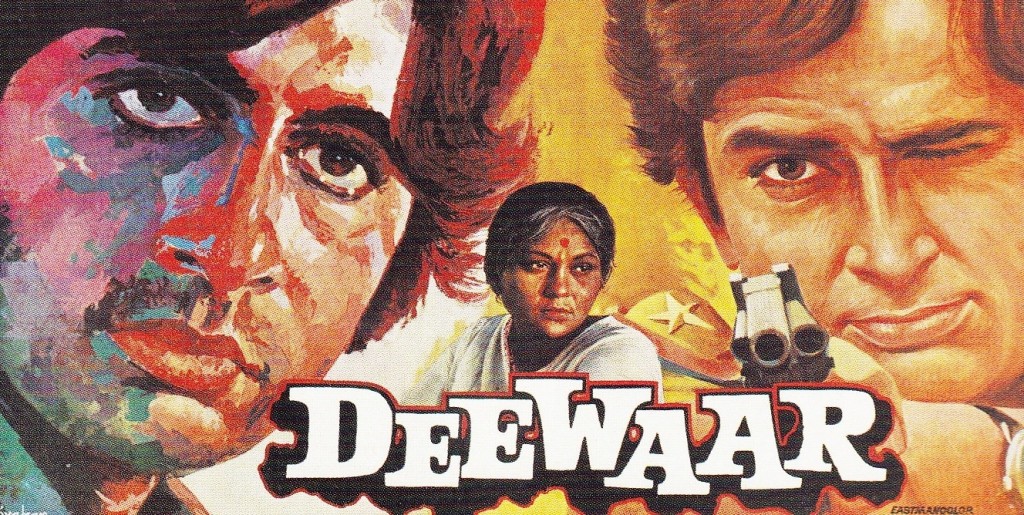
Vijay (Amitabh Bachchan) and Ravi (Shashi Kapoor) are two brothers, who were raised amidst much hardship by their strong-willed mother (Nirupa Roy) after their father abandons them. Vijay is very different from his brother as he has a more hot-headed temperament while Ravi is soft spoken and polite. Ravi struggles to find a job even though he is a graduate. Ravi meets his girlfriend’s (Neetu Singh) father, a police commissioner, and after meeting him he decides to join the police force and leaves for training. On the other hand, Vijay works in a shipping dock where he comes into contact with the underworld and is driven into the world of crime. Vijay’s primary reason to go into the underworld is because he has seen his mother suffer so much in life and he wants to provide her with all the luxuries of life. Then Ravi returns from his training having become a full-fledged policeman. The two brothers are separated by their duties as one protects the law while the other breaks it…
Deewaar is probably one of the most memorable Hindi films of all time. The film is a perfect amalgamation of two older classics – Gunga Jumna (1961) that looks at the conflict between the good brother and the bad brother, and Mother India (1957) in which the mother undergoes all sorts of hardships to bring up her sons on her own, after she is abandoned by her husband.
The film contains all the stock-in-trade elements of the Indian melodrama – brothers on opposing sides, the long suffering mother as the central moral force, divine intervention and religious symbols but what sets it apart is the taut script, the powerful dialogues and above all, a powerhouse performance by Amitabh Bachchan! Deewaar is one of a series of films in which Bachchan plays the ‘angry young man’- the lone rebel, the man seeking personal vengeance and social justice, operating outside and more efficiently than the law. His character was said to have been based on the famous smuggler Haji Mastan Mirza and it is to Bachchan’s credit that he succeeds in humanizing the gangster and has the audience rooting for him rather than his law abiding younger brother.
The film also exploits popular religious sentiment. Bachchan is an atheist but he has blind faith in the miraculous power of the number 786, the number of his badge as a dockworker. (The number is as sacred to Muslims as Om is to Hindus) As long as he carries it on person, he remains invincible. While fleeing from the police his badge falls and slips out of reach and the bullet fired by his brother hits him. However, he reaches his mother in the temple and collapses and dies in her arms thus symbolizing his return to innocence.
Deewaar is also prime example of the importance of the mother syndrome in Indian Cinema. The mother had grown from a minor character in early Indian Cinema to occupy centre stage as epitomised in Mother India. The highlight of the film is an exchange between the two estranged brothers who live separately. Bachchan tells Sashi Kapoor that what has Kapoor got in life being an honest cop – a job, a uniform a Government quarter and look at him (Bachchan). He has amassed much wealth, property. He has everything. What does Kapoor have? Kapoor retorts he has their mother! Bachchan has no answer to this… Till today, the mother figure is an extremely crucial factor to mainstream Indian Cinema. She is still deified and what is most interesting, is that she always has an obsessive relationship with her son(s) but hardly ever with her daughter(s)! Nirupa Roy lives her role as the long-suffering mother, which established her as the leading screen mother of Hindi Cinema of the 1970s and 1980s. The other characters mainly work as foils to the main cast and are competently handled. Mention, however, must be made of Parveen Babi who makes a strong impact as Bachchan’s girlfriend – the whore with the Heart of gold.
The film has several impressive moments and is layered with irony and symbolism. When the mother and her two sons are forced to live on the streets in the background on the soundtrack we hear Sare Jahan Se Achcha! When Shashi Kapoor finds out his father is dead he just stops Nirupa Roy putting on her vermilion (sindoor) without saying a word rather than a standard scene where he would have to melodramatically announce his father’s death. The father who abandoned the family is shown shuttling inside moving trains all the time showing he has no fixed destination in life and when a train pulls up at Bombay at the end of its journey, he is found dead inside signifying the end of his journey in life as well.
On the flip side there is no real scope for music and though RD Burman does come up with a couple of hummable numbers – the two duets Keh Doon Tumhein and Maine Tujhe Maanga Tujhe Paaya Hai – they don’t really add much to the film overall. Also, the techniques of the 70s with excessive use of the zoom actually make the film look dated. But the life of the film is its powerful script and of course, Bachchan’s act and they come through powerfully enough making Deewaar the classic it is.
Hindi, Action, Drama, Color