


With Village Rockstars 2, Rima Das returns to the world she first sketched in Village Rockstars (2017). The film once again follows Dhunu, now poised on the cusp of adolescence. As she moves through this phase of life, childhood’s loose certainties begin to give way to quieter, more complicated reckonings.
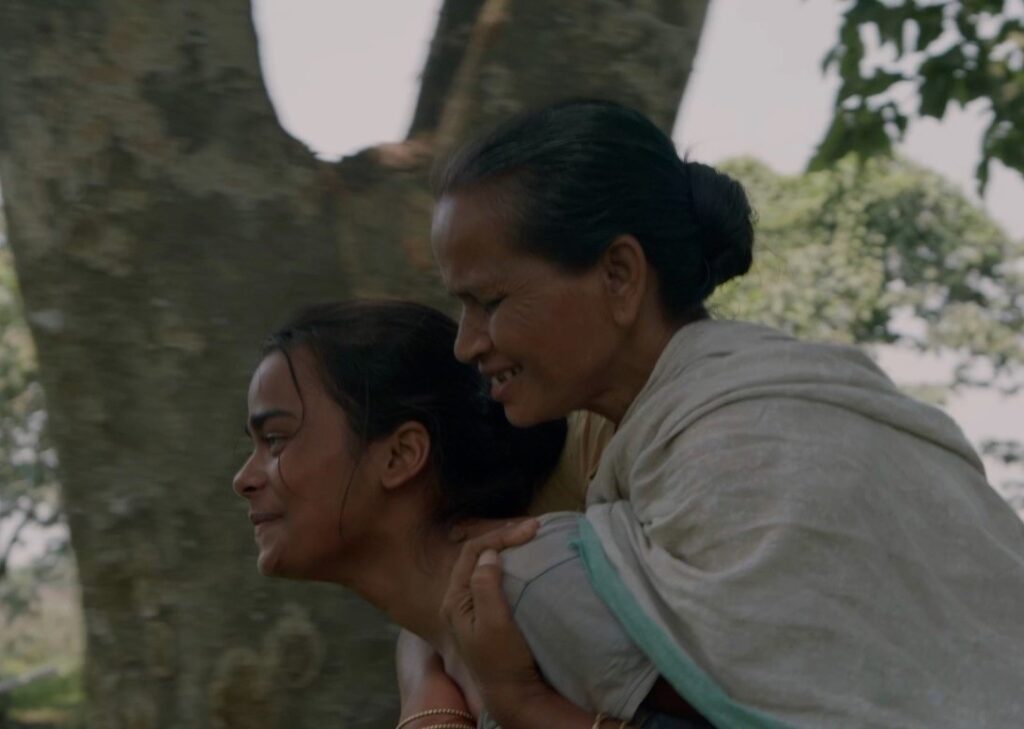
Dhunu (Bhanita Das) now owns a guitar and has become part of a small village band. She spends her days practising and gradually forms a growing camaraderie with the boys and girls around her. Keen to support her family, Dhunu wants to take on small errands and earn some money, but her mother (Basanti Das) insists that she focus on practising the guitar instead. Her elder brother Manab (Manabendra Das), meanwhile, is grappling with struggles of his own. At the same time, a local broker begins pressuring the family to sell their land for a proposed construction project. As her mother’s health begins to deteriorate, Dhunu finds herself confronting situations that slowly begin to mould her into a young woman carrying responsibilities far beyond her years…
Village Rockstars 2 adheres closely to the narrative approach that has come to define Rima Das’s films since her sophomore feature, Village Rockstars. Rather than following a conventional dramatic arc, the film unfolds as a mosaic of moments spread across changing seasons, suggesting that quotidian stories rarely move in neat plot points. Dhunu has grown older and tries to lead a life unburdened by worry, yet she confesses to a friend that she misses the carefree rhythm of her earlier days. She now climbs trees not for play but to collect betel nuts, accompanies her ailing mother to the physician, and takes on tasks such as visiting the land revenue office to pay taxes. These become markers of small responsibilities that project her gradual passage into adulthood.
As Dhunu treads these new terrains, sometimes uncertain, she finds solace in the quiet presences around her mother, the natural world, and music. She shares with a friend a simple mantra – “You are my friend, and I am yours; I understand you, and you understand me…” – a line that quietly sustains her as circumstances grow more demanding. In one of the film’s most affecting moments, Dhunu struggles to clear a road after a tree has fallen during the rain. As she pushes the heavy trunk with all her strength, the moment acquires a quiet metaphorical weight, suggesting the burdens that have begun to gather around her life. The film observes this shift with patience, allowing her resilience to emerge through the small gestures of everyday life.
Das explores a world in which the men are often absent, distracted, or unreliable, and the women learn to depend on one another, quietly sustaining the fragile fabric of their lives. Dhunu’s bond with her mother is the strongest of these relationships, one shaped by both emotional closeness and mutual dependence. Her female friends, too, remain a steady presence, offering companionship in moments of crisis and need. When her brother Manab begins to lose himself to drink, Dhunu increasingly fills the space he leaves behind within the family. At the same time, the film introduces a shrewd land broker who knows precisely how to manipulate male inheritors in order to acquire their property. In another telling moment, Dhunu and her band perform at a Bihu function, only to have their payment reduced because the group lacks a male lead singer. Such episodes quietly point to the social realities that shape Dhunu’s world, where gendered hierarchies persist in every sphere.
The annual floods that devastate Assam find their way into the film as well, though Das resists the temptation to turn them into spectacle or melodrama. Early in the film, flood is mentioned in a classroom discussion, through which we learn that Dhunu’s father had died in one. The moment carries the weight of a quiet premonition, which Das observes without raising the emotional pitch. The film also gestures towards the ecological consequences of deforestation that continue to shape lives in the region. In another strand, the presence of the conservation group Hargila Army, working to protect the endangered Greater Adjutant under the leadership of Purnima Devi Barman, is folded gently into the narrative. These details emerge organically, layering the film without turning it into a polemic.
Bhanita Das, as Dhunu, holds the film together, her unadorned, uncosmetic performance giving the film much of its soul. She brings both the character’s youthful flamboyance and her quiet struggles with a disarming naturalness. Basanti Das, as Dhunu’s mother, is equally affecting, bringing a gentle authenticity to the role. The rest of the ensemble – Manabendra Das, Boloram Das, Bhaskar Das and Junumoni Boro, among others – blend seamlessly into the film’s world, their understated performances lending it an air of lived-in reality.
Rima Das, who also serves as the film’s cinematographer and editor, maintains a careful balance between the inner lives of the characters and the rural world that surrounds them. Her images capture the landscape with an unadorned beauty, while the editing allows the film to unfold in a gentle, languid and unhurried rhythm. The sound design by Shreyank Nanjappa further deepens this sense of place, allowing the ambient textures of rural life to seep naturally into the film’s atmosphere.
Village Rockstars 2 stands out as a worthy sequel and yet again affirms Rima Das as a filmmaker of quiet conviction. Working with a striking economy of form, she once again crafts a film that appears deceptively simple yet is rich in authenticity, texture and soul.
Following its world premiere at the Busan International Film Festival on 11 October, 2024, the film received the Kim Jiseok Award. The following year, it was selected for the Generation 14plus section of the Berlin International Film Festival (75th edition), and is currently playing in theatres across Assam.
Assamese, Drama, Color