
Praveen Morchhale’s White Snow shows how art strains against invisible boundaries of authority, and offers an understated yet piercing critique of the personal costs of freedom of expression.
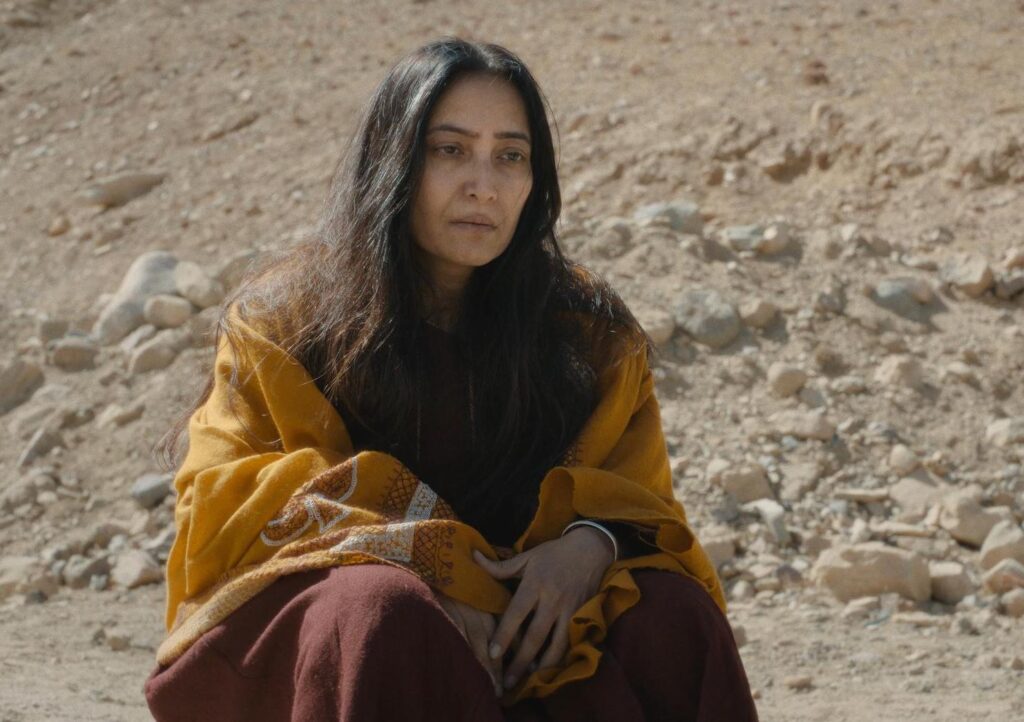
In a remote, unknown village in Kashmir, young Ameer’s (Bhavya Khurana) titular short film is banned after a religious leader objects to its depiction of postpartum blood following childbirth. Arrested on false charges of inciting unrest, Ameer’s fate prompts his mother, Fatima (Madhu Kandhari) to embark on a perilous journey, trekking through mountain villages on a yak to screen his film. Along the way, she encounters kindness and hardship, witnessing the social and economic struggles of the people while enduring physical and mental exhaustion.
By leaving the village unnamed, Morchhale universalizes the story, underscoring that the suppression of artistic freedom is not bound to any one place but arises wherever authority feels threatened. The town’s commissioner, disparagingly, admits that Ameer’s short film carries the power to inspire revolution. This acknowledgment reveals the deep apprehension authorities feel toward any form of artistic expression that challenges their control, no matter how trivial or localised. It highlights the film’s core tension that even small acts of defiance can unsettle entrenched power and spark wider conversations about freedom. Moreover, youths pelting stones at roofs of houses at night further indicates the underlying social unrest and a community grappling with suppressed tensions.
But Morchhale’s meditation is not on grand, public uprisings but on the small acts of resistance that ripple quietly beneath the surface. Amidst the rugged Himalayan landscape, the film portrays the journey of a mother who transcends the corporeal hurdles. Her trek with a modest television set and a DVD player strapped to a yak, driven by a singular purpose, evokes a pilgrimage, yet its essence lies in resistance through perseverance. Encounters with village inhabitants illustrate the complexity of social realities, where fear, hope, and constrained freedoms coexist. A schoolteacher hesitates to screen the banned film at her institution, yet offers monetary aid, illustrating the pervasive fear mingled with covert support. In another hamlet bereft of electricity, where the film cannot be shown, the synopsis, narrated by Fatima, resonates deeply with a woman who sees her own struggles reflected in it. While a local man remarks on the universal dread rulers have of facing uncomfortable truths. These moments cumulatively suggest that beneath repression lies an enduring desire for acknowledgment and change that transcends the visible boundaries of power.
The film’s deliberate slow pacing becomes its language, inviting us to move alongside Fatima and her yak through the stark, haunting Himalayan terrain. The rough terrain stands as a silent witness to a journey marked by sheer grit and determination. There is minimal dialogue, and when people do speak, their words remain simple and gentle. Even in silence, glances, pauses, and breaths convey emotions layered with quietly shifting currents of support, resistance, and watchfulness. Thus, the viewer is drawn into an intimate, immersive experience, becoming an active participant in the fatigue, hope, and uncertainty that shape each and every step of Fatima’s journey.
Madhu Kandhari delivers a compelling portrayal, capturing the complex emotions of a woman grappling with distress yet embodying unwavering determination in a hostile world. Bhavya Khurana effectively embodies the spirit of a creative mind stifled within an oppressive society, reflecting the anxieties and hopes of the youth yearning for expression. Kaneez Fahima’s portrayal of Noor, an actress caught in the aftermath of Ameer’s film ban, is marked by a quiet intensity and depth.
The technical inputs enhance the film a further notch. Mohammad Reza Jahanpanah’s cinematography renders the landscape with dynamic precision. The careful framing alternates between protective wide frames and constricting compositions. This visual modulation underscores the protagonist’s shifting relationship with her environment. The production design by Akhilesh Dogne upholds the film’s simplicity and seamlessly blends with the natural milieu to reinforce authenticity and understated beauty. Anthony Joseph’s editing maintains a thoughtful pace that mirrors the rhythm of the journey, allowing moments to breathe and resonate. The sound design by Hossein Mashali and Ómid Mohammadipour employs delicate layers that bring the film’s quiet world to life. Nalin Vinayak’s music complements this restraint and enhances the quiet mood without overwhelming it.
White Snow stands out for its focused approach that draws the viewers deeply into its prejudiced world, making them feel engaged rather than mere spectators. Its simple and clear style exposes how strict religious rules are often used to justify wider unfairness and discrimination.The resilience of the human spirit and the persistence of truth, even when silenced, linger with us as the film ends.
White Snow was screened in the Indian Panorama section at the 56th edition of the International Film Festival of India (IFFI), Goa.
Urdu, Drama, Color