
Whispers Of The Mountains (2025) unfolds in the exhausted, rugged folds of the Aravalli hills, where marble mining has steadily eroded both land and livelihood. Jigar Nagda’s sophomore feature frames a story less about environmental catastrophe and more about the quiet, incremental endurance of those on society’s margins. Resisting spectacle, the film observes survival as a daily negotiation in a world where nature and economy are equally unforgiving.
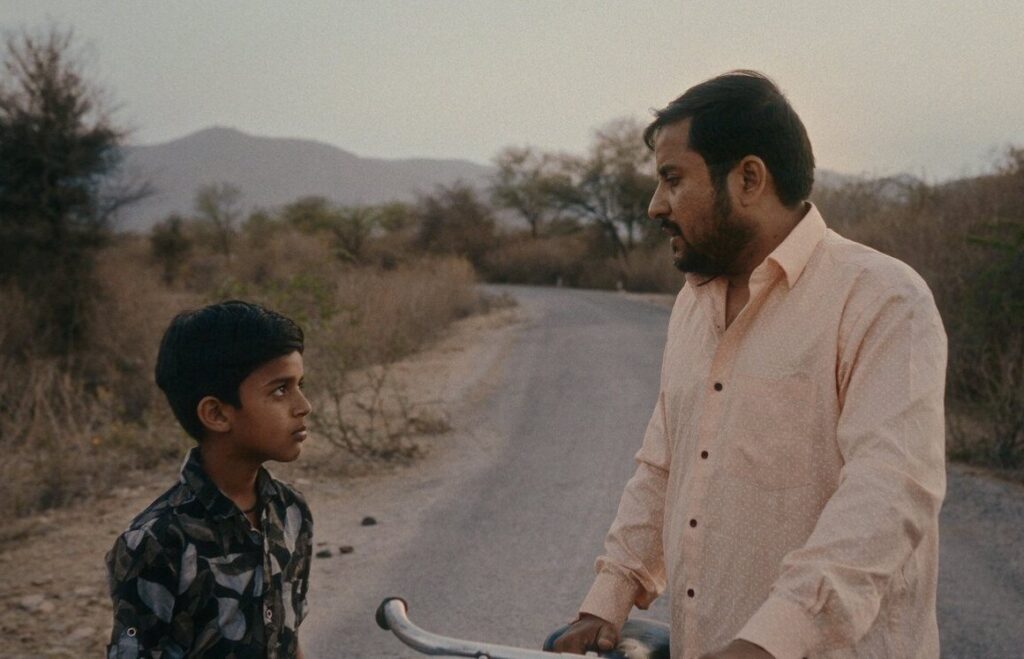
Set in a small village in Rajasthan, the film follows Tilak (Harshant Sharma), a widowed tea stall owner whose livelihood depends on the nearby marble mines. He lives with his twelve-year-old mute son Raghu (Rajveer Rao), who shares a quiet, instinctive bond with the surrounding landscape. When Raghu is offered a scholarship to a city school, Tilak forbids him from leaving, fearing loneliness and economic precarity. As quarrying intensifies and the mountains are reduced to rubble, the fragile equilibrium between father and son begins to fracture…
Caught between survival and sacrifice, Whispers Of The Mountains offers an intimate portrait of a childhood compressed by ecological and economic pressure, where silence carries more weight than protest and survival comes at an irreversible cost. Tilak and Raghu’s lives unfold through modest routines of boiling water, serving customers, and walking dusty paths, gestures constantly shadowed by forces that remain largely offscreen. Mining trucks rumble past, hills are carved away, and labor becomes inseparable from destruction. The narrative refuses explanatory scaffolding, letting damage register through grit rather than rhetoric. What emerges is a vivid unfolding of situations, settling in quietly and inescapably.
Like his debut feature, A Boy Who Dreamt Of Electricity (2024), and the documentary Aravali: The Lost Mountains (2022), here too Nagda is similarly attentive to people at the lower rungs of economic systems, those who absorb the consequences of decisions taken elsewhere. The Aravallis are not simply a backdrop but an active moral presence. They are places of shelter, labor, memory, and increasingly, of loss, as though the landscape itself continues to pose questions that refuse easy closure. Corporations and governments remain unnamed, yet their imprint is unmistakable. This refusal to point fingers reflects Nagda’s patient moral attention, rooted in the understanding that devastation unfolds slowly, and that the most profound losses often pass without noise.
The film’s emotional centre is Raghu, whose muteness becomes a crucial formal choice. Without being over-reliant on dialogue to declare intent, Raghu’s silence allows Nagda to work through gesture, gaze, and rhythm, bringing a lived-in quality to the scenes. The boy’s instinctive bond with the mountains, his attentiveness to sounds, textures, and absences, stands in quiet contrast to the adult world of compromise and necessity. Raghu’s journey is less a coming-of-age than an erosion of childhood, shaped by ecological damage and economic pressure. The loss of innocence is not dramatic but imperceptible, mirroring the slow erosion of the hills. Silence belongs not only to Raghu, but to the film itself, guiding the viewer to observe events far more minutely. Rajveer Rao as the film’s moral compass, brings a fragile innocence tested by a terrain as harsh as his circumstances.
Harshant Sharma’s performance grounds Tilak as a father figure torn between survival and responsibility. But Tilak is never portrayed as an antagonist, even as his choices place him at odds with his son. His desire for security, though fragile and morally compromised, stems less from cruelty than from fear of abandonment, irrelevance, and losing the one relationship that anchors him. Nagda allows these contradictions to remain unresolved, resisting moral binaries and acknowledging how survival often demands choices that defy ethical neatness. By choosing observation over intervention, the film avoids slogans and sermons, preserving the dignity of ordinary lives while quietly revealing the systems that shape them.
Visually, Whispers Of The Mountains favours unadorned realism. Burhan Habshee’s camera observes from a measured distance, using static compositions to let the terrain and performances register without emphasis. Suraaj Gunjal’s editing maintains a restrained rhythm, letting scenes breathe. Nilay Bhivgude’s sound design foregrounds the abrasive presence of mining—trucks grinding past, stone detonating, while allowing moments of stillness to settle around the characters. Roberto David Evlagon’s score remains spare and subdued, carrying a quiet serenity edged with a sense of encroaching unease.
Selected for the Indian Panorama at the International Film Festival of India, Goa, 2025, Whispers Of The Mountains also featured in the Indian Language Competition at the Kolkata International Film Festival 2025, and was recently selected for the Unsung Incredible India section – Films from Little-Known Languages – at the Bangalore International Film Festival held from January 29th – February 6, 2026.
Rajasthani, Drama, Color