
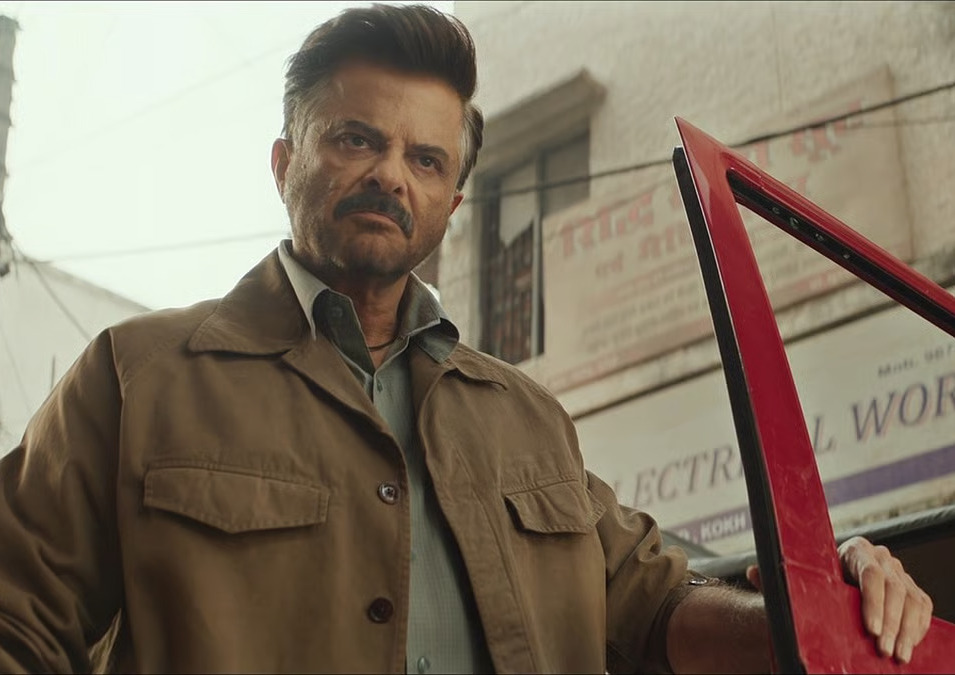
Subedaar, directed by Suresh Triveni and streaming on Prime Video, follows a retired army officer who is drawn into conflict with a gang of local thugs, forcing him to defend not only his family but his sense of dignity. The film draws on familiar ageing-warrior tropes, yet struggles to turn its action-paced milieu into a truly high-octane drama.
Set in the fictional town of Bhetod, Uttar Pradesh, Subedaar centres on Arjun Maurya, a retired soldier struggling to adjust to civilian life while attempting to repair his fraught relationship with his daughter, Shyama (Radhika Madan), their distance being tied to an incident surrounding the death of Arjun’s wife, Sudha (Khushbu Sundar). With the help of his old comrade, Prabhakar (Saurabh Shukla), Arjun takes up work as a bodyguard to Prince (Aditya Rawal), an impulsive young man operating under the shadow of his jailed stepsister, Babli Didi (Mona Singh), who controls the town’s sand-mafia network. Arjun’s path soon collides with Prince’s, setting off a chain of escalating confrontations…
Suresh Triveni, whose earlier films such as Tumhari Sulu (2017) and Jalsa (2022) centred on complex women and unfolded with a certain quietness of design, shifts here to a more overtly masculine terrain. With Subedaar, he appears to be negotiating between the demands of a star vehicle for Anil Kapoor and his own instinct for a more restrained dramatic texture. Alas, the balance proves difficult to maintain as the film struggles to sustain this mood, caught between the pull of familiar action tropes and the filmmaker’s quieter, observational approach.
Where the film falters is in its handling of the vigilante arc, the moment when the protagonist should reach a breaking point, and the narrative erupts. That escalation never quite gathers force, and when it finally arrives, the payoff feels hurried. What follows resembles a series of loosely strung incidents rather than a steadily mounting drama. Suresh Triveni and his co-writer Prajwal Chandrashekhar seem to have the right ingredients at hand, yet remain uncertain how best to bring them together. The film also suffers from inconsistency in its accents, with several actors delivering lines in dialects that do not seem to belong to the same region, giving the impression of characters inhabiting different linguistic worlds rather than a coherent setting. The recurring chapter-style title cards, seemingly inspired by Dhurandhar, likewise feel like a borrowed trope that never quite works here.
A subplot involving a missing revolver might have generated greater tension than the film ultimately allows. It is also difficult to accept that Prince, who has ready access to guns and muscle, fails to retaliate with the expected ferocity after being publicly humiliated by Arjun. There is, admittedly, an Oldboy-style corridor fight in which Arjun takes on a line of goons while the song Lalla plays over the action. It is imaginatively staged, but feels like a solitary flourish rather than part of a larger design. Meanwhile, a parallel strand involving Shyama’s trouble with a fellow college student leads to one of the film’s most chilling sequences. It is arguably more gripping than the central conflict itself.
Anil Kapoor brings a certain agility to the role, and the wounded expression that crosses his face at moments of humiliation makes us instinctively root for him. Radhika Madan handles both the emotional passages and the more physically charged moments with assurance while Faisal Malik lends a calm, almost composed demeanour to a character capable of sudden violence. However, Aditya Rawal’s sadistic, power-drunk petty tyrant, comes across as a somewhat lacklustre variation of Munna Tripathi from Mirzapur. Mona Singh’s characterization, too, is not fully fleshed out on the page, though the actor commits to each scene she appears in. Similarly, Khushbu Sundar is given too little space for the relationship between her and Anil Kapoor to acquire emotional heft. Saurabh Shukla proves a welcome presence while the brief appearance by Nana Patekar feels like a nod to Prahaar (1991), the actor’s own film about a soldier confronting social decay. It has to be said here that the earlier work possessed a far greater moral and dramatic force.
The cinematography by Ajay Saxena captures both the landscape and the characters with an attentive eye, lending the film a tangible sense of place. Shivkumar V Panicker’s editing keeps the drama moving at a steady pace. The sound design by Anthony BJ Ruban generates tension in equal measure, further heightened by the background score from Rohan Vinayak Music.
Subedaar carries odd moments that suggest a director trying to assert a measure of control over the material. Yet such flashes, on their own, are not near enough to hold the film together. As the film closes, it clearly prepares the ground for a sequel, and one hopes that the follow-up, if it were to happen – proves a stronger and much more assured work.
Hindi, Action, Drama, Color
