
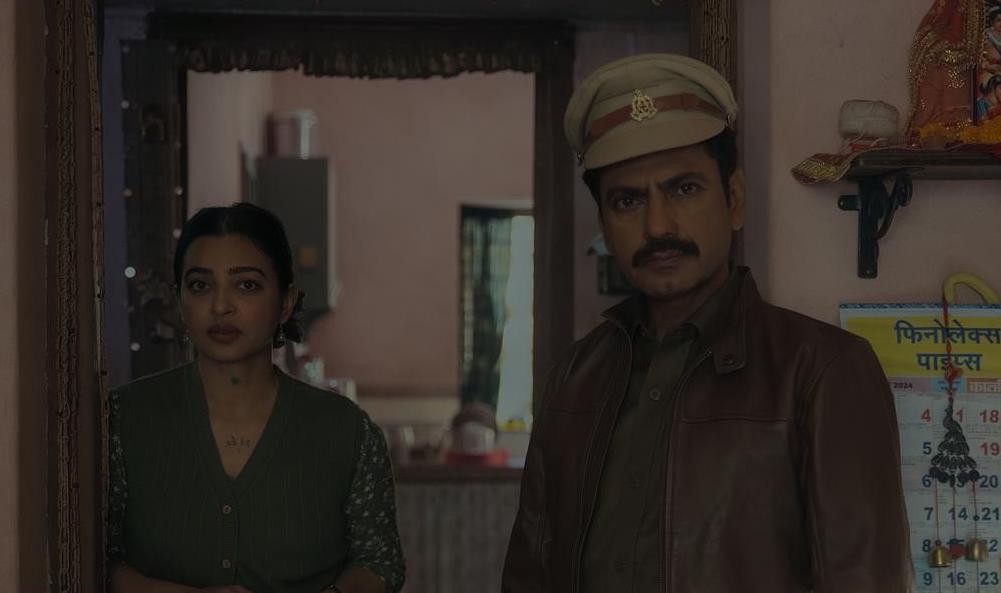
With Raat Akeli Hai: The Bansal Murders, a follow-up to his earlier film Raat Akeli Hai (2020), Honey Trehan situates a police investigation within the brittle façade of wealth and social standing. Though the film follows the familiar path seen in most police procedurals, it makes for fairly engaging viewing. Following its world premiere at the 56th International Film Festival of India in Goa, the film was recently released on Netflix.
The film begins one morning, at the sprawling mansion of the Bansals, an influential family that owns the news network Prabhat Manthan. The granddaughter of the family, Meera (Chitrangada Singh), sees that the compound of the mansion is strewn with the bodies of crows and the severed head of a pig. The family interprets this act as a serious threat and turns to higher authorities for intervention. The case is assigned to Inspector Jatil Yadav (Nawazuddin Siddiqui). He begins his investigation promptly, arresting two men believed to be responsible the following day. That very night, however, most members of the Bansal family are brutally murdered in their home. Meera survives the attack, as does her cousin. With the crime no longer limited to intimidation or vandalism, Jatil is forced to reassess his assumptions and confront a more complex web of motives, power, and long-buried resentments surrounding the family…
Raat Akeli Hai: The Bansal Murders proceeds less as a hunt for clues than as an immersion into the viscous atmosphere of inherited authority, ritualised deference, and moral corrosion. As the investigation advances, it becomes evident that the crime cannot be disentangled from the social distances that determine who is protected and who is rendered expendable. In Smita Singh’s screenplay, the gap between the privileged and the dispossessed is not merely economic; it is a space in which desperation is slowly, almost inevitably, formed. As the inquiry unfolds and layers of uncomfortable realities are exposed, the film moves toward a revelation not through surprise but through accumulation, making clear that guilt and consequence are structured by asymmetries of class. The household itself embodies a social order weighed down by custom and patriarchal control, where dissent is quietly neutralized. As Jatil moves through rooms and testimonies, these forces surface not as themes announced in dialogue but as pressures embedded in behaviour, shaping who is believed, who is shielded, and who is left vulnerable.
The atmosphere of complicity extends beyond the domestic sphere into the Bansal family’s relationship with faith itself. Through the figure of Geeta Vohra (Deepti Naval), known as Guru Maa, the film casts a dry, unsettling eye on the elite’s dependence on spiritual intermediaries. Her presence in the household is treated by its members as a redemptive balm, offering belief as a means of deflection rather than reckoning. This logic of distraction and suppression extends outward, shaping the film’s broader social vision. An illegal settlement, already marked by injustice, is threatened with demolition by bulldozers. Police cases tilt according to public sentiment rather than evidence, and justice reveals itself as neither blind nor neutral, but responsive to visibility and influence. The crime at the film’s centre thus emerges not as an aberration but as a symptom of a world in which privilege cushions brutality and collapses through a steady erosion of accountability.
Where the film falters in relation to its predecessor is in its treatment of interiority. The earlier instalment invested more fully in the psychological density of its characters. But here, attention is directed more insistently toward the mechanics of investigation, with narrative momentum taking precedence over inward complexity. Although familiar figures return such as Jatil’s mother, Saria (Ila Arun), and his love interest, Radha (Radhika Apte), their presence feels largely functional, more a gesture toward continuity. Much of the remaining cast exists primarily to physically advance the plot points rather than psychologically. Even the revelation of the figure behind the massacre asks to be accepted with a degree of reserve, registering more as a narrative resolution than as a satisfying culmination.
Nawazuddin Siddiqui reprises Jatil Yadav with a familiar steadiness, conveying the officer’s dogged commitment to truth. Revathi, as the forensic expert Dr Rosie Panicker, brings an unembellished authority to the role, her scenes providing the investigation with a necessary ballast. Chitrangada Singh shapes Meera as an empathetic yet calculating figure, coping with personal loss while remaining alert to the shifting currents of power around her. Priyanka Setia is granted a handful of pointed moments that gesture toward the film’s concern with structural inequity while Deepti Naval’s Guru Maa operates in a quieter register, blending composure with an insinuating capacity for influence.
Sirsha Ray’s cinematography sustains the film’s tension, framing characters within spaces that feel at once exposed and enclosing. Tanya Chhabria’s editing maintains the forward pull of a procedural without allowing momentum to slacken. Dhiman Karmakar’s sound design works discreetly, sharpening the film’s unease, while Karan Kulkarni’s score underlines the mood without insisting upon it.
Raat Akeli Hai: The Bansal Murders does not possess the novelty or inward density of its predecessor, yet it functions as a self-contained chapter in the professional life of Jatil Yadav. What finally holds is not the promise of reinvention but a steadier, more modest achievement. Should another instalment follow, it would not be unwelcome.
Hindi, Thriller, Drama, Color
