
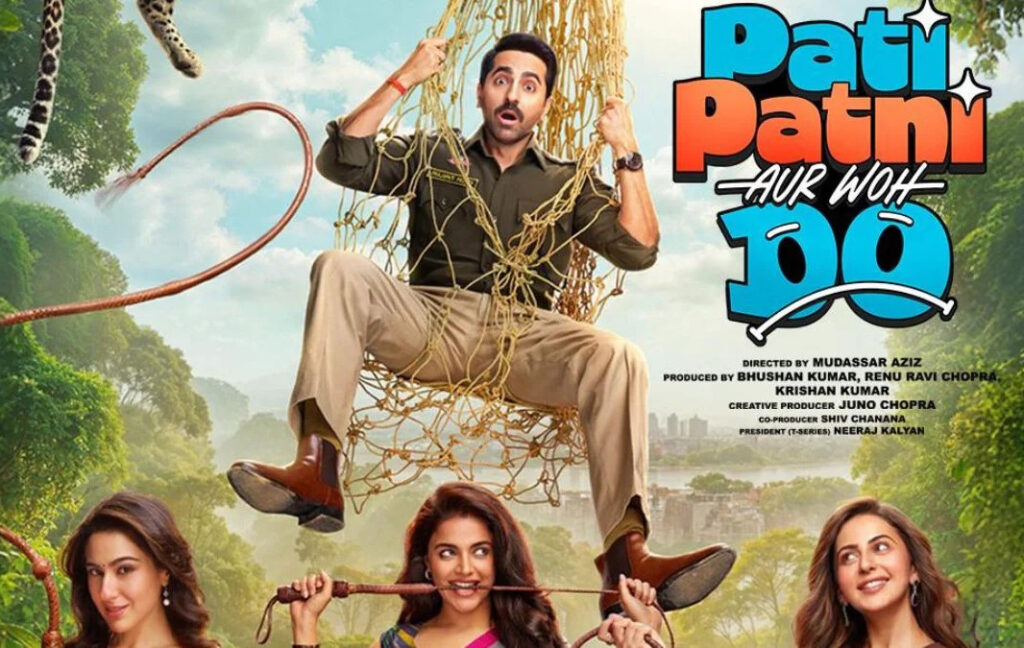
Pati Patni Aur Woh Do, a spiritual sequel to Mudassar Aziz’s Pati Patni Aur Woh (2019), unfolds as a broad comedy of confusion, built around one hapless man and the three women who complicate his life. Barring a few moments of sporadic charm, the film treds a more familiar strain of mainstream Hindi filmmaking, one that dutifully reduces comedy to a lowest-common-denominator exercise rather than trusting viewers with something genuinely inventive.
Prajapati Pandey (Ayushmann Khurrana), a forest officer known for capturing dangerous wild animals, is drawn into a far messier human crisis when his old, friend Chanchal Kumari (Sara Ali Khan), seeks his help in Prayagraj. Chanchal is in love with Sunny (Vishal Vashishtha), the son of powerful Banaras MLA, Gajraj Tiwari (Tigmanshu Dhulia), but a leaked photograph of the couple puts her life at risk due to caste tensions. To protect her from Gajraj’s goons, Prajapati pretends to be her lover. Matters take an unexpected turn, however, when he discovers that his journalist wife, Aparna (Wamiqa Gabbi), is the one who leaked the photo…
Adding to the growing list of films that rely on exaggerated misunderstandings, simplistic gender politics, and the assumption that audiences will settle for the broadest possible strokes, Pati Patni Aur Woh Do sustains a long-standing tradition of mistaking lazily written scenarios for wit. The screenplay by Aziz and Ravi Kumar repeatedly manufactures situations and introduces characters solely to generate comic set-pieces that feel forced rather than organically amusing. As the story increasingly hinges on the confusion created by the three women in Prajapati’s life, the film struggles to sustain either emotional investment or comic momentum, exposing the wafer-thin narrative.
There is, admittedly, a certain inventiveness in the way songs are made to gatecrash the narrative, though more often than not this feels less inspired than desperate with little regard for coherence. Comedy often asks logic to take a back seat as it is abandoned altogether with exhausting frequency. By the time the film reaches its climactic showdown, it appears to be straining for the manic, farcical energy of a Priyadarshan-style crescendo, yet without the precision, rhythm, or comic architecture that made those moments work. In fact, in its closing moments, the film suddenly attempts a note of relevance when Prajapati speaks about a society increasingly willing to trust viral content without pausing to verify facts. It is one of the few lines that carries thoughtful contemporary weight, yet by then the damage has been done so thoroughly that the sentiment feels airlifted from an altogether different (and better) film.
Sadly, the film’s characterizations remain depressingly reductive. A gay character exists largely as a punchline built around exaggerated feminine mannerisms; the presence of a Muslim character serves as a flimsy device to engineer a superficial connection with a Hindu aunt while Aparna’s journalistic ambitions are reduced to a caricature of scandal-chasing opportunism. Most glaringly, Prajapati himself is introduced as a fearless forest officer capable of capturing dangerous wild animals with professional ease, only to be conveniently stripped of competence whenever the plot demands easy jeopardy. All this leaves the film not merely inconsistent, but fundamentally careless in how it constructs both its comedy and its characters.
Ayushmann Khurrana, Wamiqa Gabbi, Sara Ali Khan, Rakul Preet Singh, Vijay Raaz, Tigmanshu Dhulia and the supporting cast try to bring some degree of conviction and screen presence to their roles. Yet it becomes difficult to meaningfully assess any performance when the actors are less permitted to inhabit characters and more required to service a screenplay that reduces them to devices within an increasingly chaotic travesty. In such a framework, performance often becomes secondary to noise, leaving even capable actors stranded within the burlesque.
Jishnu Bhattacharjee’s cinematography lends the film a colourful, glossy visual texture, capturing its chaos with a polished commercial sheen. Ninad Khanolkar’s editing maintains a brisk, steady rhythm, ensuring that the film rarely lingers long enough on its own ridiculousness. In a film of this nature, Arun Nambiar’s sound design is forced to give up on subtlety, depending more on amplification. Ketan Sodha’s background score, along with the barrage of songs by multiple composers, works overtime to heighten humour, emotion and farce, sometimes actually compensating for scenes that struggle to generate those effects on their own.
Pati Patni Aur Woh Do is ultimately a film that mistakes exaggeration for entertainment, ending up as a bloated spectacle of mistaken identities and diminishing returns and little more.
Hindi, Comedy, Color
