
Fazil Razak’s sophomore Malayalam feature, Moham (Desire, 2025), is a study of fractured souls who drift tentatively towards one another, discovering a form of companionship that briefly unsettles their isolation in a world where violence has become habitual.
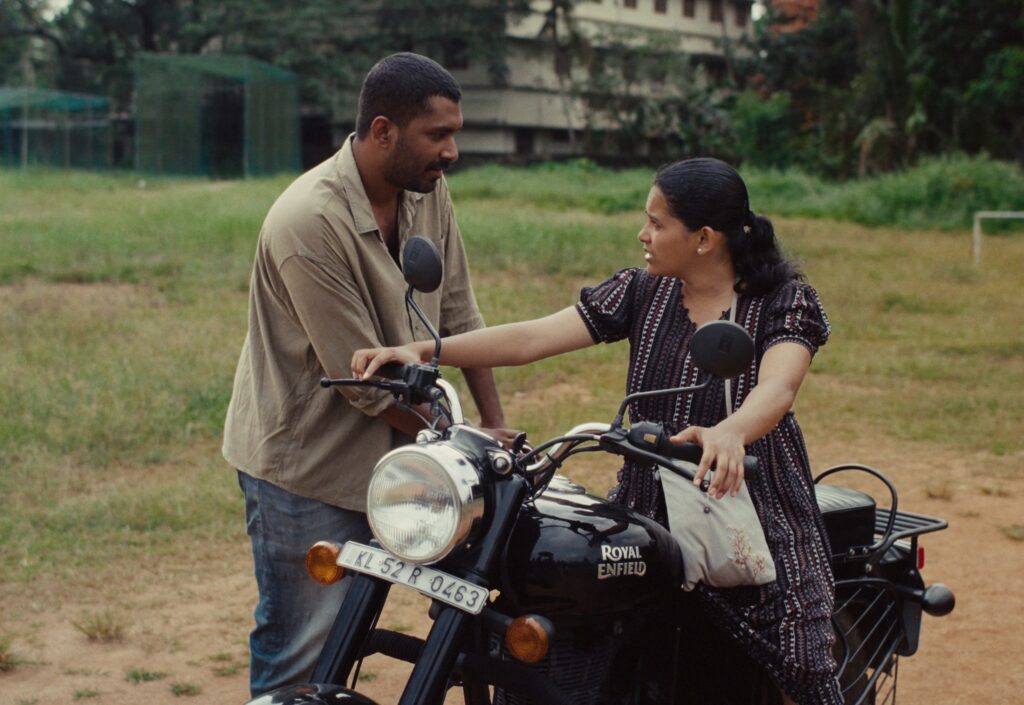
Amala (Amrutha Krishnakumar) is psychologically challenged because of a traumatic past. She lives with her widowed mother, Shreeja (Beena Chandran), in a modest house. Shreeja works at a hosiery unit stitching clothes. While her mother is at work, Amala wanders the streets and eats the chapatis prepared for her in the morning. In the evening, she goes to her mother’s workplace, and they return home together. This has become their daily routine. Because of her condition, Amala sometimes impulsively makes off with people’s two-wheelers, which often gets her into trouble. Aware of this, Shreeja quietly accommodates these lapses, balancing care with exhaustion. During one such episode, Amala encounters Shanu (Ishak Musafir), a shadowy figure who befriends her under the guise of concern, concealing motives that are far less benign…
Moham offers an unflinching set of emotional observations on human conduct at its most conflicted core. Its protagonist, Amala, unable to clearly judge what is good or harmful for her, is drawn obsessively to two-wheelers, an attachment rooted in memories of her deceased father’s Honda bike. Her aimless wandering brings her into contact with Shanu, a volatile man nursing resentment after a breakup provoked by his own overbearing behaviour. The alliance between the two appears, at first, ambiguously mutual; only gradually does its exploitative nature come into focus.
Razak pointedly withholds information regarding Shanu’s backstory, allowing opacity to function as a governing principle. The screenplay, co-written with Amrutha Krishnakumar, Mridul S, and Ishak Musafir, neither redeems its characters nor condemns them outright. Rather, it governs their actions to register within a landscape where ethical choices are constrained rather than freely made. Violence is not sensationalised but treated as an inherited masculine grammar, with women repeatedly positioned at its receiving end.
There are brief moments of compassion, feeling, and even a warped kind of affection, but these remain buried within the film’s rough, low-life setting. Much of the film keeps Amala and Shanu together—sitting by a riverbank, roaming the city’s edges, or quietly following Shanu’s girlfriend, Zulfi (Gauthami Gauram). What emerges is a relationship defined less by trust than by proximity, where closeness itself becomes another form of exposure. Within this uneasy closeness are flashes that briefly register as tenderness. These shared moments do not soften the relationship so much as reveal how care, coercion, and dependence blur into one another. It underlines how gestures of care can coexist with manipulation and harm, and deepens its unsettling portrait of damaged lives.
The film unfolds without recourse to convention. Shanu is never presented as a figure worthy of sympathy or redemption, though fleeting traces of vulnerability occasionally break through. So, it keeps us on tenterhooks about Amala’s well-being as she is repeatedly drawn into dangerous situations by Shanu. As her past is gradually revealed, the narrative takes on a more sinister tone, allowing us to grasp the roots of her fragile mental state. This disclosure is quietly devastating, a feeling sharpened by the film’s final moments. Razak uses this closing stretch to gesture towards the unpredictability of life, suggesting that hope can surface even in its bleakest moments.
Even so, the film is not without minor uncertainties. Razak chooses not to fully account for why Amala’s mother, aware of her daughter’s fragile mental state, continues to allow her such freedom, particularly once Shanu’s presence begins to feel threatening. The sudden arrival of the figure linked to Amala’s suffering also leans towards the emphatic. These choices appear aligned with the filmmaker’s preference for ambiguity, though a touch more contextual grounding might have clarified intent without compromising the film’s carefully sustained tone.
Amrutha Krishnakumar is the emotional anchor of the film. She portrays Amala with such immediacy and sensitivity that we are drawn into her vulnerabilities, her innocence, and even her missteps. Ishak Musafir brings a brooding intensity to Shanu, as he reveals his inner conflicts and moral ambiguity. As Amala’s mother, Beena Chandran embodies quiet resilience, devoted to protecting her daughter and serving as a shield against the dangers that surround her.
Mridul S’s cinematography frames the characters with an intimacy that draws us into their inner worlds, while keeping the surrounding spaces deliberately muted. Vinayak Suthan’s editing maintains an unhurried rhythm tempo, allowing scenes to breathe without forcing momentum. Eldhose Issac’s sound design immerses us in the film’s realistic diegetic world. Shamsheed Mariyad’s background score remains understated and soothing, offering a quiet counterpoint to an otherwise dark and unsettling tale that still makes room for fragile hope.
Moham continues to probe the intricacies of human behaviour first explored in Razak’s directorial debut, Thadavu (2023). Once again, he is drawn to stories of incomplete, struggling individuals placed in morally and psychologically fraught terrains. At the 30th International Film Festival of Kerala (IFFK) held in December 2025, the film won the FIPRESCI Award for Best Malayalam Film by a Debut Director. It also won the Second Best Indian Film at the just concluded 17th edition of the Bengaluru International Film Festival(BIFFes).
Malayalam, Drama, Color