


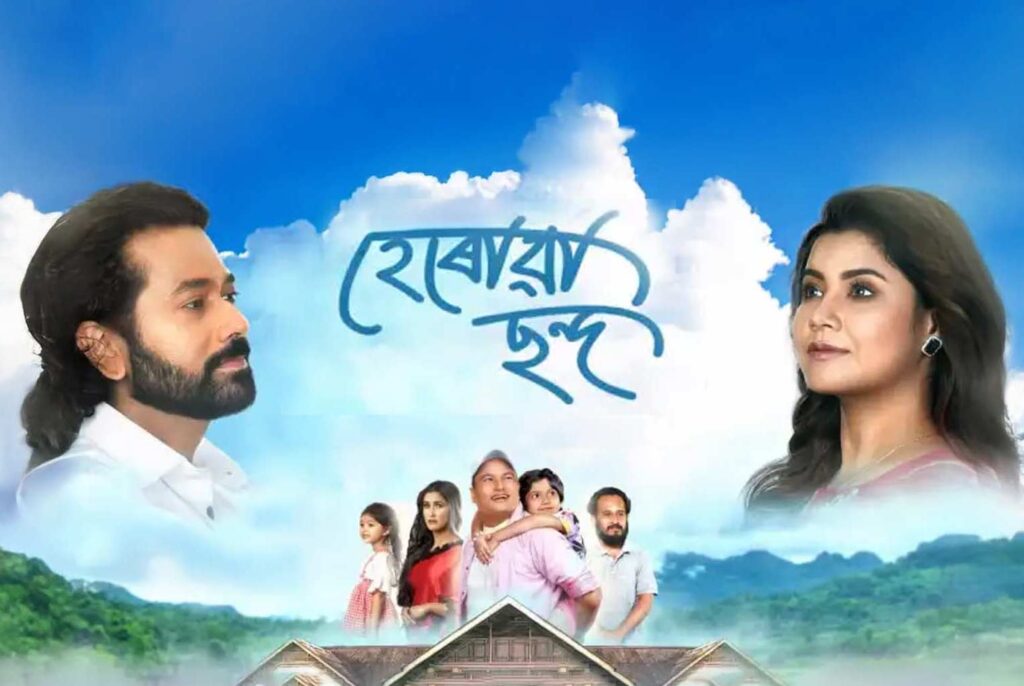
After a hiatus of seven years, the veteran Assamese filmmaker Jahnu Barua returns to cinema with Herowa Chanda (Lost Rhythm). While the film carries the familiar stamp of a director known for socially rooted subjects and moral earnestness, it rarely feels invigorating, its rhythms too cautious to fully engage or surprise.
Kuhee (Amrita Gogoi) is a model and actress who has worked in the Assamese film industry for over a decade. A single mother, she lives with her young daughter Moon (Amaira) in a modest flat in Guwahati. Her relationship with her former husband, Anup (Joy Kashyap), remains strained. Although he spends weekends with their daughter, their interactions are marked by unresolved tensions and frequent disagreements. Through a series of flashbacks, the film traces how Kuhee and Anup first met and the circumstances that led to their separation. One day, when Kuhee’s house help is unable to pick Moon up from school, Kuhee goes herself. An unexpected incident during this errand unsettles her sense of control and personal safety…
Herowa Chanda is among Jahnu Barua’s most urban works, engaging with the lives of characters shaped by a distinctly cosmopolitan milieu. At its centre lies a sharp contrast between Kuhee and Anup, whose temperaments and outlooks diverge in telling ways. Kuhee is buoyant and forward-looking, occasionally faltering even in her use of Assamese, a detail that quietly underscores her distance from inherited linguistic and cultural moorings. Anup, by contrast, is deeply invested in questions of continuity and belonging. He insists that Moon be educated in an Assamese-medium school and is anxious that his daughter remain connected to her roots. His impulse towards preservation extends to the meticulous charting of Moon’s lineage on both the paternal and maternal sides, a gesture that reveals his faith in ancestry as a stabilising force. Kuhee, however, believes in charting her own course, guided less by inherited customs than by personal choice. Her financial autonomy affords her a degree of confidence, and she sees the possibility of moving forward into another relationship not as betrayal or grief, but as renewal. Barua grounds these opposing impulses with characteristic restraint. He allows scenes to unfold without haste, resisting the pull of saccharine or overt melodrama. By holding on to moments and sequences, he permits the narrative to advance with quiet accumulation rather than dramatic punctuation.
Although Barua’s concerns remain recognisable, the film’s dramatic progression feels curiously circular and repetitive. Instead of developing through a carefully plotted screenplay, one that Barua himself has written, the narrative tends to return to the same emotional beats without sufficient escalation or transformation. Several promising narrative threads are introduced only to be left unexplored. Kuhee’s professional anxiety—hinted at early on, when a client implies she may no longer be young enough to represent a brand—is touched upon briefly and never meaningfully revisited. Similarly, Prabir (Mayukh Sharma), with whom Kuhee has been going on dates, is confined to just two scenes, both set in an expensive restaurant. This lets Prabir’s presence function more as a gesture than as a character with dramatic weight. Kuhee’s father (Dibson Lal Baruah), who lives in a village and has recently been appointed president of a monastic institution, remains a largely symbolic presence rather than a fully developed figure. Anup’s professional life, too, is conveyed almost entirely through dialogue. We rarely see him in the business environments that would lend texture to his authority or ambition.
As the film progresses, the narrative narrows increasingly around Kuhee, while the surrounding characters recede into functionality. What begins as an ensemble of intersecting worlds gradually contracts, leaving the film emotionally focused but dramatically undernourished. Midway through the film, Kuhee’s brother, Ekon (Ozu Barua), recently promoted to the rank of captain in the army, comes to visit her. Within the narrative, his presence serves less as emotional support than as a series of unsolicited admonitions. He explains why Anup may not be solely responsible for the divorce. The film reinforces his corrective gaze through a series of illustrative episodes. Kuhee’s only female friend, Anjali (Sukanya Rajguru), is introduced through an extended sequence designed to underline the completeness of family life. This is followed by a visit to the elderly parents of one of Ekon’s colleagues, a couple living alone, yet presented as serenely content. Such instances accumulate not as organic narrative developments but as moral signposts, gradually steering Kuhee towards the realisation that singlehood is a form of lack rather than choice.
It is striking that this vision emerges from the same filmmaker who once created some of the most quietly radical female protagonists in Assamese cinema. In Firingoti (1992), Barua gave us the fierce and resolute schoolteacher Ritu (Moloya Goswami), a character defined by determination and moral clarity, and a performance that remains the only National Film Award for Best Actress in the language. A decade earlier still, in Aparoopa (1982), the titular character, played by Suhasini Mulay, leaves her husband to be with her former lover, a decision presented without moral panic or punitive judgment. In Herowa Chanda, by contrast, Kuhee’s independence appears provisional, permitted only until it bends back towards social conformity. The film’s final shot makes this position explicit, closing with a supertitle, presented in three languages, declaring that amid the material excess and chaos of the world, it is family that ultimately matters. As we move into 2026, such didactic closures feel less like wisdom hard-earned than conclusions imposed, flattening the ambiguities the film itself intermittently gestures towards.
Suman Duwarah’s cinematography is restrained and functional, avoiding gloss or visual excess. Heu-en Barua’s editing lends the film a languid pace, though at two hours and eighteen minutes, the film often feels longer than its runtime. Amrit Pritam’s sound design is composed and unobtrusive, never overwhelmed by the background score. The title track, composed by Ibson Lal Barua and sung by Usha Uthup, carries an emotional weight, while the song, Prakriti, feels conspicuously out of place.
Amrita Gogoi commands most of the screen time and portrays the character’s struggles and dilemmas with assured ease. Joy Kashyap conveys the quiet pains and emotional residue of his role with sensitivity. Ozu Barua delivers a measured performance, while Sukanya Rajguru, appearing midway through the film, brings a brief but perky presence before her character recedes from the narrative. In a special appearance, Audrey Hatibarua, as an aging woman who takes pleasure in recounting her youthful romantic escapades, adds a light comic touch. The rest of the cast are just about serviceable.
In Herowa Chanda, Jahnu Barua revisits concerns that have long preoccupied his cinema, though with a caution that blunts their dramatic force. This constraint, both formal and ideological, ultimately limits the film’s impact as it retreats from its more unsettling possibilities, choosing reassurance over confrontation.
Assamese, Drama, Color