
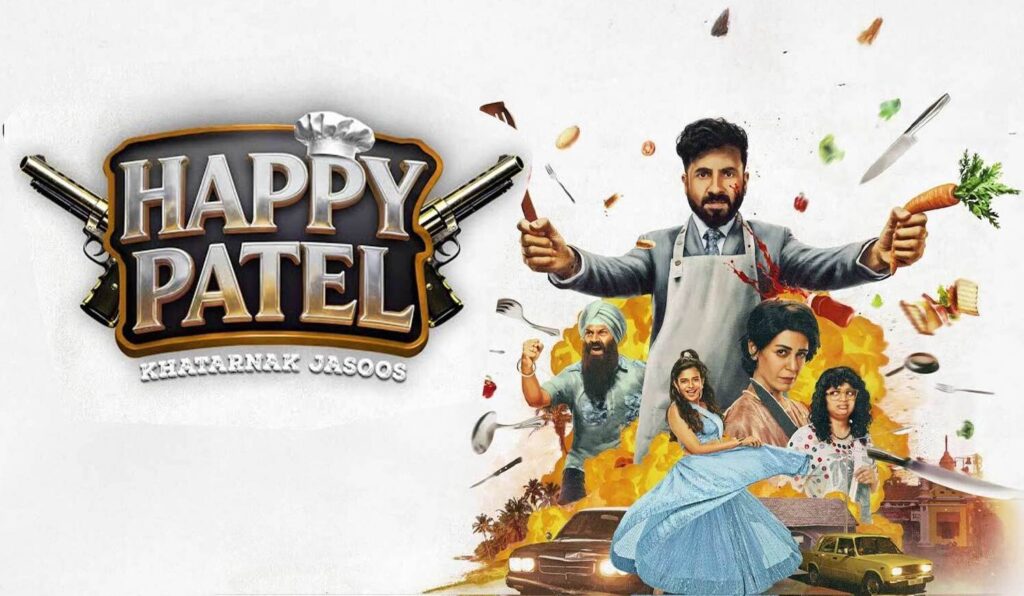
Happy Patel: Khatarnak Jasoos, co-directed by actor-turned-stand-up-
comedian-turned-filmmaker Vir Das and Kavi Shastri, sets out to revive the broad Hindi spoof through a barrage of deliberate absurdities. The film is frequently and unapologetically funny, piling one outlandish situation upon another with a confidence that suggests careful comic engineering, but finally struggling to cohere into a consistently satisfying experience.
In early 1990s Goa, two British agents have a showdown with a local don, Jimmy Mario (Aamir Khan), in Panjore. Jimmy is gravely injured in the encounter, and in the crossfire, the maid of the agents, Sakhubai Patel (Sumukhi Suresh), is shot dead. The two agents adopt Sakhubai’s infant child. By 2025, the child has grown up to become Happy (Vir Das), a well-meaning but inept aspirant who has repeatedly failed the MI7 entrance exam, his dream of becoming an agent like his adoptive father seemingly out of reach. Fate intervenes when Happy is unexpectedly recruited by MI7 and sent to Panjore on a rescue mission. He must bring back a kidnapped scientist, Beatrice (Maya Rachel McManus), who has been abducted by Mama (Mona Singh), Jimmy’s daughter, so she can develop a controversial fairness cream in a secret laboratory. As Happy arrives in Panjore, he is accompanied by fellow operatives Geet (Sharib Hashmi) and Roxy (Srushti Tawade). Amid the escalating chaos of the mission, he also finds himself smitten with a local dancer, Rupa (Mithila Palkar)…
Vir Das, who has long honed his craft as a stand-up comedian, draws heavily on his strengths while shaping the film’s dialogue, co-written with Amogh Ranadive. The humour is less reliant on punchlines and more on social observation. When Happy arrives in Goa, a taxi driver immediately assumes he is an NRI, an assumption that collapses when bargaining tactics fail. Roxy repeatedly assigns him teasing labels that underline his in-betweenness. Indian by birth, English by upbringing, and perpetually out of sync with the codes and manners of his ‘native’ soil. These moments establish the film’s recurring interest in cultural dislocation.
The satire in the film extends to genre parody. Happy’s training as a spy involves watching Bollywood films that offer a shorthand education in romance and combat, with exaggerated nods to the Rohit Shetty universe and its hyper-masculine heroes. A climax cooking competition in the climax, featuring Sanjeev Kapoor playing himself, pushes the absurdity further, functioning as a cameo-driven aside on India’s television spectacle culture. Most pointed, however, is the film’s treatment of the fairness cream plotline. Mama’s obsession with developing a skin-lightening ointment becomes an ironic commentary on a deeply ingrained and toxic beauty fixation. This is underscored by its contrast with a British female officer who finds the obsession baffling and responds with a knowing joke about preferring dark chocolate, an obviously pointed pun on brown skin.
Smaller details reinforce the film’s satirical impulses. Happy’s confusion over which god to pray to upon reaching Panjore offers a mild dig at performative religiosity, while Rupa’s reflexive slap each time he crosses physical boundaries works as a blunt but clear corrective to male entitlement. Taken individually, these moments are sharp and often perceptive, and collectively, they suggest a film rich in ideas, even if their accumulation does not always settle into a fully integrated comic vision.
Midway through the film, Imran Khan makes a special appearance, followed by a fleeting glimpse of Kunaal Roy Kapur, a knowing nod to Delhi Belly (2011), the cult hit in which Vir Das appeared alongside Khan and Kapur. The reference is unmistakable, yet it also invites an unflattering comparison. What Happy Patel conspicuously lacks is the disciplined screenplay structure that Akshat Verma provided for Delhi Belly. It had a narrative spine that allowed even its wildest diversions to feel purposeful. Here, scenes and comic moments arrive in abundance, but without a firm underlying architecture. The film remains buoyant through sheer energy, yet drifts considerably as it progresses. This looseness is partially acknowledged within the narrative itself. Moreover, the film’s sensibility is conspicuously urbane. Happy speaks in fractured Hindi, and even when English is not being spoken, subtitles and transliterations are frequently deployed. The device feels deliberate rather than ornamental, aligning with a film that foregrounds its own niche identity. It recalls the Hinglish experiments of late-1990s India—an era of linguistic hybridity that gestured toward cosmopolitanism but never fully stabilised. The dialogue is dense with sexual innuendo and double meanings, a register that feels less transgressive than routine in post-OTT-boom India. These lines usually land, but they rarely accumulate into anything more enduring. The same pattern holds for the film’s more ambitious ideas, including the figure of Mama, the lady don who functions as a matriarchal inversion of the genre’s familiar male overlord. In theory, she embodies the film’s attempt to subvert masculine power structures and inherited notions of authority. In practice, however, she remains a loosely drawn comic construct. Her potential is diluted by the film’s restless piling-up of gags.
As the investigation falters, Geet remarks that the mission is likely to fail, signalling early on that this is not a conventional macho-spy fantasy. The film repeatedly insists on this subversion, almost too earnestly. While the intention is clear and often refreshing, the seamlessness lacks follow-through. The introduction of multiple characters, including a trio of women forming a special investigative team tracking Mama’s movements, briefly promises a new narrative direction, but goes nowhere, reinforcing the film’s larger pattern of ideas that appear briskly and fade out just as quickly.
Vir Das dominates the screen time and anchors the film with assured comic command. He understands the rhythm of the character instinctively, using timing rather than excess to generate humour. Mona Singh perfectly combines broad comedy with a hint of underlying menace, making her one of the film’s more compelling presences. Sharib Hashmi’s comic sense is rooted in restraint, allowing his reactions to carry as much weight as his dialogue. Mithila Palkar brings warmth and credibility to her role of the struggling dancer who becomes Happy’s emotional anchor, while Srushti Tawade injects energy and momentum into the film. The supporting cast functions efficiently without overstatement, and the cameo appearances by Aamir Khan and Imran Khan serve less as crowd-pleasing gimmicks than as tonal reinforcements, aligning neatly with the film’s self-aware, madcap comedy.
Himman Dhamija’s cinematography privileges characters over postcard exoticism, resisting the temptation to turn Goa into a purely touristic backdrop. This approach, complemented by Tapas Paren Singha’s minimal production design, helps establish a functional milieu rather than an ornamental one. Daanish Shastri’s editing sustains the film’s intended absurdity, keeping the pace buoyant even when narrative focus begins to waver. Dhruv Parekh’s sound design is used inventively, most memorably through exaggerated sonic details such as the growling of an empty stomach, which reinforces the film’s humorous logic. The background score by Shalom Benjamin, Nirmit Shah and Parth Pandya supports the comic rhythm without overwhelming it, while the songs blend comfortably into the film’s tonal landscape rather than standing apart as set-piece interruptions.
Ultimately, Happy Patel: Khatarnak Jasoos brims with ideas but lacks the discipline to shape them into a coherent whole. What remains is a string of clever, often amusing gestures that entertain in the moment, but eventually fail to accumulate into something lasting.
Hindi, Comedy, Color
