
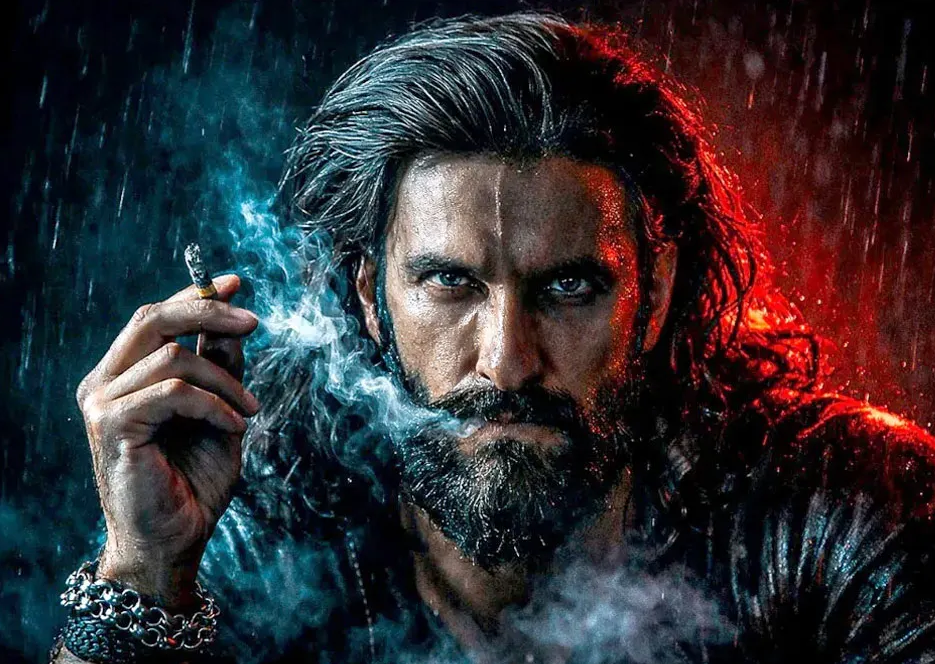
Dhurandhar: The Revenge, a sequel to last year’s spy thriller Dhurandhar, returns its protagonist to familiar terrain, placing him in a position to retaliate against forces intent on destabilising India. Packed with an obvious political ideology, action set-pieces, divided into chapters, explosive confrontations and a measure of calculated gore, it remains intermittently entertaining, even if its pleasures are largely of the immediate kind.
The film opens in 2000, as a young Hamza, then Jaskirat (Ranveer Singh), seeks revenge for the murder of his father and elder sister, and the abduction of his younger sibling. Though acquitted, he is kidnapped during a prison transfer by intelligence officers, recruited, and later deployed across the border as a covert operative. Meanwhile in Pakistan, Rehman Dakait is dead, leaving a vacuum that Arshad Pappu (Ashwin Dhar) is quick to exploit. In the aftermath of the funeral, Hamza orchestrates a retaliatory move, goading Uzair (Danish Pandor) into killing Arshad, an act he ensures is recorded and leaked to the media. With the authorities closing in, Uzair flees to Dubai, only to be apprehended. In the shifting power dynamics that follow, Hamza consolidates his position in Lyari, gradually extending his influence across Karachi and assuming the mantle of ‘Sher-e-Baloch’. Meanwhile, a frail and ailing Dawood (Danish Iqbal) commands a meeting, drawing Hamza into a widening web of loyalties, betrayals and uneasy alliances that begin to test the limits of his control…
Dhurandhar: The Revenge is cut from the same cloth as its predecessor, returning us to a familiar milieu where gang rivalries between Pakistanis and Baloch factions continue to spill into cycles of violence. This time, however, the emotional stakes feel more pronounced, and the succession of events carries a sharper sense of progression, propelling the narrative with little excess. The film is driven by a clear revenge arc, as Hamza sets out to target those responsible for orchestrating attacks on Indian soil. In the absence of a formidable figure like Rehman, the vacuum is filled by an aging don, Dawood Ibrahim, also known as ‘Bade Sahab’. His presence arrives as something of a surprise, yet it proves to be an intriguing liberty taken by the filmmaker. The screenplay, written by Dhar, places Hamza in situations that demand moral reckoning, forcing him to choose between the demands of his mission and the cost of losing those close to him.
Family becomes a recurring motif in the narrative. In the final moments of the film, there is a sequence where Hamza returns to Pathankot, where his widowed mother, sister and nephew reside. It plays out as a subdued, emotionally resonant moment, refreshinglyly free of melodrama or expository dialogue, conveying the dilemma he carries within. It suggests that Dhar is also capable of handling quieter emotional passages with restraint, if he so desires. A similar sensitivity is evident in the scene where he reveals his true identity to his wife, Yalina (Sara Arjun), and explains the burden of his past. Major Iqbal (Arjun Rampal), meanwhile, shares an acerbic relationship with his father, Jahangir (Suvinder Vicky), a former Brigadier during the 1971 war, who taunts him on both professional and personal fronts. These strands add a degree of layering to the narrative. Hamza is also shown to have a child with Yalina, though one wishes this aspect had been explored in depth.
The action in Dhurandhar: The Revenge is as graphic, if not more, as in its predecessor. Beheadings staged with grotesque bravado, gouged eyes, and dismembered bodies are integral to the film’s vocabulary of violence, employed not merely for shock but to heighten its sense of brutality. At the same time, the narrative remains unambiguous in its political positioning. An extended strand around a mission ‘Operation Green Leaf’ is used to justify the necessity of the disastrous 2016 Indian demonetisation, suggesting that counterfeit currency was being funnelled into India through Nepal ahead of the Uttar Pradesh elections. Archival references to Narendra Modi’s televised address are woven in, alongside barbed remarks from opponents about a ‘chaiwala’ disrupting established power structures. Yet, the film stops short of acknowledging the brutal, collateral hardships faced by ordinary citizens in the wake of the decision. The film also gestures towards the post-Uri attack 2016 shift in India’s security posture, granting Hamza a near-unchecked mandate from Indian authorities to carry out retaliatory operations in Pakistan. Elsewhere, the figure of an Indian MLA-turned-gangster, Atif Ahmed (Salim Siddiqui), clearly modelled on Atiq Ahmed, is folded into the narrative, with his elimination portrayed as a state-orchestrated act. Taken together, these elements reveal a film that plays its ideological hand with calculated assurance, aligning itself closely with the rhetoric of the incumbent establishment.
Ranveer Singh dominates the film with a commanding performance, occupying much of the film’s screen time and, in the process, pushing the supporting cast to the margins. He is a menacing presence in the action set-pieces, yet allows flashes of vulnerability to surface in the quieter, emotional passages. Arjun Rampal, as Major Iqbal, has several striking moments, particularly in his tense exchanges with his embittered father Jahangir, played with authority by Suvinder Vicky. R Madhavan, as Ajay Sanyal, along with his colleague Sushant Bansal (Manav Gohil), form a functional duo within the Intelligence Bureau. Sanjay Dutt, as SP Chaudhary Aslam, is less prominent than in the earlier instalment but delivers a competent performance, while Rakesh Bedi, as Jameel, provides intermittent comic relief, often shaded with a darker edge. In what remains largely a man’s world, Sara Arjun has limited screen presence, though she makes her moments count with quiet effectiveness.
The cinematography by Vikash Nowlakha captures both drama and action with equal assurance, lending the film a consistent visual texture. Shivkumar V Panicker’s editing keeps the narrative from dragging, maintaining a steady momentum throughout the near 4-hour running time. The sound design by Bishwadeep Chatterjee creates an aural world steeped in violence, shaping an atmosphere where tension lingers, and the brutality of the film is felt as much through sound as through image. Production designer Saini S Johray effectively evokes the milieu but Shashwat Sachdev’s remixes lack the impact of his earlier work, failing to leave a lasting impression this time around.
Dhurandhar: The Revenge settles into a groove, where part visceral action spectacle, and part ideologically drives the narrative, remaining anchored in a worldview that leaves little room for ambiguity. In that sense, it works on its own terms, but rarely ventures beyond them.
Hindi, Action, Drama. Color
