
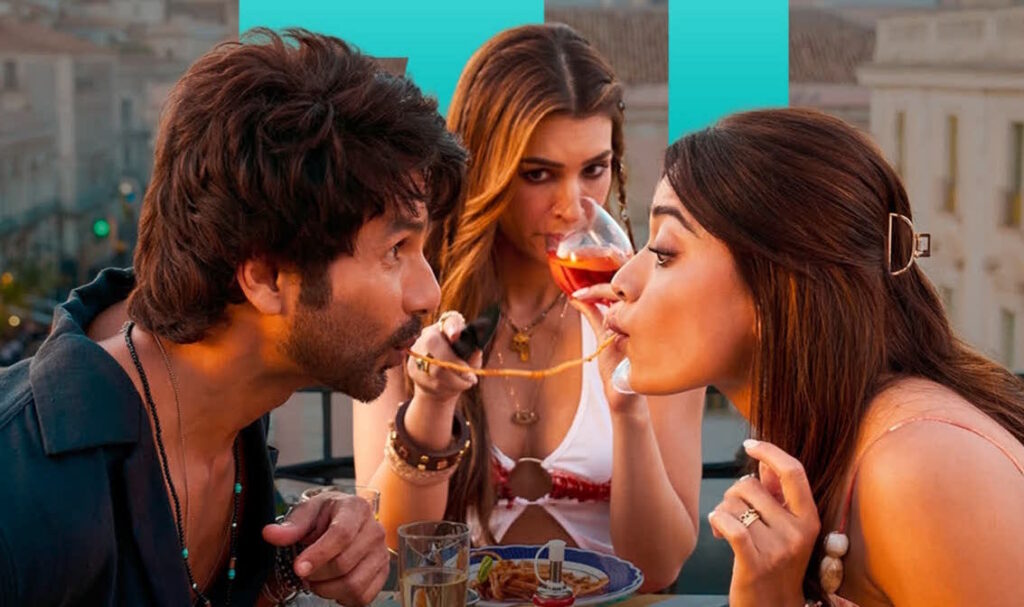
Homi Adajania’s Cocktail 2, a spiritual successor to Cocktail (2012), returns to a familiar emotional geometry: a man caught between two women, each vying for his affection, and placing him at the centre of a romantic tug-of-war. While the film initially gestures toward a more mature and complex engagement with relationships, it ends up getting undermined with familiar narrative shortcuts and a tilt towards a more safer conventionality.
Kunal (Shahid Kapoor), a chef at an upscale hotel in Delhi, possesses an easy charm and conversational dexterity to win over his complaining customers. His live-in partner, Diya (Rashmika Mandanna), works in the corporate sector, and the couple frequently finds themselves fielding questions from relatives about their plans to marry. During a house party, Kunal, in a drunken moment, jokes about the infidelity of a married friend, inadvertently planting a seed of suspicion in Diya’s mind. Even as doubts about Kunal’s fidelity begin to surface, the couple decides to take a holiday in Sicily in the hope of restoring some equilibrium to their relationship. There, they unexpectedly run into Ally ( Kriti Sanon), a dance instuctor and a close friend of Diya’s from university days. The encounter gradually alters the dynamics between the three, setting the stage for emotional complications and shifting loyalties…
Cocktail 2 adopts the language of contemporary love affairs. Its central couple have little interest in marriage as a means of satisfying societal expectations, and one of its female protagonists is unapologetic about pursuing her desires. Yet this apparent sophistication remains largely cosmetic. Adajania situates his characters amid the enviable surroundings of the vineyards and other postcard vistas of Sicily, and the sleek high-rise apartments of Delhi. The problem is that the film seldom finds emotional or psychological depth beneath its attractive surfaces. Apart from a handful of scenes that hint at greater complexity, the film relies heavily on glamor, song sequences, and picturesque locations, as though visual splendour might compensate for the thinness of its dramatic stakes.
The screenplay, by Luv Ranjan and Tarun Jain, is curiously uneven in the way it distributes agency and moral responsibility among its characters. Kunal is positioned as a fundamentally loyal figure, a man largely free of blemish, while much of the narrative conflict is generated by the actions of the two women around him. In the process, both women are framed as calculating and, at times, manipulative, whereas Kunal appears less an active participant than an unwitting figure caught in a web spun by others. He is also given an extended monologue in the climax that risks sounding preachy. Once the narrative pivots toward the wedding ceremony, the characters’ parents suddenly assume a central role despite having remained largely absent from the story’s narrative fabric. Their presence feels far too engineered to provide the film with a final push toward its predetermined resolution.
If Cocktail belonged to Veronica, memorably played by Deepika Padukone, Cocktail 2 finds its closest equivalent in Ally. But while Veronica’s boldness emerged from a characterization that allowed for contradictions, vulnerabilities, and emotional depth, Ally, by contrast, is too often defined through external markers of desirability. The result is a character whose supposed modernity feels more asserted than explored. What begins as an attempt to portray a sexually confident woman ultimately lapses into objectification, which becomes the character’s most persistent defining trait.
Shahid Kapoor brings considerable charm to Kunal, a man forced to navigate the uncertainties and competing demands of a complicated relationship. His performance lends the character a warmth that makes him easy to root for. Kriti Sanon carries Ally with confidence and poise, capturing both the character’s self-assurance and vulnerability. She is particularly effective in the film’s quieter moments, though the performance is often let down by the film’s tendency to flatten the character into an image of desirability. As Diya, Rashmika Mandanna convincingly conveys the anxieties and insecurities of a woman struggling with doubt and emotional uncertainty. She commits fully to the role and has several affecting moments, but her performance is occasionally undermined by dialogue delivery that feels strained, preventing some scenes from achieving their intended emotional resonance.
Cinematographer Santhana Krishnan Ravichandran captures the sun-drenched landscapes of Sicily and the sleek interiors of Delhi’s upscale apartments with considerable flair while framing the characters in ways that reveal their emotional states. Akshara Prabhakar’s editing maintains a smooth rhythm and keeps the narrative moving, though one is occasionally left wondering whether a leaner cut might have served the material better. Anirban Sengupta’s sound design creates an immersive atmosphere, and combined with Pritam’s soundtrack, it lends the film much of its energy and momentum.
Cocktail 2 possesses the ingredients for something more daring but opts instead for crowd-pleasing resolutions. The result is a film that is never quite as adventurous as its glossy packaging suggests, but one that ultimately bows down to the safe and conventional.
Hindi, Drama, Romance, Color
