
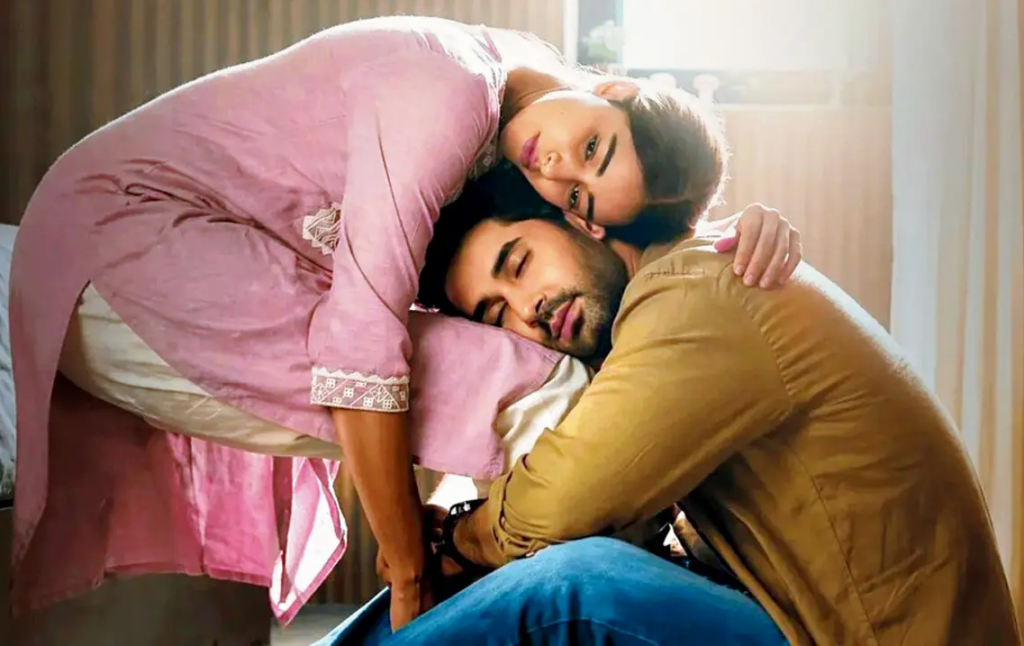
Chand Mera Dil marks another attempt by director Vivek Soni to explore the emotional uncertainties of contemporary relationships. Though the narrative unfolds with an engaging sincerity and emotional openness, it does not always arrive at the emotional fullness it aspires to achieve.
Set in Bengaluru in 2017, Aarav (Lakshya) and Chandni (Ananya Panday) are mechanical engineering students navigating the uncertainties of youth and companionship. Their youthful romance, however, takes an abrupt turn when Chandni becomes pregnant. The couple initially decides to undergo an abortion, but circumstances spiral beyond their control. Rejected and judged by their families, Aarav and Chandni eventually choose marriage and parenthood in the hope of building a life together…
In most love stories, it is the obstacles surrounding the lovers that make the relationship worth investing in. Here, however, the confrontation lies within the relationship itself. There is a certain freshness to the premise as the two young lovers are pushed into adulthood far sooner than they had imagined. Responsibility at such a young age is hardly easy, and the screenplay by Vivek Soni and Tushar Paranjape, with additional collaboration from Akshat Ghildial, devotes considerable time to placing the couple in one difficult situation after another, where they must balance the demands of raising a newborn alongside the anxieties of securing their futures. The film derives much of its emotional tension from these everyday pressures. As Chandni stays back to care for the child, Aarav becomes the sole breadwinner, only to find himself gradually overwhelmed by the mounting financial and emotional pressures that accompany such expectations. These are the instances where the film comes closest to capturing the quiet exhaustion and fragility of young adulthood.
Chandni comes from a fractured household and has been raised single-handedly by her mother after witnessing domestic violence during her childhood. The emotional scars of that upbringing continue to shape her as an adult, informing her anxieties, insecurities, and responses within the relationship. Consequently, when she decides to separate from Aarav at one point in the narrative, the decision feels justified rather than impulsive. The film also presents parents not merely as authoritarian figures but as reluctant problem-solvers. A particularly revealing sequence unfolds in an expensive restaurant where both Aarav and Chandni’s parents come together with the young couple in an attempt to resolve their differences. The scene quietly underlines the generational gap in understanding love, marriage, and responsibility, while also exposing how familial intervention often oscillates between genuine concern and subtle emotional coercion.
What ultimately derails Chand Mera Dil is the oversimplification of several crucial moments. To begin with, the early stretch in which the romance between Aarav and Chandni blossoms feels less like an evolving relationship and more like a montage of fleeting moments stitched together to accelerate investment. The college setting, too, resembles an overly sanitised Dharma universe, detached from the texture and unpredictability of actual student life. The narrative also spends an excessive amount of time cycling through the repeated trials and tribulations of the couple’s domestic life with the story moving in loops rather than progression. As a result, the film acquires a meandering quality that weakens the emotional impact of its central conflict. Even the climax arrives with a degree of convenience designed to secure emotional closure. In doing so, the film dilutes and softens the more difficult questions raised by its premise.
Ananya Panday delivers one of the film’s strongest performances. She brings a convincing vulnerability to the role, particularly in moments where Chandni’s emotional scars and frustrations quietly surface beneath her composed exterior. Lakshya effectively captures the confusion and exhaustion of a young man abruptly burdened with responsibilities he is not fully equipped to handle. Among the supporting cast, Manish Chaudhari, Iravati Harshe Mayadev, Charu Shankar, Vidushi Kaul, Aastha Singh and Paresh Pahuja lend the film a dependable presence.
Debojeet Ray’s framing and lighting maintains a visual sensibility that complements the film’s urban romantic setting. Aparna Sud’s production design embraces a glossy aesthetic that aligns comfortably with the film’s polished mainstream sensibilities. Prashanth Ramachandran maintains a rhythm that largely goes with the film’s shifting emotional beats, even if the narrative occasionally turns repetitive. The background score plays a significant role in sustaining the momentum of the film. Music composed by Sachin–Jigar, coupled with lyrics by Amitabh Bhattacharya, adds warmth and accessibility.
Chand Mera Dil is the kind of film that neither reaches excellence nor collapses into total failure. It walks a delicate tightrope between sincerity and oversimplification, managing to remain intermittently engaging even if it does not ultimately deliver a wholesome emotional experience.
Hindi, Drama, Colour
