


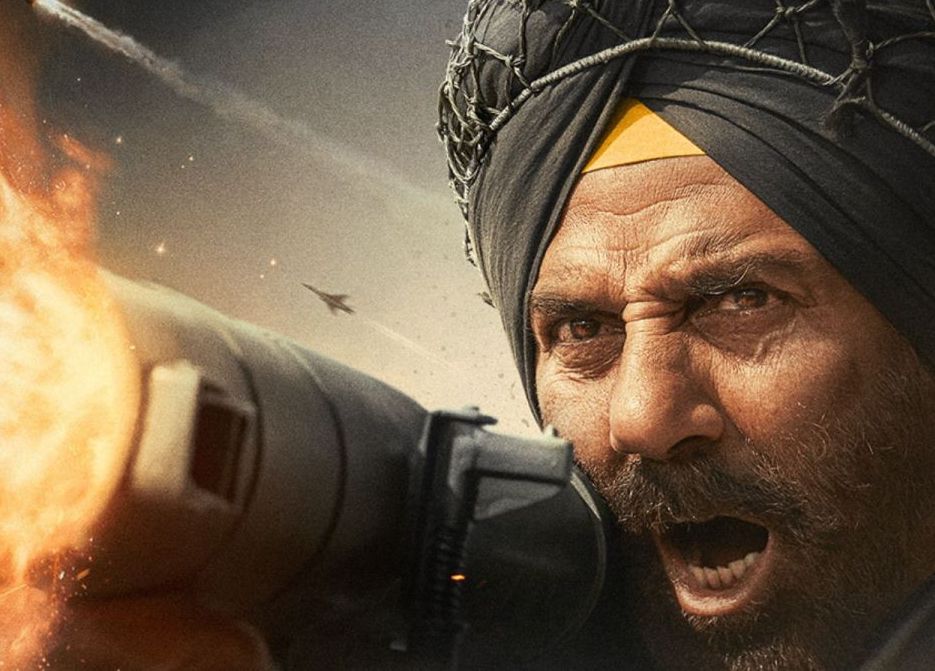
Border 2, a standalone sequel to JP Dutta’s Border (1997), directed by Anurag Singh, revisits the familiar terrain of military valour through the Indo-Pak war of 1971. While, the film positions itself as a new chapter, it ends up recalling the original more than creating a distinct identity of its own.
Hoshiar (Varun Dhawan), Nirmal (Diljit Dosanjh) and Rawat (Ahan Shetty) are cadets at the Indian War Academy representing the Army, Air Force and Navy, respectively. Under the stern supervision of Lt Col Fateh Singh (Sunny Deol), the three men are shaped not only by military discipline, but also by a growing sense of mutual trust and camaraderie. Their bond extends beyond the academy grounds as Nirmal’s family – his widowed mother and younger sister – gradually becomes a shared responsibility for Hoshiar and Rawat, while their friendship plays a decisive role in facilitating Nirmal’s marriage to Manjit (Sonam Bajwa). Personal warmth and domestic stability, however, prove short-lived. As celebrations give way to mounting political tension, war with Pakistan is declared. Fateh Singh and the three friends are dispatched to the frontlines, leaving their families behind and stepping into a destiny marked by uncertainty, separation and the demands of duty…
Midway through Border 2, a soldier at the warfront receives a letter from home announcing the birth of his daughter. Elated, he moves to share the news with his comrade, only to stop short when he learns that the latter has received word of his mother’s death. In an emotionally charged gesture, the soldier decides to name his newborn daughter after his colleague’s deceased mother. The moment could easily have slipped into overt melodrama, but Singh stages it with restraint and assurance, allowing the sentiment to register without tipping into excess. Similar emotional control marks the scenes shared between Fateh Singh and his wife Simi (Mona Singh). A comparable tenderness surfaces in Nirmal’s first meeting with Manjit, a sequence that carries a gentle, almost old-fashioned romantic cadence. These instances hint at the emotional possibilities embedded in the screenplay by Singh and Sumit Arora, from a story by Nidhi Dutta. Such connective moments, going back to the template created by perhaps India’s finest war film, Haqeeqat (1964), are particularly vital in a war film, grounding large-scale conflict in personal experience and enabling viewers to invest emotionally. Yet these sequences remain isolated, standing out precisely because they are so few in a film otherwise inclined towards spectacle and a rhetorical exercise.
JP Dutta’s Border largely resisted the temptation to deploy chest-thumping patriotism as its primary dramatic engine. Its action and stunts followed the grammar of mainstream Hindi cinema, but they were rarely allowed to overwhelm character or situation. In Border 2, however, the repetition of Sunny Deol’s character, clearly shaped by his enduring star power, tilts the balance decisively. From the opening sequence itself, Fateh Singh is positioned as a near-mythic saviour, repeatedly placed at the centre of heroic intervention. The emphasis on Deol’s physicality and action persona recalls his recent roles, most notably last year’s Jaat, rather than serving the specific demands of the story at hand. This focus persists all the way to the climax, steadily marginalising the ensemble that the film initially appears keen to develop. As a result, Border 2 gradually sheds its promise of a multi-perspective war drama and settles into the more familiar contours of a star-driven action enterprise sprinkled with martial heroism.
Border 2 struggles to generate the cumulative emotional effect achieved by its predecessor even in its depiction of the personal lives of its four principal characters. Notably, the moments shared between Fateh Singh and Simi carry far greater emotional weight than those allotted to the younger trio. This imbalance is difficult to ignore. With T-Series among the producers, the personal lives of Hoshiar, Nirmal and Rawat are frequently articulated through ineffective song sequences. The time spent at the academy, which ought to establish the emotional foundation of the trio’s bond, is loosely structured and curiously inert. Their camaraderie appears less the result of lived experience than of narrative insistence, as though these sequences exist primarily to extend the film’s running time rather than to deepen character or dramatic stakes.
Border 2 repeatedly gestures towards its predecessor, drawing on it less as a point of dialogue and more as a reservoir of recognisable cues. Sandese Aate Hain, once an aching articulation of absence, is staged here with choreographed hook steps. As each of the three protagonists breaks into synchronised movement, the song is transformed into an overtly melodramatic spectacle, diluting its original poignancy. Toh Chalun, is used briefly and almost hesitantly in the background as the characters depart for the front, its restrained placement rendering it faint and largely ineffective. In one action sequence, Ahan Shetty delivers a line famously spoken by Suniel Shetty, in Border. Stripped of its original dramatic context, the moment lands without any resonance whatsoever. Even the climactic action set-piece echoes the prequel, with a tank positioned as a decisive instrument of threat.
Sunny Deol leans heavily on his established screen persona as a battering, fearless commander. The quieter scenes he shares with Mona Singh allow for some moments of emotional vulnerability, which raise his performance a notch or two. Varun Dhawan is sincere, but often appears caught between heightened dramatics and emotional accessibility. Diljit Dosanjh grounds his character with warmth and restraint but Ahan Shetty, as Rawat, struggles with both body language and dialogue delivery. Among the women, Mona Singh is given the most screen time and makes the strongest impression. Sonam Bajwa and Medha Rana provide capable support, while Anya Singh’s appearance is fleeting, registering more as a cameo than a fully developed role.
Anshul Chobey’s cinematography captures the scale and spatial immensity of the battlefield with assurance. Manish More’s editing deftly negotiates the shift between kinetic action and quieter, static emotional passages. Nihar Ranjan Samal’s sound design maintains a convincing sonic weight that complements the narrative while John Stewart Eduri’s background score is suitably rousing and functional. The songs, however, lack the melodic distinctiveness of the original Border and leave little lasting impression.
Border 2 settles into the familiar contours of a mainstream war film designed to stir patriotic sentiment around the Indian soldier during the Indo–Pak conflict of 1971. Drawing heavily on nostalgia, it offers little in the way of fresh perspective or dramatic inquiry. What remains is a serviceable action spectacle, more invested in invoking reminiscence rather than meaningfully reimagining it.
Hindi, War, Patriotic, Drama, Color