
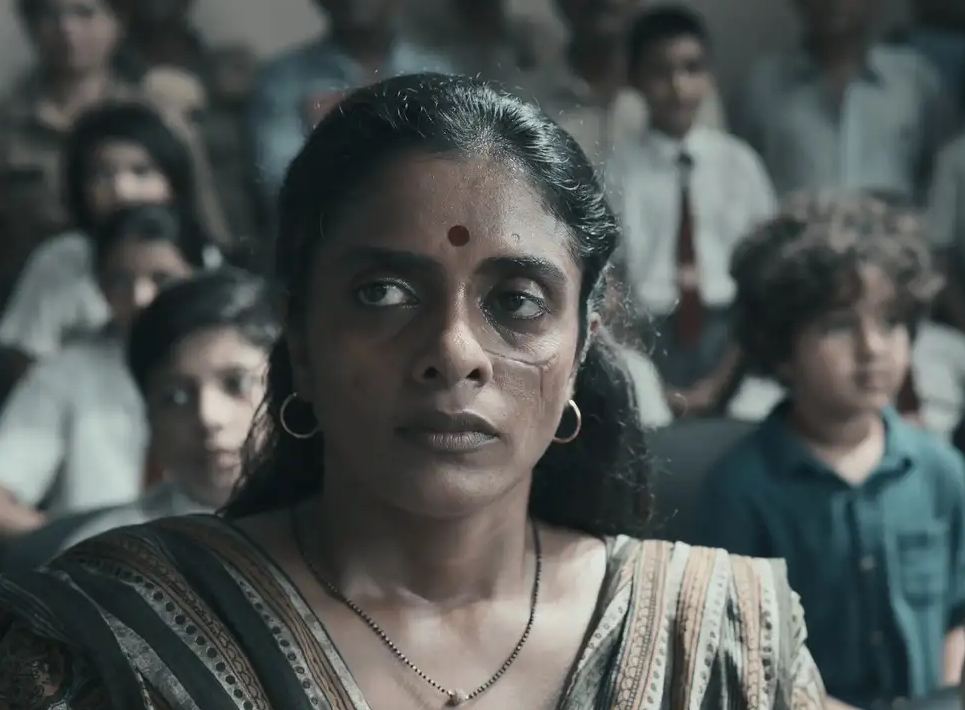
With Assi, Anubhav Sinha turns his gaze towards the brutal fact of sexual violence and its protracted afterlife. What unfolds is not simply a narrative of crime and consequence, but a study in how trauma is processed and contested within both intimate and institutional spaces.
Set in Delhi, Assi follows Parima (Kani Kusruti), a schoolteacher married to the considerate Vinay (Mohammed Zeeshan Ayyub) and mother to their young son, Dhruv (Advik Jaiswal). Returning home late one evening after a colleague’s farewell, she is abducted and raped by four men in a vehicle driven by Nikka (Abhishant Rana), the entitled son of the affluent and well-connected Deepraj (Manoj Pahwa). As the investigation begins under police officer Sanjay (Jatin Goswami), the accused are apprehended on the basis of CCTV footage. The legal battle that follows is led by Advocate Raavi (Taapsee Pannu), who represents Parima in court. Complicating matters is Raavi’s estranged brother-in-law, Kartik (Kumud Mishra), recently returned to Delhi and is still burdened by a past tragedy…
Assi emerges as a discursive work that invites argument rather than closure, probing what justice might mean within systems compromised by prejudice and power. Sinha’s approach, shaped with co-writer Gaurav Solanki, is measured rather than sensational, framing rape not as spectacle but as rupture, exposing fault lines in social life and legal structures alike. Eschewing prosecutorial urgency, the film adopts an observational patience, attentive to institutional rhetoric and private faltering, less concerned with the singular act than with the concentric shockwaves it sends through victim, perpetrator, family and the mechanisms of justice.
The film opens a space not merely to register violence but to examine the habits of silence and moral evasion that sustain it. That inquiry extends beyond the courtroom. When Parima seeks to return to school after her recovery, the principal (Seema Pahwa) hesitates. Her act is not out of hostility, but fear of the toxic jokes circulating among students on WhatsApp. Her rueful admission that the school has excelled academically but failed morally gestures toward a broader social malaise. In court, when a lawyer questions Vinay for bringing his young son Dhruv to the hearings, his blatant reply that the boy is old enough now underscores how the aftermath of violence reshapes childhood itself. The film’s most pointed moment arrives when students attend the proceedings and Judge Vasudha, portrayed by Revathi, urges them to become better than ‘us’, a line that shifts responsibility from punishment to generational reckoning. When Parima returns from the hospital, the line of shoes outside the house evokes a vigil rather than a homecoming, turning the space into a site of mourning and positioning her as a reluctant idol of collective grief.
The narrative is also populated by figures shaped and misshapen, by the very system they inhabit. Sanjay, once an avid reader of Hindi poetry, is occasionally heard reciting lines from canonical writers, vestiges of an earlier self. In court, however, he concedes that poetry did little to secure him a future, and the police force, with its sanctioned brutality and corruption, proved a harsher education. Deepraj, determined to shield his son at any cost, embodies another contradiction. He speaks the language of respectability, insisting on preserving the family’s ‘clean’ name. Yet, he reveals an ingrained sexism that undercuts his paternal concern. We also encounter Sameer (Sahil Sethi), one of the accused, who seeks to negotiate with the police and distance himself from blame. His assertion that rape cannot occur without a woman’s consent is delivered without theatrical emphasis, exposing a misogyny so internalised it passes as reason. Kartik, meanwhile, remains haunted by his inability to secure justice for his dead wife, his grief refracted through procedural delay and institutional fatigue. Together, these figures form a mosaic of complicity and injury, where individuals are neither wholly monstrous nor innocent, but conditioned by structures that normalise power, prejudice and evasion.
Yet despite its acuity, the film begins to falter with the introduction of a vigilante figure determined to exact retribution beyond the law. What might have been intended as a moral complication instead feels like a narrative accretion, pulling the film away from the procedural realism it had carefully established. The shift weakens the earlier restraint, replacing inquiry with a more schematic confrontation.
Part of the difficulty lies in the film’s proliferation of perspectives. It gestures toward too many vantage points, diluting the force of its observations. The narrative briefly aligns itself with Dhruv, registering how he absorbs the proceedings and, in the process, sheds a measure of childhood innocence. It’s a poignant thread that remains underdeveloped. Similarly, when Parima confesses that news of one accused man’s death brings her a disquieting satisfaction, a moment ripe with moral ambiguity, the film moves on before allowing us to inhabit that contradiction. We are ushered into multiple lives without lingering long enough in any one of them. The cumulative effect is not confusion but dispersal. At intervals, the screen turns red, accompanied by the reminder that a rape occurs every twenty minutes. Repeated insistently, the device begins to feel imposed rather than earned. And while the final courtroom monologue by Raavi is undeniably moving, it carries a faint air of obligation, as though the film, having posed so many questions, feels compelled to close on a note of emphatic address.
As Parima, Kani Kusruti resists the familiar grammar of victimhood, lending the character a quiet resolve that registers in the smallest gestures rather than overt declarations. Taapsee Pannu plays Raavi with conviction, grounding the courtroom rhetoric in emotional clarity. Kumud Mishra brings a troubled introspection to Kartik, suggesting a man worn down as much by private grief as by institutional fatigue. As Vinay, Mohammed Zeeshan Ayyub embodies a composed decency, a figure striving to retain his humanity amid personal devastation. Jatin Goswami gives Sanjay a conflicted interiority, hinting at the moral erosion beneath bureaucratic routine, while Manoj Pahwa, in only a handful of scenes, sketches Deepraj as a man suspended between paternal protectiveness and ethical compromise. The young Advik Jaiswal lends Dhruv an observant stillness, his silence often more eloquent than speech. In smaller appearances, Seema Pahwa, Supriya Pathak and Naseeruddin Shah add texture without grandstanding, reinforcing the film’s emphasis on performance as accumulation rather than flourish.
Cinematographer Ewan Mulligan works with an unobtrusive clarity, favouring compositions that draw us into interior spaces without calling attention to themselves. The camera observes rather than intrudes, allowing gestures and silences to accumulate meaning. Editor Amarjit Singh maintains an even rhythm, though the steadiness cannot entirely counter the script’s occasional meanderings. Sound designer Anita Khushwaha shapes an aural environment that deepens the film’s moral unease, while Ranjit Barot’s background score underscores emotion without tipping into insistence.
Assi is an important film in its willingness to confront the brutality of sexual violence and the misogynistic attitudes embedded within a society mired in prejudice and corruption. Yet, conviction alone does not ensure cohesion. In striving to encompass too much, the film diffuses its force, leaving a work of genuine moral seriousness that struggles to fully align intention with form.
Hindi, Drama, Color
