


Sanjib Sabhapandit’s latest Assamese feature film, Akash Henu Nodir Naam (Ballad To The Winds), is a tale of a clash between the persistence of age-old traditions and an uneasy encounter with modernity. While it is animated by a noble conceptual impulse and offers a glimpse into lived traditions, its narrative remains scattered and ends up diluting its emotional and dramatic force.
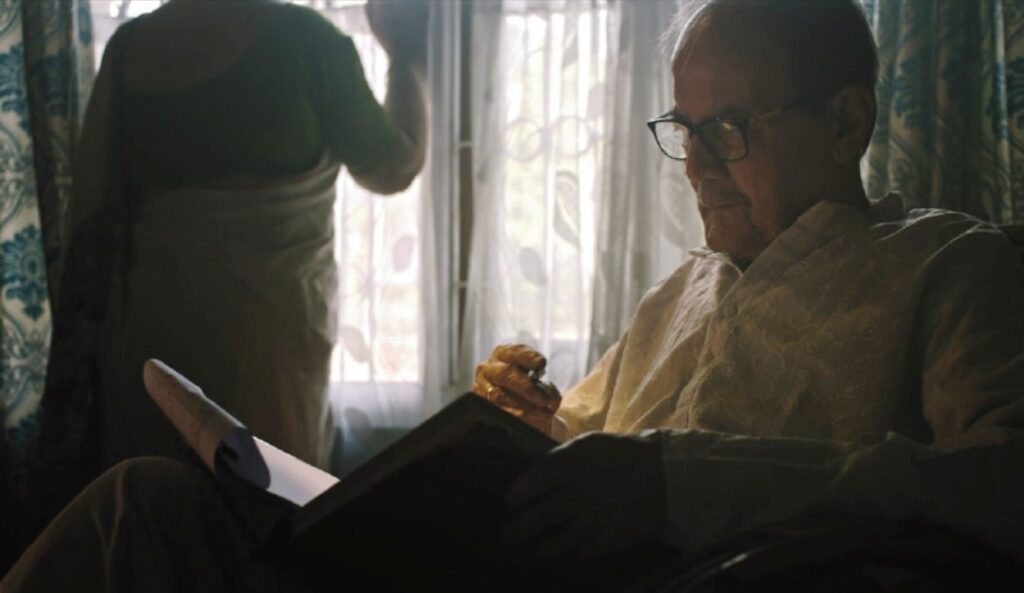
Akash Henu Nodir Naam revolves around Bijoy (Bishnu Kharghoria), a literary scholar on the verge of publishing a book dedicated to reviving the near-extinct language, Brajavali. Respected for his work, he is also being considered for a significant position within the local Xatra (an Assamese Vaishnavite Monastery). His wife, Radha (Rina Bora), is a school teacher, while Kokai (Atul Pachani), their devoted house help, remains an integral presence within the household. Their lives are quietly unsettled when their son Jayanta (Chanku Niranjan Nath) returns home after many years away, accompanied by his close friend Suman (Atanu Mahanta) from Kerala. His arrival initially brings a sense of warmth and reunion, but this fragile harmony begins to fracture when Bijoy and Radha turn their attention towards arranging Jayanta’s marriage…
The film locates its central tension in a rather pointed irony. Bijoy, committed to preserving the fading language of Brajavali, finds himself unable to recognise, let alone accept, the truth of his son’s queer identity. It gestures towards a world where communities strive to preserve what is fading, yet remain hesitant, even incapable, of accommodating new ways of being. The contradiction is not overstated, yet it lingers, shaping the film’s emotional undercurrent. What might have emerged as a deeply felt conflict, however, is only intermittently realised, as the narrative circles around it without quite penetrating its full complexity.
There is a certain circularity to the narrative, as exclusion begins to reproduce itself within the very space that once resisted it. Jayanta and Suman find themselves gradually marginalised within the household, to the extent that Radha withdraws into a kind of self-imposed austerity by refusing to cook. What unfolds inside the home is mirrored outside it, too. The village slips into gossip, and Bijoy’s anticipated elevation within the Xatra begins to recede. This pattern acquires an added resonance when set against the past. Bijoy and Radha’s own inter-caste marriage had once invited a similar form of social ostracism. That history now returns, refracted through their son’s relationship with Suman. The irony is difficult to ignore as those who once stood at the receiving end of exclusion now find themselves, perhaps unwittingly, enacting it.
The film’s poetic ambitions are steadily undercut by an absence of tonal modulation and a certain narrative inertia. What unfolds feels more like an accumulation of scenes, each gesturing towards significance without quite cohering into a persuasive whole. There is a sense of movement, certainly, but little clarity of direction, as though the film knows the emotional destination it seeks but remains uncertain of the path required to arrive there. Jayanta’s revelation, rather than deepening the film’s inquiry, registers as a device to intensify the drama that is insufficiently explored in its emotional or social complexity.
Conversations across generations regarding Jayanta’s relationship with Suman recur throughout, yet they dissipate without consequence, contributing to an impression of discursiveness rather than development. Even moments that ought to carry emotional weight, such as Suman preparing a meal for the family, are handled with a curious lack of attention. As the story moves forward somewhat waywardly, it further accentuates this unevenness. Jayanta’s sister, for instance, appears only at the very end through a phone call, assuming the role of a belated mediator. Similarly, Jayanta’s attempts to reach her over the phone are marked by a heightened insistence on being overheard by neighbours, introducing a strain of contrivance. In these moments, the film abandons its observational mode and emphasises its concerns to articulate an undue insistence on being overheard. Taken together, these elements lend the film a diffuse quality, where intention is evident, but realisation remains frustratingly out of reach.
Most importantly, the film is set against the backdrop of Xatra culture, yet this remains largely underdeveloped. Apart from a few scenes in the namghar and brief moments where a young disciple teaches devotional songs to children, the cultural milieu is never fully woven into the narrative. It hovers at the periphery, suggesting depth without quite embodying it. Similarly, the relationship between Jayanta and Suman never feels fully realised. It remains curiously distant, as though the film observes it from afar rather than inhabiting its emotional reality.
Bishnu Kharghoria, as a man caught between tradition and the uneasy recognition of his son’s truth, strikes a careful balance, lending the film a measure of emotional anchorage. Rina Bora, as the mother struggling to come to terms with what she cannot accept, has her moments of sensitivity, though the writing occasionally pushes her towards a more theatrical register. Atul Pachani’s Kokai, gentle and unassuming, brings a certain quiet depth; his philosophical reflections add texture, even if they begin to feel excessive and sermon-like. However, Chanku Niranjan Nath and Atanu Mahanta’s performances remain curiously muted. More problematically, Mahanta’s portrayal of a Keralite lacks the necessary linguistic and cultural inflection, further distancing the character from credibility.
Parasher Baruah’s cinematography remains attentive to the characters’ inner turmoil, while the occasional aerial shots carry a certain visual grace. Sourabh Dutta’s editing, however, is unable to fully contain the unruliness of the screenplay, allowing its diffuseness to persist. The sound design, meanwhile, is largely dominated by Saurav Mahanta’s background score.
As is often observed, the heart and intention may well be in the right place, but it is execution and the discipline of a well-structured screenplay that ultimately determine a film’s lasting impact. Akash Henu Nodir Naam stands as a case in point. While it appears more assured than much of contemporary Assamese cinema, that alone does not suffice. Its recognition at the Third Eye Asian Film Festival, where it won Best Film in the Indian Competition section, and at home with the Best Screenplay award at the 8th Sailadhar Baruah Film Awards (NE) 2025, signals the regard it has garnered. Yet, one is left with the sense that the film’s ambitions exceed its realisation, and its promise is only partially fulfilled.
Assamese, Drama, Color