


It was towards the end of May 2023 after nearly 25 years of no contact, when Mukund Moorthy, a techie and a family friend, called me out of the blue, saying he wanted to make a documentary film. So, we met in Mumbai and discovered that we were both deeply disturbed by all the negativity around us and by how readily people fueled it by forwarding, commenting on and justifying their biases and hatred.
“It’s like blind hate as opposed to blind love, I wonder how the blind perceive the world, and I want to explore this”, Mukund said. I immediately said yes and joined in as the co-director and co-producer. Of course, there was never any question of my not wielding the camera.
The following month, we met again in Bengaluru, as Mukund is based there and spoke with various blind individuals as well as organizations who worked with the blind along with some trusts that dealt with the higher education of the blind. This led us to the Samarthanam Trust for the disabled, where we met Dr Mahantesh Kivadasannavar, the founder and managing trustee of Samarthanam.
Through our interactions, we learnt that discrimination based on colour, caste, religion or language barely resonated with the blind community, although they certainly faced discrimination because of their disability. More importantly, they spoke passionately about what united them—music, food and cricket.
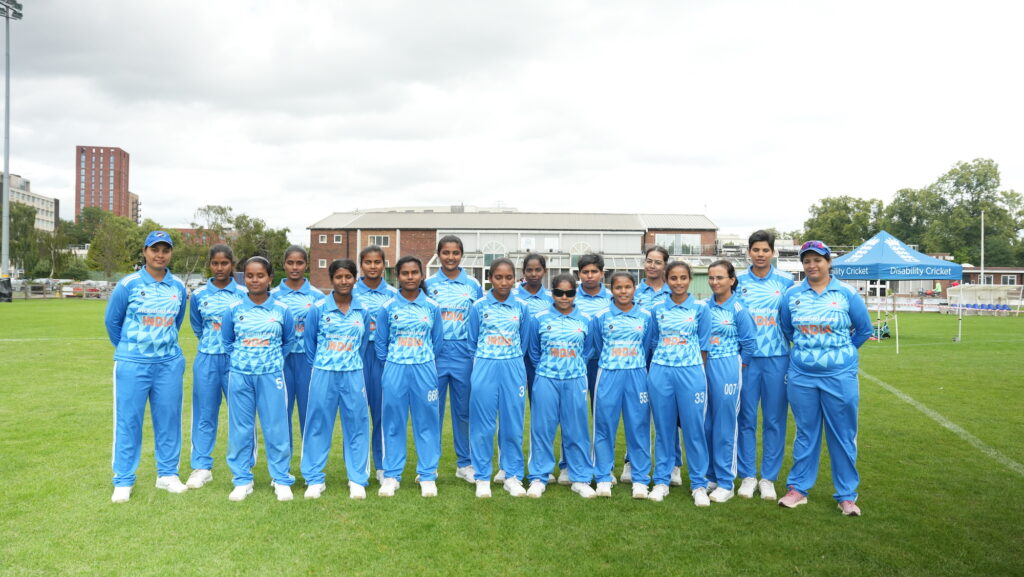
We also discovered that the Cricket Association for the Blind in India (CABI) was housed in the same building as Samarthanam, and we paid them a visit. Dhiraj Sequeira, showed us around and casually mentioned that the newly formed Indian women’s cricket team for the blind would be attending a coaching camp being organized for them in preparation for the World Blind Games (equivalent of Olympics for the blind) being held in Birmingham in August of 2023. This is when ‘the force of Dekh Le! India’, came into play! We decided to follow the journey of these blind women cricketers, aged between 12 and 22, who would go on to win gold for India. We had found the subject of our film, and quite organically its title too.
In July, we began preparing for the shoot. A three-camera set up would have been ideal, but given the budget constraints, we decided on two cameras with Khushee Hegde coming on board as the second camera person. Later, she also handled the location sound in Birmingham and the DIT responsibilities for the shoot. A major decision had to be made: should we travel with the team to Birmingham? And what if they didn’t win? We had to make that decision before we had even met them. Despite limited finances, we decided we had to go. Thankfully, Samarthanam and CABI were instrumental in helping us secure the necessary permissions, accreditation for the Games, and accommodation with the team. Without their support, this film would simply not have been possible.
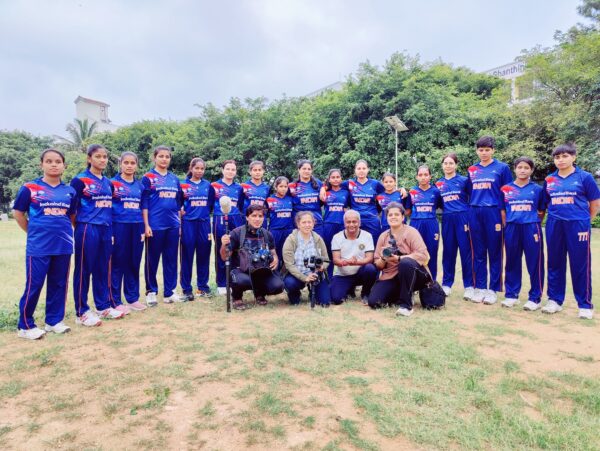
The shoot commenced in August in Bengaluru. Khushee, Ali, our sound recordist, and I lodged ourselves where the team was staying and Mukund would travel to location from home. Living alongside the team and filming with them throughout the day and often into the night, helped us gain their trust as they opened up to us with remarkable honesty. The coach and the team manager were equally instrumental in helping both us and the players understand each other’s spaces so that we could work together as unobtrusively as possible.
From the beginning, it became apparent that blindness was only one part of who these young women were apart from the focus on the world games, they aspired to get good jobs, be financially independent and to be able to support their families. One phrase that kept coming up in every conversation was “No pity, no sympathy, just give us opportunity.” In fact, every player was either in school or pursuing higher education. They were confident despite their disability, deeply aspirational, and determined to contribute meaningfully to society.
It soon became clear to us that coming into sports was a huge achievement for them and they loved the joy of playing. Although each player had a compelling personal story, we consciously chose to tell the story of the team rather than focus on individuals. This is because blind cricket is a game built on interdependence with the team comprising of totally blind and the partially sighted. Even the design of the sport, from the audible ball and metal stumps to the team composition and inclusivity, revealed an ingenuity that made the game both fascinating and complete.
I felt these young women deserved a song – an anthem that celebrated who they were. I contacted Lokesh Bakshi, with whom I had worked previously, shared everything the girls had told us, and asked him to compose a song for the film. Before the schedule ended, the song was ready. We played it to the team, and much to our joy (and relief), they gave it an enthusiastic thumbs-up. Later the song, Dekh Le! India, would win couple of awards at the Cliff Music Awards in 2025. Lokesh also composed the background score for the film.
We filmed throughout the ten-day training camp, covering interviews, practice matches, training sessions and every aspect of the team’s preparation. And though we began with a prepared list of interview questions, the conversations became increasingly spontaneous and personal as the girls opened up and spoke their hearts out. Many even broke down during the interviews. It was like they were actually being seen for the first time.
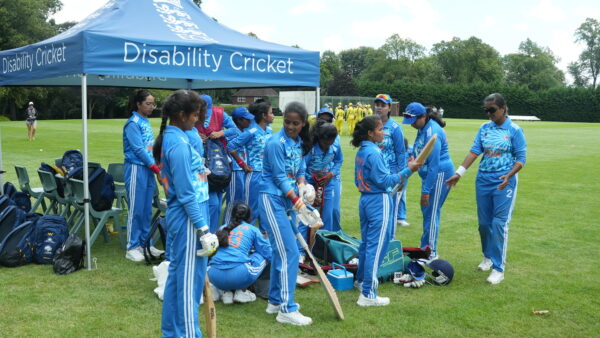
Our small crew, Khushee, Mukund and I, travelled to London before heading to our Airbnb in Birmingham, close to where the teams were staying. Our routine quickly settled into a rhythm. Every morning we would go to the university hostel where the team was staying, film with them, travel in the team bus to the grounds, cover the matches, return with them, continue filming, and end the day over dinner organised by Birmingham’s Indian community, who had come out in large numbers to support the team. The players were immensely grateful for this because very few of them enjoyed the English food served in the dining hall, having come from remote villages across India. As an added bonus for us, our crew was spared the task of organizing dinner for ourselves every night.
Filming the matches had its own peculiar challenges. The wind frequently made sound recording difficult One of the cameras would overheat occasionally leaving us to shoot with a single camera. Nevertheless, we were fortunately able to capture key moments of the matches. The icing on the cake was when the team emerged triumphant, winning the tournament. It was as if we had won too!
The next stage required us to travel to the players’ villages, but we had run out of funds. Swati Jaiswal joined as editor and cut together a sizzle reel to help us raise the required money. Fazilla Allana and Kamna Menezes of SOL Productions, and Bhuvan Shrivastava then came on board as co-producers. Bhuvan also wrote the film’s narration, as we realized during the edit that the story needed a narration. We were sure that both the narration and the title song had to be recorded in female voices.
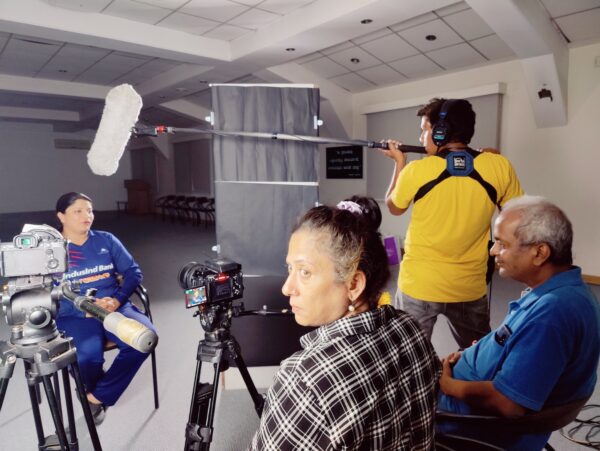
With the influx of new funds, we were ready for the final schedule. We went to various states in December, to the homes of the girls. Supriya Misquita, on loan from SOL, came in as 2nd unit director for some shoots happening simultaneously. My knowledge of various South Indian languages helped us greatly with the interviews and interactions as seven of the team members were from the Southern states.
By now, we had accumulated nearly 110 hours of footage, and the film still had to be completed within set timeline. Swati left midway through the edit in May to join another project, but not before meticulously sorting all the material and completing fourteen versions of the film. Shahnawaz Khan then took over as editor doing various versions, finally culminating in what became the final and twenty-fourth cut. The SOL team beautifully facilitated the entire post-production process under the watchful guidance of Prerit Vyas and Prateek Singh with us completing the film (finally!) in February 2025. Throughout the process, we remained in constant touch with the team at Samarthanam, for their feedback, ensuring that we represented their community with accuracy and sensitivity.
I have always watched sports more than almost any other form of content, and making a sports documentary has been a dream come true. Yet I feel Dekh Le! India is much more than a sports film. From starting out to explore how the blind perceive the world, to their incredible journeys through cricket, to their focus on coming together, achieving something meaningful and building a shared future was humbling and an eye-opener. Meanwhile, we, the sighted, remain caught up in divisions of color, size, caste, religion, and language, often allowing us to discriminate amongst each other and pull us apart.
Following its completion, the film has had its share of moments on the festival circuit. It was selected for the International Documentary and Short Film Festival of Kerala (IDSFFK), along with several other festivals. We received the Best International Film Director Award at the 7th Nepal Cultural International Film Festival in Kathmandu and the Chairman’s Award at the Kenya International Sports Film Festival. But we knew the film had to reach a much wider audience, and so the marketing journey began. Reliance Entertainment came on board as our distributor, and today Dekh le! India is streaming on JioHotstar. The ‘force of Dekh Le! India’ indeed, has done its job!
Shanthi Mohan is a filmmaker and cinematographer based in Mumbai. She has graduated from the Film & Television Institute of India (FTII), Pune with specialization in Motion Picture Photography.