


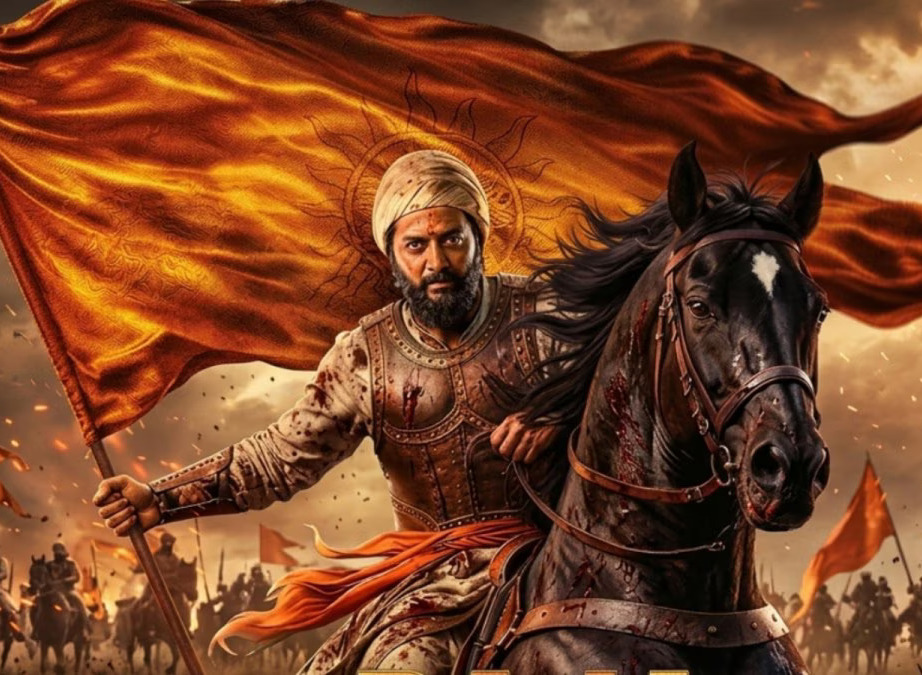
With Raja Shivaji, made in both Hindi and Marathi, Riteish Deshmukh assumes the director’s mantle to chronicle the heroics of one of the most revered figures of the Bhonsle clan. Mounted as a historical epic steeped in spectacle, action and dynastic pride, the film appears less concerned with exploring the man behind the legend and more with embalming him in unabashed reverence and grandeur.
Set in the turbulent 17th century, when the Marathas remained subordinate to the Adil Shahi dynasty, Raja Shivaji unfolds against a subcontinent fractured by imperial ambition. As Shah Jahan (Fardeen Khan) seeks to expand Mughal dominance, Adil Shah (Amol Gupte) resists, while the embattled Shahaji Raje Bhonsle (Sachin Khedekar) finds himself defending his land against the encroaching might of the two kings. Forced into constant displacement, Shahaji relocates with his wife Jijabai (Bhagyashree) and their young sons from Pune to Bengaluru as political upheaval shapes the family’s destiny. In time, Sambhaji (Abhishek Bachchan) and Shivaji Maharaj (Riteish Deshmukh) emerge as formidable warriors, challenging Adil Shahi authority and spearheading rebellion. Yet standing in their path is the ruthless Afzal Khan (Sanjay Dutt), Adil Shah’s feared general, determined to extinguish the Maratha uprising before it can alter the course of history.
From the very beginning, Riteish Deshmukh makes it clear that Raja Shivaji will be staged not as a nuanced historical inquiry, but a loud, melodramatic chronicle of a legendary Maratha ruler’s struggle to preserve the ideal of ‘Swarajya’. From a historical standpoint, the Marathas’ contribution is undeniably significant and worthy of recognition, yet cinema demands more than veneration alone. A film cannot sustain itself merely as an act of glorification without shaping that legacy into compelling drama. This is where Raja Shivaji stumbles. Too often, Prajakt Deshmukh’s dialogues prefer grand declarations of gallantry and dignity to the harder task of constructing a dramatically persuasive narrative.
The film’s repeated invocation of saffronized symbolism edges uncomfortably close to endorsement of a particular ideology, though the film stops just short of crudely reducing its politics to broad communal binaries. Deshmukh is careful not to frame conflict solely through religion, even if Afzal Khan’s brutality towards the weak and non-combatant serves as an unmistakable political signifier. Yet the screenplay, co-written by Deshmukh, Ajit Wadekar and Sandeep Patil, also introduces Hindu chieftains who refuse to align with Shivaji, complicating what might otherwise have lapsed into simplistic good-Hindu versus bad-Muslim rhetoric. It is in these moments that the film reveals an awareness of political complexity, even if its broader tonal excess often threatens to overwhelm such restraint.
Deshmukh also uses the film, quite transparently, to construct his own screen persona within the mythology he is depicting. The camera repeatedly lingers on him in slow motion — in battle sequences, heroic entrances, even musical interludes — with such insistence that Shivaji is less developed as a man and more enshrined as an icon. Consequently, in this self-mythologising approach, the film neglects the more dramatically urgent question of formation. How Shivaji became the warrior he was, what discipline, training or psychological evolution shaped him is glossed over, instead privileging heroic iconography over the personal dimensions that might have transformed its subject from monument into man.
Across India, Shivaji Maharaj has long been revered not merely as a symbol of resistance but as a tactical genius whose strategic acumen repeatedly outmanoeuvred more powerful adversaries. It is in the film’s climactic confrontation with Afzal Khan that it most vividly gestures towards this dimension of its subject. Here, Deshmukh stages Shivaji’s calculated strategy with genuine dramatic force, revealing flashes of the sharper, more disciplined historical epic this film might have been. That these sequences prove so effective only makes it more disappointing that much of the preceding narrative is burdened by a soap-operatic excess that too often undermines its own potential.
The film’s chapter-based structure, marking key moments in Maratha history while introducing principal characters with on-screen title cards, appears subconsciously indebted to Dhurandhar (2025). There are also moments where the juxtaposition of brutality and sentiment is strikingly effective. As in the sequence depicting Afzal Khan murdering his 63 wives before marching into battle, immediately followed by a scene of tenderness between Shivaji and Saibai. Such contrasts suggest an ambition to frame violence against humanity, cruelty against moral composure. Yet isolated flourishes cannot ultimately rescue the film from its deeper failings.
Riteish Deshmukh, in the titular role, commits himself fully to the part, bringing visible conviction and physical dedication to his portrayal of Shivaji Maharaj. Yet, commitment alone cannot compensate for a characterisation written with little interior complexity. Sanjay Dutt, by contrast, embraces Afzal Khan with a theatrical ferocity that proves far more dramatically vivid. Right from his first appearance, he invests the character with a demonic menace, leaning into cruelty with such gleeful force that his villainy, though broad, at least possesses a certain magnetic clarity. Bhagyashree and Genelia Deshmukh, as Jijabai and Saibai respectively, are largely confined to emotional support roles whose primary narrative function is to sanctify the men around them. More intriguing is Vidya Balan’s Khadija Sultana, who, though not given nearly enough screen time, suggests the presence of a more layered female agency than the screenplay is otherwise willing to sustain. Elsewhere, the capable supporting ensemble cast including Sachin Khedekar, Amol Gupte, Jitendra Joshi and Abhishek Bachchan lends the film a degree of solidity. As for Salman Khan’s cameo, well…
Technically, Raja Shivaji is mounted with considerable polish. Santosh Sivan’s cinematography, paired with the production design of Nikhil Kovale, Apurva Bhagat and Shashank Tere, captures the historical milieu with a grand visual texture. Urvashi Saxena’s editing is effective in places, particularly when the narrative leans into momentum rather than melodrama. John Stewart Eduri’s background score beats with impact, while the action and stunt choreography by Dawid Szatarski and Manohar Verma is executed with commendable precision. Ajay-Atul’s compositions complement the film’s larger-than-life ambitions. However, the VFX of the film is a major disappointment, something that continues to be the bane of even big budget Indian cinema.
Ultimately, Raja Shivaji stands as a film of immense ambition, visual pomp and evident reverence, yet far too content to sanctify rather than scrutinise. The film settles for hagiographic and rhetorical grandeur whereas greater tonal control and narrative rigour might have delivered something genuinely stirring.
Note: This is a review of the Hindi version of the film.
Hindi, Marathi, Historical Biopic, Color