


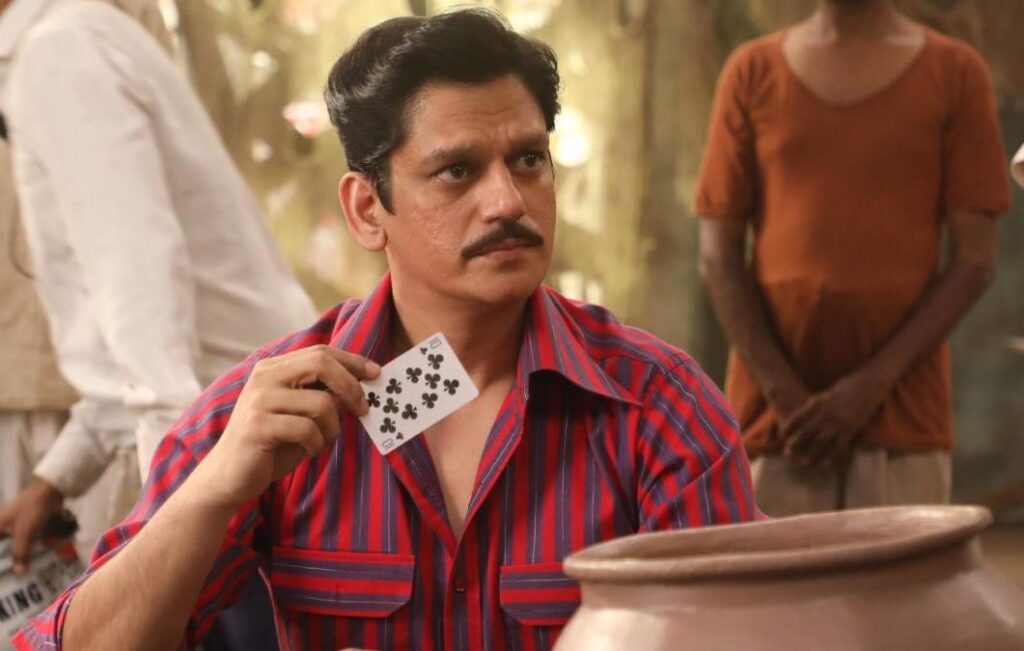
Matka King, currently streaming on Prime Video, is created and directed by Nagraj Popatrao Manjule and draws loosely from the life of Ratan Khatri, the man who reimagined the architecture of gambling in Mumbai. The series is thick with drama, emotion, and the restless texture of a city in flux, offering, in passing, a pocket history of its undercurrents. Though it has some glimmers of a narrative force, it doesn’t hold together itself consistently.
Mumbai, 1964. Brij Bhatti (Vijay Varma) lives in a chawl with his wife, Barkha (Sai Tamhankar), and his brother, Laxman (Bhupendra Jadawat). Brij works as a manager for a shrewd cotton market owner, Lalji Bhai (Gulshan Grover), who also runs rigged gambling games. Laxman, burdened by debt, is one day chased home by a loan shark and his goons, who threaten him with violence. Brij intervenes, promising to repay double the borrowed amount. When Brij turns to Lalji Bhai for help, a chaotic confrontation leads to his dismissal. Left with few options, he decides to start his own gambling operation, and claims will be fair and honest. Through eight episodes, the series follows the rise and the fall of his empire…
With just three feature films, Nagraj Manjule has carved out a distinct space in Indian cinema as someone with a strong authorial voice. In his first outing as a web-series director, however, that balance appears to falter. The series feels heavily indebted to Hansal Mehta’s Scam 1992, which similarly charted the journey of a morally compromised protagonist striving to assert his place in society. Manjule, along with his co-writer Abhay Koranne, frames this tale of an ostensible egalitarian’s ascent through narrative beats that seldom surprise. Brij’s journey adheres to a well-worn arc. Early struggle gives way to success, followed by a steady climb up the social ladder. In the process, allies thin out, adversaries multiply, and personal relationships fray, and then the inevitable happens, with the government closing in. Thus, the predictable manner in which events unfold here feels doubly familiar, lacking that element of freshness.
Having said that, some characters and situations suggest the writing isn’t without promise. In the first two episodes, the mechanics of the gambling operation and how Brij devises strategies to draw more people into it, while maintaining an appearance of fairness, are laid out with some intrigue. We are also introduced to characters who later assume greater significance. TP (Girish Kulkarni), a journalist on the verge of exposing the spread of gambling culture from the racecourse to matka, is thwarted by his editor. Inspector Eknath Tumbade (Bharat Jadhav), whose attempts at honest policing are stifled by his superiors, and moments from Brij’s personal life, such as when he takes Barkha shopping and to the racecourse to assert his social standing after she is slighted by their neighbours. These glimpses hint at a more textured drama, but unfortunately, much of the series settles into patterns that feel overly familiar.
Through archival footage, the series gestures toward the tumultuous period in which it is set, attempting to build a sense of the era, but little beyond that is consistently sustained. There are brief references to the Maharashtra government introducing lotteries to counter illegal gambling, as well as Brij’s use of telephone services to announce the opening of his ‘matka’ draws across the country. The Mumbai mill workers’ strike, which had such a profound impact on the city, is not given sufficient space to develop. The narrative also stages moments of crisis in Brij’s operations, where he is unable to conduct the draw, once while being held at a police station and another time while aboard a flight. These scenes appear designed to construct a near-heroic image of the protagonist. But this intention sits uneasily with the way the milieu is otherwise conceived, leaving the portrayal not fully aligned with a nuanced sensibility.
Vijay Varma ably carries the series largely on his shoulders, conveying a wide range of emotions across the ups and downs of his character’s journey. Siddharth Jadhav delivers a strong performance as his friend and employee, bringing a restrained warmth to the role that makes his fate resonate. Sai Tamhankar, as Varma’s wife Barkha, portrays a dutiful yet ambitious woman striving to find her own footing. Kritika Kamra plays an ambitious woman involved with Varma, but sadly, the chemistry in their illicit relationship lacks spark. Girish Kulkarni and Bharat Jadhav, as the moral compasses of the story, perform their roles effectively. The rest of the supporting cast, including Gulshan Grover, Bhupendra Jadawat, and Kishore Kadam, handle their roles effectively. Vineet Kumar Singh, modelled on Dawood Ibrahim, is less weighty and does not leave as strong impact as was needed.
Sudhakar Reddy Yakkanti’s cinematography and Priya Suhas’s production design capture the milieu to a large extent. However, Nitin Baid’s editing is unable put a rein on the meandering nature of the writing. Pritam Das’ sound design sustains the mood and emotion, while the songs composed by Ami Trivedi are surprisingly forgettable.
Overall, Matka King offers an ambitious retelling of a formative chapter in Maharashtra’s economy. Yet, despite its thematic potential and periodic flashes of craft, the series struggles with uneven writing, remaining watchable and intermittently engaging at best. Manjule is capable of far more, and as the series signals a sequel, one hopes he finds firmer ground the next time around.
Hindi, Drama, Color