


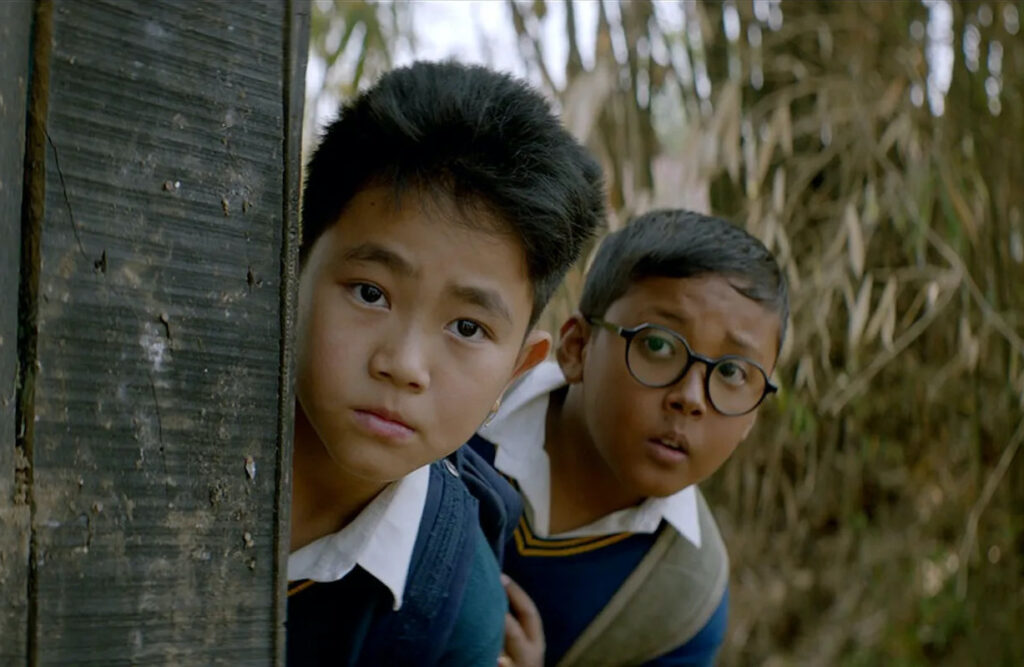
Boong, Lakshmipriya Devi’s directorial debut made in Manipuri, is a lovely little tale of faith and resilience. While it offers little in the way of solutions to the problems it raises, the film remains compelling as we follow its young protagonist on a journey through uncertainty. Along the way, he begins to form his own values while navigating a world shaped by the polite evasions and quiet corruptions of society.
Brojendro, known to all as Boong (Gugun Kipgen), refuses to continue in a vernacular school and stages a prank involving the school’s nameplate. The administration is incensed, but Boong gets his way when his mother, Mandakini (Bala Hijam), decides her son should not remain in a place where he is unhappy. Boong and his friend Raju (Angom Sanamatum) soon enrol in an English-medium school. Mandakini, a single mother who sells clothes in the local market, is long estranged from her husband, Joykumar (Hamom Sadananda), who left home to run a furniture shop in Moreh and gradually ceased all contact with the family. One night, news arrives that he has died. Mandakini refuses to believe it, and Boong finds himself compelled to take matters into his own hands. He sets out to search for his father and bring him home…
Boong may centre on a schoolboy, but Devi successfully touches upon issues deeply rooted in the region and woven into everyday life. Boong’s desire to study in an English-medium school, for instance, reflects a social aspiration that runs through many parts of the Northeast. A holiday in Delhi carries greater prestige than a trip within Manipur, and such choices quietly function as markers of status. The film also addresses the fraught question of insider and outsider with a light touch. Boong’s friend Raju is an Agarwal whose forefathers migrated decades earlier from Rajasthan to do business in Manipur. Boong often teasingly calls him a ‘filthy outsider’. The remark is framed as banter, yet it hints at deeper anxieties about belonging. There are also reminders of the region’s geopolitical realities. The crossing from Moreh into Myanmar is tightly regulated by the army, and those who fail to return within the stipulated time risk detention across the border. Hovering in the background, too, is the presence of extremist organisations and the atmosphere of threat they create. Devi weaves these details into the narrative so unobtrusively that they feel less like overt political commentary than an organic part of the landscape.
Mandakini is portrayed as a quietly resilient woman who raises her son single-handedly, meeting his pranks and mischief not with corporal punishment but with patience and understanding. Though her husband has been absent for years, she continues to nurture the hope that he might one day return. Her candid conversations with Raju’s father, Sudhir (Vikram Kochhar), are enough for local women to cast scandalous glances in her direction. Even when Sudhir attempts to help during her moment of crisis, he is reminded that he remains an outsider and should not interfere in local matters. These details do more than sketch a social backdrop. They deepen the emotional stakes for the characters. By placing Mandakini and Sudhir on the margins of the community in different ways, the film quietly mirrors the larger tensions of belonging and exclusion that shape the region. Their circumstances, in turn, lend greater weight to Boong’s journey, situating the boy’s personal quest within a wider social landscape.
One of the principal strengths of Boong lies in its screenplay. Tightly focused and deeply empathetic, it helps the film to unfold with an unhurried urgency. From the outset, the film establishes its details with care, avoiding the sort of forced setups that often feel mechanically inserted. The film also threads together seemingly disparate elements with a strong sense purpose. Madonna’s audacious song, Like a Virgin, acquires a resonance as events unfold. Likewise, Juliana (Nemetia Ngangbam), a girl from an affluent family and Boong’s classmate, is not introduced merely to create a passing moment of conflict. She eventually assumes a more meaningful place within the story. Even the depiction of festivals — the way Holi is celebrated in the region, or the rituals surrounding a funeral — is not included for exotic flavour. Each moment contributes to a steady forward movement. In this way, the film demonstrates a clarity where every detail, however small, ultimately finds its place within the larger fabric of the story.
Gugun Kipgen beautifully captures Boong’s courage and innocence, quietly conveying the ache of growing up without a father. Bala Hijam, as his mother Mandakini, balances strength, poise and vulnerability without ever tipping into melodrama. Angom Sanamatum is equally engaging as Boong’s loyal friend Raju. Vikram Kochhar lends Sudhir dignity, suggesting both the hurt of being treated as an outsider and the persistent desire to belong. In a brief but memorable appearance, Jenny Khurai as the transgender singer JJ brings warmth, humour and an easy charm, while Nemetia Ngangbam, as Boong’s affluent classmate Juliana, also leaves a distinct impression.
Tanay Satam’s cinematography effectively captures both the expanse of the landscape and the psychological turmoils of the characters, allowing the terrain to function as a constant observer. Shreyas Beltangdy’s editing gives the film a smooth, languid rhythm, while Dipankar Chaki’s sound design is subtle and effective. The score by Zubin Balaporia and Ronid Chinganbam lends gentle support to the film’s emotional currents without drawing undue attention to itself.
With Boong, Lakshmipriya Devi shows considerable promise, demonstrating how a story centred on children can richly illuminate the social textures of a region without becoming polemical or didactic. In its striking ambition, the film recalls the way Iranian filmmakers once used child protagonists to reveal the moral and political contours of their region.
At the 79th British Academy Film Awards earlier this year, Boong became the first Indian film to win the BAFTA for Best Children’s & Family Film. It is currently playing in theatres across India.
Manipuri, Drama, Color