


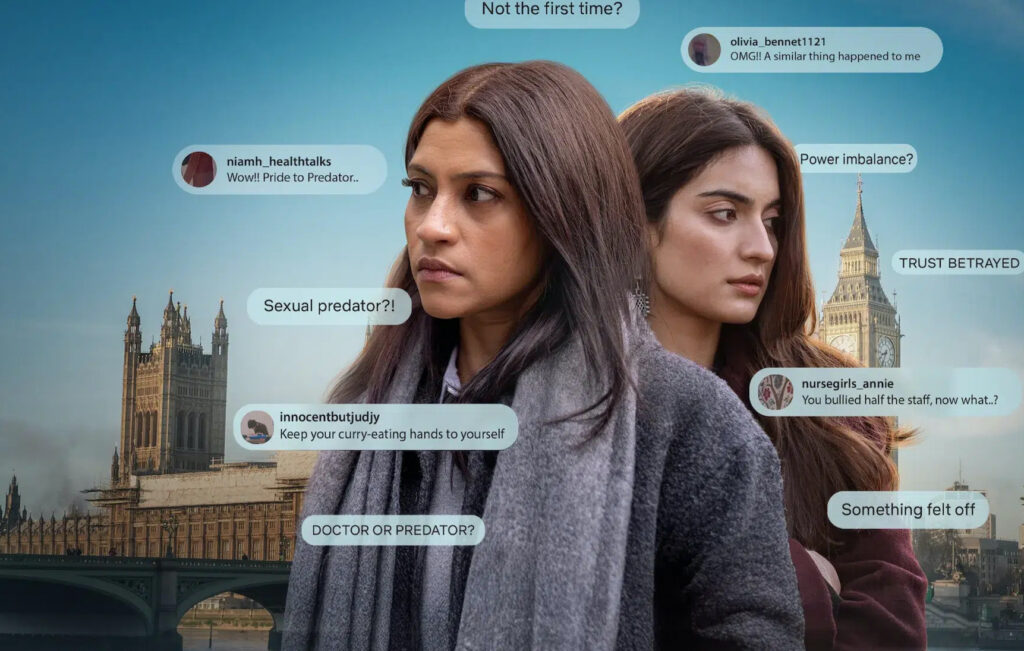
Accused, directed by Anubhuti Kashyap and produced by Dharmatic Entertainment and now streaming on Netflix, places at its centre a female doctor accused of sexual misconduct involving a patient and members of staff at a London hospital. As the drama unfolds, it traces the fault lines of institutional power, suggesting how the uneasy intersections of politics, profession and personal ambition allow authority to curdle, almost imperceptibly, into suspicion.
Geetika (Konkona Sen Sharma), a formidable and highly accomplished gynaecologist, is a woman accustomed to authority. Brilliant at her job and intolerant of incompetence, she commands respect as readily as she invites resentment. She shares a live-in relationship with her partner, Meera (Pratibha Ranta), a paediatrician, and the two are on the cusp of adopting a child. With Geetika poised to become dean of another branch of her hospital, her professional ascent appears assured. That certainty collapses when an anonymous email to the hospital’s HR department accuses her of sexually molesting a patient. The allegation initiates a troubling inquiry that threatens not only her career and reputation but also the fragile equilibrium of her relationship with Meera…
One of the film’s most striking choices is to place a woman at the centre of allegations of sexual assault against other women. Geetika’s queer identity complicates the moral terrain, unsettling the familiar binaries through which power and victimhood are often understood. At its most unsettling, the film considers whether resistance to patriarchy guarantees moral clarity at all. It hints that entry into structures of authority may entail absorbing some of their habits, their blind spots, even their cruelties. In a climate shaped by social media, where reputations can fracture overnight in the post #MeToo era, the drama reflects on how quickly judgment congeals into a verdict. The narrative suggests that authority, even when claimed in defiance of a historically exclusionary order, does not inoculate against the temptation to misuse it. Gender dynamics here are inseparable from power, as well as the asymmetries that shape professional conduct as much as intimate life.
These are, undeniably, weighty themes, and they serve well as a premise. Yet the screenplay by Seema Agarwal and Yash Keswani seems determined to fashion them into a taut institutional thriller, only to lose momentum well before the finish line. The film opens with a caesarean surgery gone awry. A junior surgeon falters, chaos looms, and Geetika steps in to restore order. The scene efficiently establishes her competence and authority, but dramatically, it feels curiously weightless. A subsequent house party introduces supporting characters and plants narrative set-ups in a perfunctory fashion where announcements are made, relationships sketched, and a brief dance interlude is inserted, before the following morning delivers the central crisis. The progression feels as though plot points are being ticked off rather than allowed to emerge from the characters. These weaknesses gather weight as the film edges towards its final act, and each narrative convenience further dilutes the tension. By the time the resolution arrives, the drama feels less the consequence of accumulated choices than of expedient design.
The introduction of secondary characters promises texture but seldom delivers it. Jaidev Bhargav (Mashhoor Amrohi), an ex-journalist brought in as an external investigator, remains largely confined to a room, interviewing colleagues and staff. He serves a function, certainly, but as a presence, he is curiously bloodless and appears more device than character. Similarly, the private investigator Mansoor, hired by Meera to shadow Geetika, is sketched with a few eccentric tics that hint at colour yet never cohere into complexity. He, too, operates chiefly as a mechanism. Angad (Aditya Nanda), Meera’s colleague, appears poised to complicate matters but contributes little beyond the requirements of the plot. Each of these figures suggests the possibility of intrigue, yet none meaningfully deepens it. Their accumulation reinforces the sense of a thriller assembled from components rather than driven by lived tensions.
Anubhuti Kashyap’s debut, Doctor G (2022), was hardly without flaws, yet it possessed a discernible subject and a certain directorial assurance that felt promising. Here, that command appears markedly looser. The material calls for tonal precision and formal control, and without it, the drama drifts. Strong performances cannot compensate indefinitely for structural uncertainty. If the script proves a disappointment, the direction does little to steady it. What lingers is not outrage or revelation, but a muted sense of weak possibilities gesturing towards urgency, yet seldom finds the discipline to sustain it.
Konkona Sen Sharma lends Dr Geetika a steely assurance, inhabiting her as a woman accustomed to authority and unwilling to yield entirely to pressure. In contrast, Pratibha Ranta plays Meera with a composed sharpness that quietly anchors the film. Her restraint provides an emotional counterweight to Geetika’s severity. It is largely on the strength of these two performances that the drama remains watchable. Sukant Goel, as Mansoor, suggests an intriguing presence but is given too little shading to leave a lasting impression. Mashhoor Amrohi delivers Bhargav with competence, though the character’s flat conception limits him majorly. Aditya Nanda, as Meera’s colleague, fares similarly. The rest of the supporting cast acquit themselves adequately, if without distinction.
Linesh Desai’s cinematography preserves the spatial coherence of the hospital as well as the domestic interiors, framing them with a clinical restraint that mirrors the characters’ emotional containment. Prerna Saigal’s editing maintains narrative clarity, yet it cannot entirely overcome the soap-opera-inflected tone that seeps into the material. Dhiman Karmakar’s sound design, when afforded room, introduces an undercurrent of unease. Too often, however, it is submerged beneath the insistent background score by Neeraj Adhikari.
Instead of burrowing into the darker psychological and institutional implications embedded in its material, Accused resolves its central mystery in a manner that feels cursory, even faintly evasive, leaving one with the sense of a drama that gestures towards complexity, only to retreat from it.
Hindi, Drama, Thriller, Color