


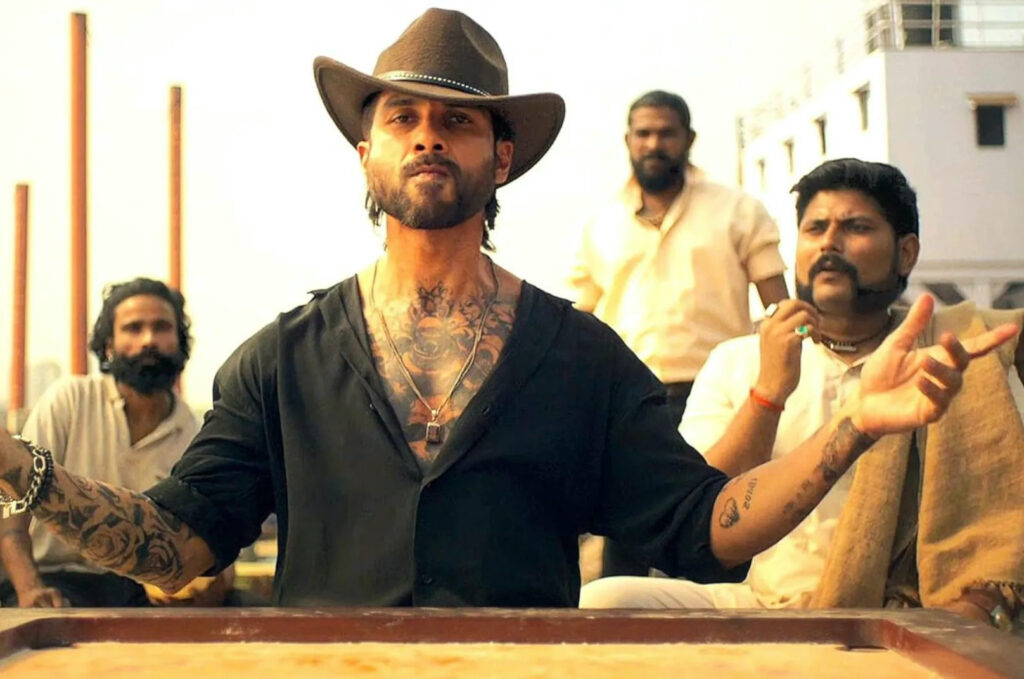
O’Romeo, the latest from Vishal Bhardwaj, loosely adapts the chapter Ashraf’s Reincarnation from Mafia Queens Of Mumbai by S Hussain Zaidi. It unfolds as a revenge drama centred on a woman, a feared gangster, and the man fatally drawn to her orbit. Slick but familiar, even a few well-etched characters cannot stop it from feeling overextended and oddly weightless.
Bombay, 1995. Ustara (Shahid Kapoor) is a gangster and contract killer working under intelligence bureau officer Ismail Khan (Nana Patekar), who once saved him from the feared don Jalal (Avinash Tiwary), now based in Spain. Afsha (Triptii Dimri) approaches Ustara with a job to eliminate four men, including Jalal, whom she holds responsible for the murder of her husband, Mehmood (Vikrant Massey). He refuses. Undeterred, she takes up work at a restaurant frequented by his gang and, during a late-night delivery, steals a pistol from their car. She attempts to kill one of her targets at an Iranian café but fails. Ustara intervenes and saves her life, and a wary romance begins…
O’Romeo becomes a case of a thoughtful Hindi filmmaker straining to court a mass audience and losing conviction in the process. The uncertainty appears within the opening minutes, where the protagonist cuts through a corridor of enemies inside a private screening theatre. It is a set-piece unmistakably reminiscent of Oldboy (2003), a stylistic hangover Bollywood still hasn’t entirely shaken off. Within forty-five minutes, two songs arrive before the story even finds some direction. Scenes pile up, blood flows freely, yet tension and surprise scarcely register. The film keeps announcing significance rather than earning it, where confrontations flare and fade, emotions land as cues rather than consequences. Despite a web of interconnected characters, few are meaningfully used to move the drama forward.
At heart, the film aims for a dark romance between Ustara and Afsha, but offers too little intimacy to bind us to their fate. Thus, their suffering barely registers. Julie (Disha Patani), a dancer from a red-light district who performs only after the arrival of Ustara, exists largely for two songs and a few perfunctory scenes. Ustara himself comes to resemble a composite of the volatile lover in Kabir Singh (2019) and the swaggering brutality of Animal (2023). This is underlined by a humiliating scene in which Afsha obeys his command to undress, recalling Triptii Dimri’s forced to lick the boot moment in the latter film. Given its commercial packaging and producer Sajid Nadiadwala, it could easily have passed as a Baaghi instalment with a different face at the centre.
The liberal profanity long associated with Vishal Bhardwaj since Omkara (2006), here, feels performative rather than lived-in. The milieu never quite supports it, and lines like ‘Randibaaz Se Romeo’ land as slogans rather than speech. Jalal, meanwhile, repeats a catchphrase about friendship and enmity that recalls old-style villains without their menace. His threats are broad and oddly ceremonial. We are told, in passing, that following the Bombay serial blast, he aligned himself with a terrorist network, yet this remains merely an expositional detail, never dramatised or embodied in behaviour. Even a drunken raid by Ustara on his drug lab in India, which should heighten danger, unfolds without urgency. It becomes another noisy event rather than a turning point.
The film is largely anchored by the performances and the chemistry between Shahid Kapoor and Triptii Dimri. Kapoor fully inhabits the character of Ustara — a cowboy-like, guitar-playing killer — not only through attitude but also through his dance movements and the agility he brings to the action sequences. Dimri, as the vulnerable Afsha who refuses to remain a victim, creates an emotional foothold for the viewer and surprises in the few action passages involving guns, rings and the climactic sword piece. The supporting characters mostly exist to populate this canvas of gangster drama. Ismail Khan is reduced to a thin shadow though his banter with Ustara offers occasional humorous respite. Even Inspector Pathare (Rahul Deshpande), a National Award–winning playback singer, becomes little more than a classical-singing cop, his vocal ability foregrounded over character depth. Tamannaah Bhatia, as Rabia, Jalal’s wife, gets a few strong scenes in the second half and commits to them earnestly. Hussain Dalal, playing Chhotu, Ustara’s sidekick, delivers some effective comic lines. The remaining women — Farida Jalal, Aruna Irani and Disha Patani — appear only briefly. Vikrant Massey makes a special appearance as Mehmood Qureshi and leaves a fleeting impression. As an antagonist, Avinash Tiwary essaying the role of the brutal gangster Jalal is loud and caricaturish.
Technically, the film is often more assured than it is dramatic. Ben Bernhard’s cinematography supplies sweep and kinetic energy, lighting the characters in a way that accentuates the story’s moral duskiness. Aarif Sheikh’s editing maintains a propulsive rhythm, though it cannot fully disguise the screenplay’s shapelessness. The sound design by Yash Darji and Shantanu Yennemadi remains alert and textured, adding density to otherwise thin stretches. As composer and music director, Vishal Bhardwaj deploys the background score to lift sagging passages, yet the effect rarely lingers as craft can sustain attention, but not investment, when the drama itself feels distant.
For a director capable of marrying pulp and poetry, O’Romeo feels strangely impersonal. Within the uneven but often rewarding body of work of Vishal Bhardwaj, the film registers less as a misfire than a lapse of instinct. Also, it’s a reminder that style, untethered from conviction, can only carry a story so far.
Hindi, Action, Drama, Color