


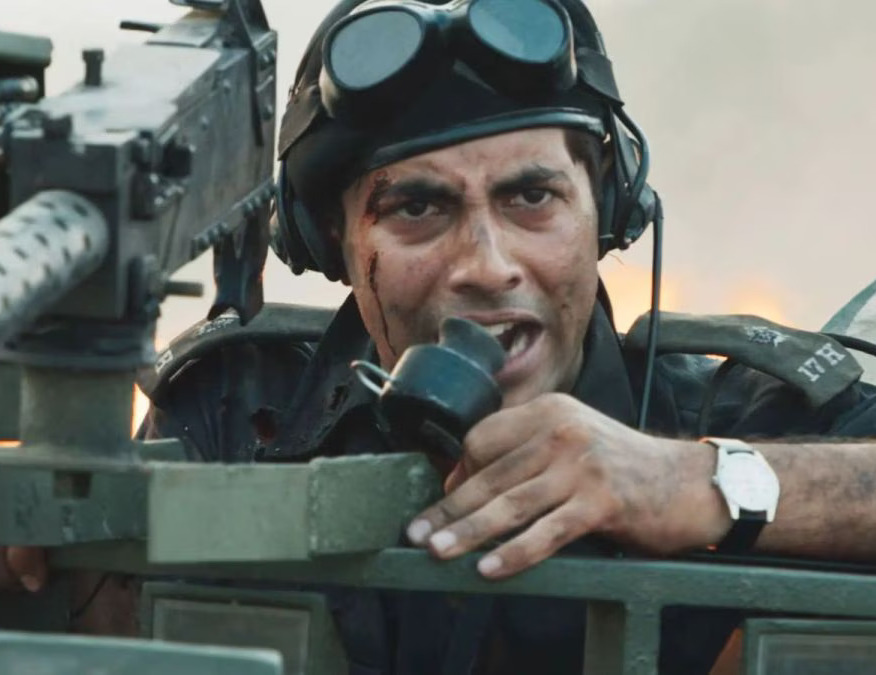
Sriram Raghavan’s Ikkis, is inspired by the life of Second Lieutenant Arun Khetarpal and his role in the Battle of Basantar during the 1971 India–Pakistan war. The film defies the conventions of the typical combat film, effectively turning to the quieter aftermath of conflict, and focusing on loss, memory, and the lives irrevocably altered by war.
Three decades after the 1971 Indo-Pak war, Brigadier Madan Lal Khetarpal (Dharmendra), father of the late Arun Khetarpal (Agastya Nanda), travels to Lahore for a college reunion, where he is hosted by Jaan Mohammad Nisar (Jaideep Ahlawat), a former army officer now serving as a cricket selector. Madan also intends to visit Sargodha, his ancestral home before Partition, and the very landscape where his son had met his fate. As the story unfolds, the film moves between past and present, tracing Arun’s journey from training ground to battlefield, while Nisar quietly harbours an uncomfortable truth, awaiting the right moment to reveal it to Madan…
Having built a reputation over two decades for some of Hindi cinema’s most accomplished thrillers and crime dramas, Sriram Raghavan shifts register here to tell a more humane story; one attentive to the costs war imposes on those who must live with its consequences. He approaches the material with characteristic control, favouring precision over excess and maintaining a steady grasp on detail through small, telling touches that quietly accumulate meaning. A soldier at the war front listening to songs requested by his wife over the radio; a discreet allusion to Hemingway’s For Whom the Bell Tolls; and an ageing Pakistani man (Asrani), suffering from Alzheimer’s, whose fragmented memories evoke a time before Partition, when borders had yet to harden into destiny.
Working with his regular collaborators Arijit Biswas and Pooja Ladha Surti, Raghavan traces Arun’s journey from training ground to battlefield. Still unfinished in his formal instruction, he distinguished himself through an instinctive command of the Centurion tank, emerging as a vital presence within the Poona Horse regiment. Running alongside these recollections is an unspoken tension in Lahore, centred on Nisar, that quietly unsettles the present and subtly reframes the history the film has been circling. In doing so, the narrative shifts attention away from victory and sacrifice toward the quieter, more inconvenient consequences that linger long after the fighting has ended.
Ikkis also presents itself as a study of character rather than incident, yet its seriousness is as carefully managed as it is earnestly declared. Arun’s passage through the rigours of cadet life is rendered with patient attention, shaping him into a figure for whom discipline becomes both ethic and identity. Even his relationship with Kiran (Simar Bhatia) is instrumentalised to underline this self-fashioning. Love is permitted, but only insofar as it does not distract from the larger project of becoming a soldier. His decision to report a fellow cadet for breaking protocol, briefly rendering him a pariah within the unit, is framed less as a moral dilemma than as an affirmation of his unyielding code.
The present-day strand involving Madan carries greater relevance, though it, too, remains carefully contained. Now physically diminished, he encounters unexpected warmth while visiting his ancestral home across the border, an experience that invites him to reconsider the easy binaries of enemy and ally. A quietly poignant moment comes when he rediscovers a glass he had hidden decades earlier in a tree in the courtyard. Its presence, unchanged despite the shifting of national borders, hints at a deeper, unsettling reflection on history and belonging. Yet the film rarely allows such moments to fully destabilise its underlying certainties. Nisar, once a dutiful brigadier during the 1971 war, appears primed to embody the film’s moral unease, carrying a guilt that has long resisted articulation. Even the two ISI agents who tail Nisar and Madan are shown as individuals merely performing their duties, not caricatures of malice. Similarly, a soldier who lost his leg fighting India is given reason to feel uneasy about the hospitality extended to Madan by his Pakistani neighbours, adding nuance to the film’s exploration of loyalty, duty, and human cost.
On the flip side, the film’s constant movement between 1971 and 2001 disrupts the emotional investment to some extent. Its dramatic peaks arrive unevenly, surfacing at irregular intervals that appear motivated by intent but ultimately dilute their cumulative force. This restraint proves most limiting in the climactic revelation Nisar offers Madan, which gestures toward a deeper reckoning without fully committing to it. It approaches a moral complexity without fully surrendering to it, reflecting on the human costs of war while keeping its most troubling questions at a measured distance. This hesitation surfaces most clearly in a conspicuously didactic end-credits disclaimer, which feels externally imposed and briefly fractures the film’s humanism. It implies that figures like Nisar can exist only as safely contained fictions rather than as possibilities in lived history.
Agastya Nanda, as Arun Khetarpal, commits fully to the role, bringing a youthful combination of charm, zeal, and sincere grit. Jaideep Ahlawat anchors Nisar as a man burdened by remorse, his performance shaped by an inward struggle to live with guilt. Much of his screen time unfolds opposite Dharmendra’s Madan, who, in his final screen performance, commands much empathy for a character whose age and experience have eroded his faith in humanity. Together, their performances form the emotional spine of the film. Debutante Simar Bhatia brings a breezy, assured presence to her role, avoiding ornamental excess. The supporting cast – Rahul Dev, Sikandar Kher, Vivaan Shah, and Deepak Dobriyal in a special appearance – lend the film texture and weight without drawing undue attention to themselves.
Anil Mehta’s cinematography captures both the sweeping scale of the war sequences and the subtler emotional conflicts of the characters with meticulous framing while Monisha Baldawa’s editing maintains an even, disciplined pace throughout. Bishwadeep Chatterjee’s sound design is particularly effective, balancing the tonal balance of the war scenes as well as the film’s more intimate moments. Sachin–Jigar’s score is largely on target, supporting the narrative without overwhelming it. However, aside from the song Sitaare, the rest of the music by White Noise Collective proves underwhelming.
Ikkis is less concerned with triumph or spectacle than with the quiet aftermath of conflict, where lives are reshaped, memories linger, and moral ambiguities remain unresolved. It reminds us that the true measure of war lies not in medals or victories, but in the human stories that endure long after the guns have fallen silent. This is its biggest strength.
Hindi, War, Drama, Color