


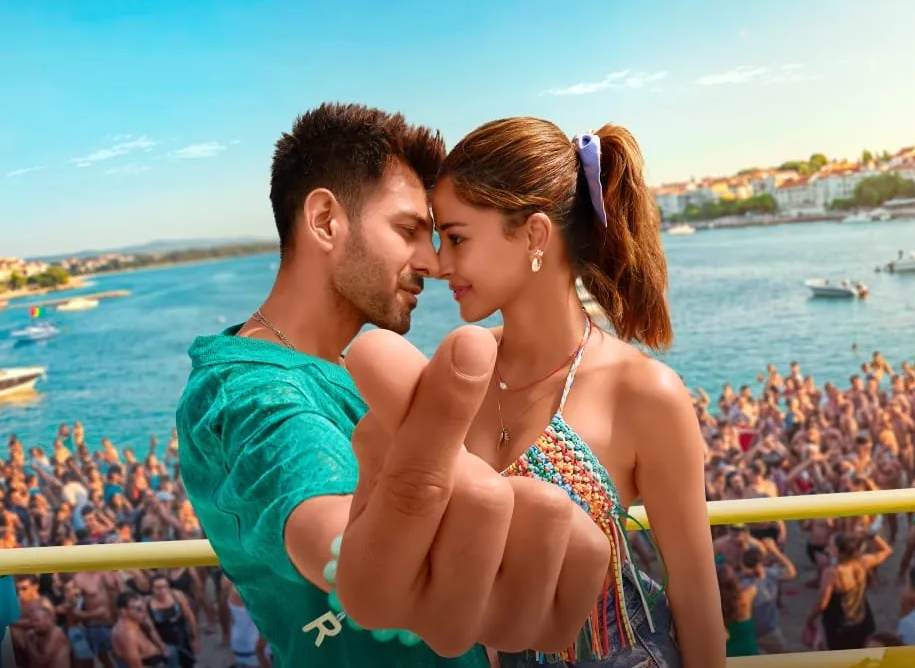
Tu Meri Main Tera Main Tera Tu Meri, directed by Sameer Vidwans, concerns a young couple, who choose the emotional comfort of their single parents over the fulfilment of their own romantic attachment. The premise hints at a seriousness of feeling and moral restraint, but on screen, it hardens into a succession of derivative situations that never quite gather dramatic force.
The film begins with a holiday in Croatia, where Rehaan (Kartik Aaryan), a wedding organiser accustomed to fleeting relationships, meets Rumi (Ananya Panday), an aspiring writer uncertain of emotional permanence. Their intimacy persuades Rehaan towards commitment, but Rumi hesitates. Her younger sister, Jia (Chandni Bhabhda), who has long shouldered the care of their ageing father, Amar Wardhan (Jackie Shroff), is about to marry. With this, Rumi must now assume the responsibilities of her father’s care. The lovers part accordingly. Rumi returns to Agra, while Rehaan goes back to the United States, where he runs a business with his mother, Pinky (Neena Gupta). It is Pinky who later urges Rehaan to return to India, reopening questions that the couple believe they have already settled.
Midway through the film, Rumi declares her desire for a romance modelled on 1990s Bollywood, repackaged for 2025 and structured around a series of tests Rehaan must pass. The moment reveals the film’s strategy more than the character. It ushers in a prolonged pastiche, borrowing songs and gestures from earlier popular cinema without understanding either the context or the dramatic logic that gave them shape. Whereas those films, for all their flaws, allowed romance to unfold through discernible progression, Rehaan’s pursuit here lurches abruptly from flirtation into something close to stalking, ticking off inherited tropes without any modulation whatsoever. Even Rumi’s affection is improbably sparked by something as trivial as Rehaan fetching theplas when she cannot digest Croatian food. This is immediately capped by a song sequence that is supposed to stand in for romantic development.
More damaging is the film’s failure to exploit what might have been its most promising emotional parallel. Rehaan is raised by his mother after his father leaves, while Rumi and Jia are brought up by their father following their mother’s death. This shared experience of parental absence could have provided the narrative with an underlying emotional architecture. Instead, it remains largely unexplored. A brief, conciliatory speech Rehaan offers Amar towards the end arrives too late to carry weight. Rumi’s sense of duty towards her father is conveyed through dialogue rather than discovered through behaviour or accumulated feelings. It is precisely here that the film loses its footing and betrays its own intentions. Occasional gestures towards self-awareness only deepen the sense of creative fatigue. In one scene, after Rumi’s book receives poor reviews, Rehaan suggests that she should have used ChatGPT. The joke feels awkward and self-defeating, raising the uneasy thought that the screenplay by Karan Shrikant Sharma itself may have taken similar paths.
The film’s first half is dominated by an anxious display of visual luxury, with each foreign location announced by a title card, as though the narrative were briefly advertising a holiday rather than unfolding a story. These spaces look impressive but remain emotionally inert. The same emphasis on surface appeal shapes the presentation of Rehaan, repeatedly framed to exhibit his physique in moments that invite admiration without adding character. Borrowed spectacle further clutters the film, most notably in a sangeet sequence stitched together from songs of earlier Hindi cinema that feels less celebratory than intrusive. In a year when a modest sleeper hit like Saiyaara demonstrated that emotional coherence in love stories can outweigh lavish production values, Tu Meri Main Tera Main Tera Tu Meri feels overblown, superficial and glossy.
Kartik Aaryan brings energy, ease and humor to Rehaan, playing the role with confidence. At the same time, the performance feels like a safe reprise of qualities he has displayed in several earlier films. Ananya Panday approaches Rumi with a welcome calmness and restraint, never allowing the character to tip into excess. Jackie Shroff lends Amar a quiet maturity and earns genuine empathy as an aging parent. Neena Gupta, cast as Pinky, an independent single mother, is underwritten and never quite given the space to realise her considerable potential. Chandni Bhabhda leaves a modest impression as Jia in a handful of well-judged scenes. The rest of the cast functions largely in support, without a strong dramatic presence.
Anil Mehta’s cinematography does provide some visual flair but Manan Mehta’s editing is constrained by the script’s wayward structure, struggling to impose rhythm, pace and flow since none has been designed. Hitesh Sonik’s background score is effective, while the songs by Vishal–Shekhar are just about serviceable, falling short of their more memorable work.
The concern for familial responsibility in Tu Meri Main Tera Main Tera Tu Meri is not misplaced. Yet sincerity alone cannot atone for the absence of dramatic shape. In the end, the film exhausts its central idea and relies on mere embellishment over genuine feeling, leaving the romance hollow, unconvincing, and curiously inert.
Hindi, Romance, Drama, Color