


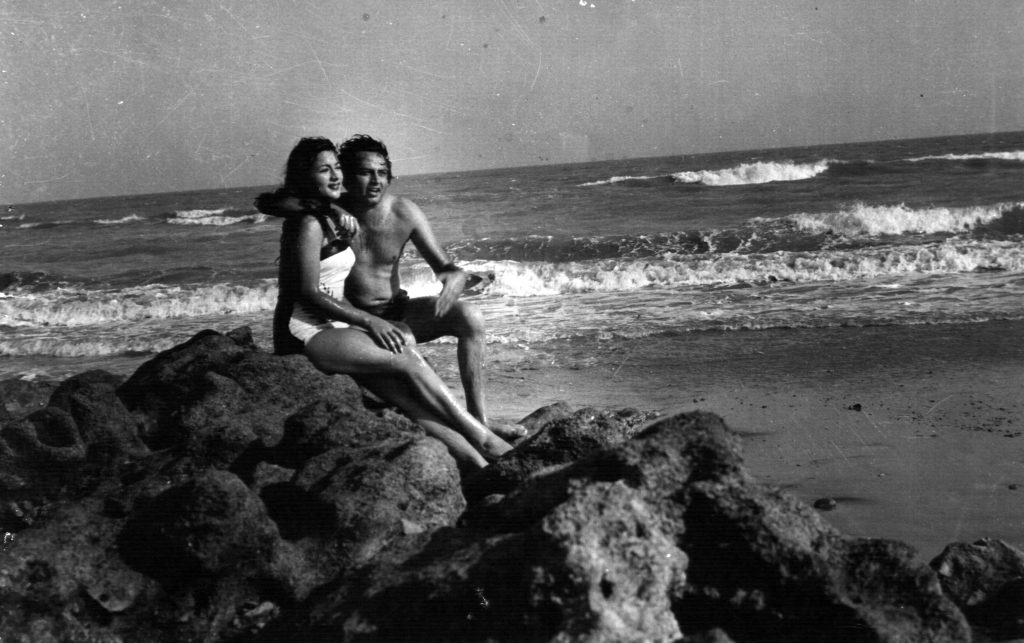
If it weren’t for its absolutely brilliant songs, Koel would be a difficult watch today. Typical of Pakistani films of the time (1959), Koel is light years behind the high technical standards Indian cinema had achieved by then. However, it is still regarded as one of the all time great films to come out of Pakistan and was a huge success at the box office there. Koel was also Noor Jehan’s last big, successful film as an actress and her last but one film as a leading lady.
The film, directed by Masood Parvez, an immensely successful filmmaker across the border, follows a childhood romance that Hindi cinema so often used in the 1940s and early 1950s in films like Anmol Ghadi (1946), Kalpana (1948) and Deedar (1951). So, yes, we are treated to two precocious children, who, in real life, would probably have no idea of what love is, while seated on swings singing profoundly to each other – Rim Jhim Rim Jhim Pade Pohar Tera Mera Nit Ka Pyar! Anyway, to cut a long story short, of course they get separated, grow up, manage to trace each other out through the adult version of the same song, face customary hurdles in their romance before the final happy ending. And yes, they have, of course, exchanged gifts as children, in this case a handkerchief and a comb, over which they keep sighing over again and again while remembering their childhood.
The script and narrative flow of this obviously loud, melodramatic film is far too predictable and unimaginative to say the least. The story fails to grip and every conflict or crisis point raised is superficial and too conveniently solved. When Ustad Allah Bande Khan is to go on a plane, much is made of what might happen if he doesn’t come back. So yes, you know the plane is going to crash for sure. You know what? It happens! And with Allaudin playing the character and him also being heroine’s father, you know he is going to survive and some passerby is going to save him as he lies by the sea shore and that he would be thought dead and thus separated from his family for years. And sure enough, that’s exactly what happens. I suppose one has to grateful for small mercies that he doesn’t suffer from amnesia as well after the crash! Key plot points are treated according to the way the makers want the film to go and not how characters might react in those particular situations. Also, the great childhood romance, the love story down the years lacks intensity. You never feel the great love Salman and Zarina have nurtured for each other through the ten years they were separated from each other when they meet and interact with each other. The loss and return of Zarina’s voice towards the end of the film doesn’t add anything to the film and just seems an unnecessary complication. The rounding-off of the film too is far too abrupt as if the makers suddenly decided – enough, now the film has to end. So all the loose ends are tied up one after another, some most unconvincingly one might add.
If the film had a point about the treatment of artists by the Pakistan Government and Pakistani society and though it is touched upon, the message, if any, gets totally lost set against the love story and ‘commercial’ constraints of the film. Ustad Allah Bande Khan is a highly respected artist in Pakistan whose death makes newspaper headlines but who lives in abject poverty. His wife has to sell her last remaining piece of jewelry (read suhag ki nishani) just to feed a guest. Yes, the Government does think of sending him as their representative for a musical competition abroad and if he wins on his own accord, then so be it. Otherwise they do nothing for him. And since his trip is insured, he opts to stay dead after the crash so his family could get by with the insurance money, which of course the righeous wife refuses to use, citing the journey as cause of her husband’s death. A point here – everyone seems to know about Ustad Allah Bande Khan and his name is taken with great respect by all sections of society. Surely if he gave performances, people would clamour to come for them. So why doesn’t he? One guess, is that if he did so, then he would not be totally destitute and that would not be the story of Koel so let’s just keep that aside, shall we?! Years later, we see his grown-up daughter Zarina is bestowed the title of Koel of Pakistan but still has to perform cheap and vulgar songs as Nagina on the stage to get by.
The performances have uniformly not held up at all. Noor Jehan’s melodramatic posturing and ‘acting’ is campy and cringeworthy in its worst moments. Never a very good actress, she always got by with her amazing voice. Her performance in Koel is pretty much stilted and unbearable even though admittedly an effort has been made to try and make her look at her glamorous best. Besides, she is much, much too old for the old. She was already well into her 30s when the film released and looks it even if the script demands her to be about 20! Aslam Pervez doesn’t have much to do while Neelo produces some high glamor in her two club songs and as she appears at Clifton Beach in a swimsuit! Even an actor like Allaudin, rated extremely high in Pakistan, is way, way over the top in his performance as Ustad Allah Bande Khan although compared to the others, he does manage to grab an odd moment or two.
Technically too, the film is below average.
If the film has anything going for it at all, it is Khursheed Anwar’s absolutely phenomenal musical score. And to be fair, the film has incorporated music within the storyline making Allaudin a classical singer and Noorjehan, his daughter, a singer thus ‘justifying’ the songs. Noor Jehan is at her vocal peak in the film and each of the songs is beautifully composed and rendered. But if one still has to pick out a standout composition, it has to be Dil Ka Diya Jalaya. The timbre and control with which Noor Jehan essays the song is simply amazing. Other great solos by her in the film suggest that there was a much wider range to her voice than what was normally exploited by the Punjabi oriented music directors in Pakistan. These include the sexy Mehki Fizayen, the soulful Sagar Roye Lehren Shor Machayen, Tere Bina Sooni Sooni Lagi Re and O Bewafa though her stagey antics in this song right from when she spots Aslam Pervez in the crowd are a hoot! The second version of Rim Jhim Rim Jhim Pade Pohar is also practically a Noor Jehan solo as Munir Hussain sings just a couple of lines so that Zarina knows her neighbour is indeed Salman, her childhood love. Zubaida Khanum leaves her vocal impress with Dil Jala Na Dilwale and Masti Mein Jhoom Re while Munnir Hussain ably renders Garaj Garaj Aaye Badal. Picturization wise – the adult version of Rim Jhim Rim Jhim and Tere Bina Sooni Sooni Lagi Re come off comparitively better.
Like most Pakistani films of yore, which struggled with their making qualities, avoid the film and hear instead the film’s audio tracks by themselves! Undoubtedly, it’s time better spent.
Urdu, Drama, Black & White
Header photograph courtesy Omar Ali Khan