


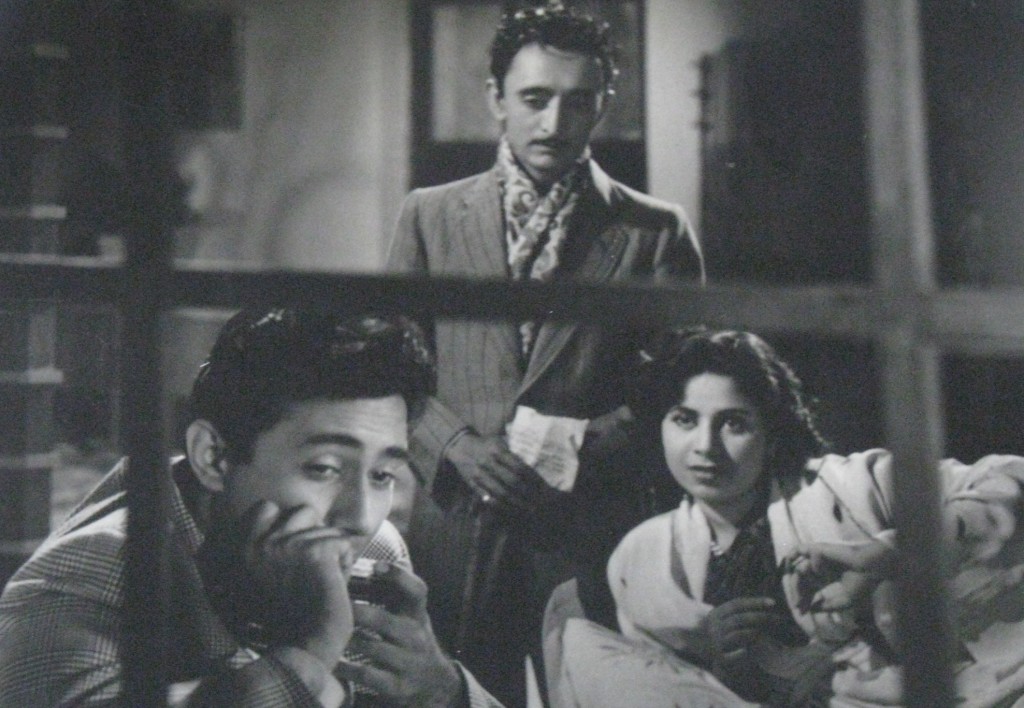
Madan (Dev Anand) is a small time gambler forced into joining the Star Hotel by its owner, a mysterious and shadowy criminal, to pay for his sister’s medical expenses. The club dancer at the hotel,Nina (Geeta Bali), falls in love with him. Madan’s sister (Roopa Verma) is treated by a kind doctor, Rajani (Kalpana Kartik), who, seeing the innate goodness within Madan, starts to love him. Gradually, Madan too reciprocates her feelings. A cop, Ramesh (Krishna Dhawan), also covets Rajani and warns her about getting too close to Madan. When Madan wants out from a life of crime, he finds out that it is easy to enter the world of crime, but impossible to get out. The boss, revealed to be Rajani’s father (KN Singh), orders him to be bumped off. Nina dies saving him but Madan is framed for her murder…
The history of Baazi goes back to a mix-up shirts at the Prabhat Picture Company in the mid 1940s. The dhobi interchanged the shirts of two young men working there and this led to a strong friendship wherein one, an aspiring actor told the other, an aspiring director that war he to turn producer, he would give the other a film to direct. The second man replied that were he get to a break as director, he would take the first man as his hero. Cut to 1949. The aspiring actor had become somewhat of a star following the success of Ziddi (1948) and had launched his Production House, Navketan, the following year. The first film they made, Afsar (1950), was directed by his elder brother, who was unable to get his second film going in spite of his first one winning an award at Cannes! Afsar did moderately well for the production company to announce their next venture. The actor remembered his promise to his old friend and invited him to direct the film for his banner. In case you’re still wondering who the two players in this drama are, the aspiring actor was Dev Anand, the director-to-be Guru Dutt and the film, Baazi.
Baazi was Guru Dutt’s first film as director. The film, clearly influenced by the Film Noir movement of Hollywood in the 1940s, does admittedly appear stilted and dated today. It’s various elements represent the classic cliches we have come to see in Indian films. The hero being led to a life of crime since he cannot afford keeping his sick sister in a sanatorium, the goody two shoes heroine bent on reforming him, the moll who loves him and takes the bullet meant for him asking him to acknowledge that she’s not such a bad sort after all and dying before he can say so in his arms, and the villain is …no surprises…the heroine’s father, on the surface a decent and well respected man! But while viewing Baazi, we have to remember it was among the first of its type. In fact, Baazi set the tone for the spate of urban crime films that were to come out of Bollywood in the 1950s and early 1960s.
But in spite of the now much imitated plot, there are some moments of inventiveness and experimentation, which give a glimpse of the genius of Guru Dutt, which were to be seen in later films. The songs are integrated into the story line rather than standard items or appendages to the plot. The entire scene where the moll warns the hero he is going to be killed is done through a club dance – Suno Gajar Kya Gaaye. A ghazal, Tadbir se Bigdi Hui Taqdeer, is set to a hep western beat as the moll tries to seduce the hero. The experiment works and how! The song, popular even today, proved to be the most popular song in the film. According to hero Dev Anand, audiences came in repeatedly just to see this song in the theaters. It was also during the recording of this song that Guru Dutt met his future wife to be, singer Geeta Roy. In fact, the entire music score of the film has a lively and zingy beat to it, all in all, a most jazzy score by SD Burman, which is easily the highlight of the film. The songs also saw an untapped side of Geeta Roy. Known only for sad songs and bhajans till then, the ease with which she went western was marvelous to behold. The sex appeal in her voice was brought to the fore and helped her build an identity of her own, a style no singer could copy.
Baazi also shows a criminal hero with a tough as nails exterior but of course with a heart of gold inside. The film took actor Dev Anand, already a star, to the top to rule the rest of the 1950s with Dilip Kumar and Raj Kapoor. He was the ideal actor for the crime wave films that followed Baazi’s success, and played shaded noirish characters in a number of them – Jaal (1952), Pocketmaar (1955), Kala Bazar (1960) to name some. Special mention has to be made of Geeta Bali’s lively performance as the dancing girl, who falls for the hero and takes the bullet meant for him. It is easily the most accomplished performance in the film. Kalpana Kartik’s performance as the goody heroine is weak and she makes no real impact in her screen debut. Neither does Roopa Verma as Madan’s sister. KN Singh effectively plays the sophisticated villain whileKrishna Dhawan lends adequate support.
Baazi also promoted a lot of new talent, several of whom went on to make quite a name for themselves – lyricist Sahir Ludhianvi in his early days, choreographer Zohra Sehgal, comedian Johnny Walker, and actress Kalpana Kartik. The screenplay was written by well known actor Balraj Sahni.
The film, though being a trendsetter, interestingly also shows Guru Dutt’s traditional attitude to women. The moll is mostly dressed in western clothes, while the goody two shoes heroine is always in traditional Indian attire. The moll is immoral and she has to pay for it with her life, her redemption being taking the bullet meant for the hero. This attitude to women was further noticed even in the posters of Mr. & Mrs. 55 where the poster on one half showed the heroine, Madhubala, dressed in western attire making the hero, Guru Dutt, buckle her shoe while the right half showed the heroine in a traditional sari touching the hero’s feet!
Overall, Baazi remains an important film for its role in popularizing the urban crime thriller in Hindi Cinema of the 1950s a big way. And that remains its biggest legacy.
Hindi, Thriller, Black & White